



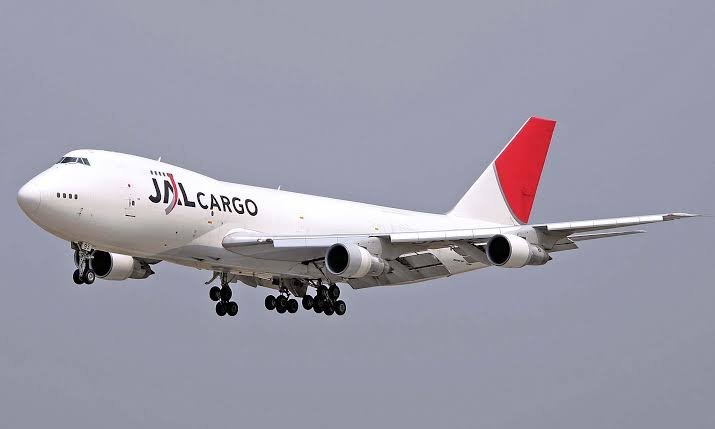
Japan Airlines is expanding its international freight business with Boeing 747 freighters from three major cargo carriers. The expansion follows rising demand for shipments of semiconductors and digital equipment and components used in artificial intelligence infrastructure, which is creating new opportunities for air cargo operators.
The Tokyo-headquartered carrier resumed dedicated freighter operations in February 2024, after a 13-year absence from the segment. The airline’s current in-house cargo fleet comprises three Boeing 767-300s converted from passenger service. The bulk of the carrier’s fleet is geared toward Asian routes, so it will need to seek extra capacity to satisfy increasing demand on longer international routes.
Japan Airlines in March unveiled its 2035 strategy, indicating it will be adding larger freighters to meet rising cargo flows between Asia, North America and Europe. The company is especially focused on high-value shipments such as semiconductor manufacturing equipment and pharmaceuticals.
To achieve this ambition, JAL has signed long-term charters with US-based Atlas Air and Kalitta Air, and Luxembourg-based Cargolux. The arrangements, announced by the company earlier this month, enable the airline to grow its cargo network using aircraft operated by specialist freight carriers.
Three cargo operators boost JAL’s international links
Each partner has been allocated a set route to help Japan Airlines expand its long-haul freight capacity.
JAL is using six weekly Boeing 747-400 freighters from Kalitta Air on the Tokyo Narita International Airport to Chicago route. The service was previously operated by Western Global Airlines, but is now being taken over by the carrier.
Meanwhile, Cargolux operates two Boeing 747-400 aircraft between Narita and Luxembourg twice a week. Atlas Air also operates twice-weekly service to Los Angeles International Airport from Narita. Atlas Air flies some of its routes in partnership with other airlines.
By combining these operations, Japan Airlines will be able to offer more capacity on important international trade routes without relying solely on its own converted freighter fleet.
Nippon Express gets dedicated network on Atlas Air flights
Japan Airlines has also acquired Atlas Air capacity to develop a dedicated air cargo network for Nippon Express Group, one of its key logistics customers, in addition to its transcontinental services.
The service is designed to meet growing demand for goods linked to artificial intelligence and semiconductor manufacturing. Nippon Express announced the new operation earlier in the month, describing it as a circular route connecting Los Angeles, Tokyo Narita, Taipei in Taiwan and Singapore. From Singapore, the plane heads back to Narita, then returns to Los Angeles.
The network started with one weekly flight, but Nippon Express said it could add frequencies as demand grows.
The logistics group said shipments of servers, server racks, semiconductors and semiconductor manufacturing equipment as well as other electronic components are especially strong between Tokyo, Taipei and Singapore. But the limited number of airlines operating large cargo planes in Asia means shippers have fewer options for moving goods.
The Boeing 747 freighter enjoys a big advantage in this market with its payload capacity of around 100 tons. Their capacity offers an alternative for transporting large volumes of technology-related goods across regional supply chains.
AI infrastructure investment drives demand for air freight
Japan Airlines’ expansion is a sign of a wider shift in international logistics, with the rapid development of artificial intelligence infrastructure pushing the production and trade of semiconductor-related equipment across the Asia-Pacific.
The region is seeing strong growth in semiconductor and AI-related equipment manufacturing, according to a recent analysis by Frost & Sullivan and FedEx. The industry depends on a vast network of suppliers who regularly move components between manufacturing centers and other markets.
Many of the end customers are North American based hyperscale companies and this results in large trans-Pacific cargo flows. These big tech firms require servers, electronic parts and specialized equipment to construct and grow the infrastructure for AI applications.
This has created a race to create services for this market by logistics providers and airlines. The sector is especially attractive, as shipments of AI-related products can command high margins, incentivizing operators to invest in more capacity and dedicated transport solutions.
But for Japan Airlines, the opportunity is not just the usual demand for freight. The company is aligning its network to serve those industries where the supply chains are increasingly reliant on reliable international air transport.
JAL’s freighter return explained by e-commerce, limited passenger aircraft capacity
Japan Airlines’ renewed focus on dedicated cargo aircraft is also a reflection of structural constraints within its existing fleet.
In 2010, as part of a bankruptcy reorganization, the carrier ceased freighter operations. It re-launched its in-house cargo airline in 2024, with the increase of e-commerce among the reasons behind its return to the market.
JAL still flies mostly standard size passenger aircraft on short haul routes in Asia. While these aircraft have some freight capacity in their lower decks, there is not enough space to meet current cargo demand.
This means that the airline’s own fleet is complemented with larger freighters operated by external partners, enabling it to handle shipments which require more capacity.
Japan Airlines is broadening its international cargo offer through agreements with Atlas Air, Kalitta Air and Cargolux, in response to the changing requirements of technology manufacturers and logistics customers. The strategy is more about high value goods and increases the airline’s ability to capture the increasing trade flows coming from AI infrastructure and semiconductor production.