




Chattanooga – The Federal Motor Carrier Safety Administration (FMCSA) is still working to stabilize its troubled Motus registration platform, but the agency has yet to provide a firm date for a full resolution. Less than a month after describing the fix as being only weeks away, deputy administrator Jesse Elison reiterated that the process should take weeks rather than months, while acknowledging that the system continues to create difficulties for legitimate carriers.
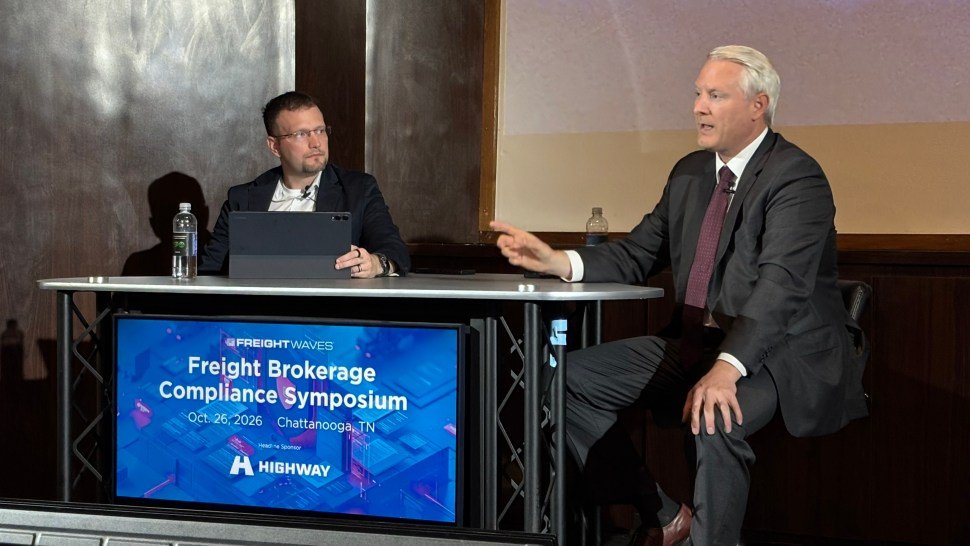
Elison addressed the issue on Monday at FreightWaves’ Broker Compliance Symposium in Chattanooga. The one-day event was one of two sessions preceding the larger Future of Freight Festival, which began on Tuesday.
During an interview with FreightWaves podcast host Charles Gracey, Elison offered no new timeline for completing the repairs. His remarks followed an early October appearance before the National Motor Freight Traffic Association, where he said the agency was “weeks away” from resolving problems associated with the launch of Motus.
He maintained that the objective remained to stabilize the platform within weeks, rather than months or as long as six months.
A system designed to block unqualified applicants
Elison acknowledged that Motus’ current user experience has, in practice, kept people out of the registration process. Preventing unqualified carriers from obtaining registration is an intended function of the platform, he explained, but the system is also affecting businesses that meet the requirements and are seeking to establish themselves in the industry.
The deputy administrator said the mechanism for blocking unsuitable applicants was working, but stressed that the results were not yet satisfactory. Legitimate companies, he noted, still face obstacles when attempting to register and build trust within the sector.
According to Elison, the situation has improved compared with Motus’ first four to six weeks of operation, which he described as particularly difficult. However, he acknowledged the challenges involved in correcting a complex system without introducing further problems.
The agency must ensure that successive adjustments move the platform in the right direction rather than creating new disruptions, he said.
Despite the current difficulties, Elison expressed confidence in Motus’ long-term prospects, arguing that the platform would ultimately deliver a registration system capable of serving the trucking industry effectively. He did not, however, indicate when users could expect a substantially improved experience.
He also encouraged companies encountering registration problems to contact the agency directly, saying FMCSA was responding to reported issues in real time.
FMCSA advises companies to delay nonessential registrations
The continuing Motus problems have already prompted FMCSA to waive certain registration requirements. At the symposium, Elison reinforced the agency’s advice to companies that do not need to use the platform immediately: they should wait before attempting to register.
For businesses facing urgent registration requirements, he recommended seeking assistance through their insurance contacts or other relevant industry representatives. Companies can also approach FMCSA directly if they cannot complete the registration process, he said, adding that the agency would reach out to the appropriate parties.
The guidance reflects the difficulties legitimate operators continue to encounter despite the administration’s efforts to improve the platform.
Elison expects trucking policies to continue despite election results
The discussion also turned to the broader regulatory changes underway at FMCSA and the US Department of Transportation (DOT).
Under Transportation Secretary Sean Duffy and FMCSA administrator Derek Barrs, the agencies have introduced significant changes to trucking oversight. Among the measures are restrictions affecting non-domiciled commercial driver’s licenses (CDLs) and the closure of truck-driving schools as part of a crackdown on CDL fraud.
Motus, however, was inherited from previous administrations. Neither Elison nor Barrs has publicly attributed the platform’s difficulties to their predecessors.
With Republicans facing the prospect of significant losses in the following week’s Election Day vote, Elison said he did not anticipate a shift in the agency’s current policy direction.
He maintained that FMCSA would continue implementing its plans regardless of the electoral outcome, citing the support of Secretary Duffy as a major factor. Elison acknowledged that political developments could create some headwinds, but said the agency intended to maintain its course.
Broker transparency rule remains among upcoming priorities
Beyond Motus, the agency is preparing additional regulatory measures, including a long-awaited broker transparency rule. The final provisions have not yet been disclosed, but the regulation is expected to establish requirements governing what freight brokers must reveal to shippers and carriers about their activities.
Although the rule’s publication has been anticipated for some time, no definitive release date was provided at the symposium.
Elison indicated that the transparency measure would be one of several FMCSA actions expected in the near future. He also highlighted planned changes to the rules governing new entrants into the motor carrier industry, identifying the issue as a priority.
The initiative appears on the agency’s Unified Agenda, published over the summer as a formal outline of planned regulatory work. Under that agenda, FMCSA intends to pursue rulemaking to ensure that new carrier applicants understand the applicable safety requirements before receiving New Entrant authority.
The agency is also considering introducing a proficiency examination as part of a revised New Entrant Safety Assurance Process, alongside other possible approaches.
Another objective is to establish greater consistency in how CDL training schools demonstrate compliance with federal requirements. Elison said FMCSA wants to move away from a system that allows schools to self-certify their compliance and instead promote uniform standards across the sector.
While the agency continues to work through Motus’ operational problems, its broader agenda therefore remains focused on carrier registration, broker transparency, entry-level safety requirements and stronger oversight of commercial driver training.