



A new commercial agreement for autonomous trucking
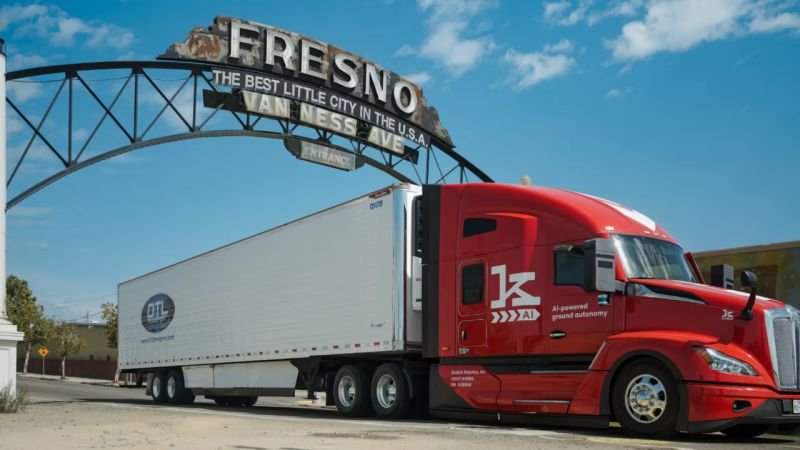
Kodiak AI has secured a binding agreement with DTL Transport to equip 75 trucks operated by the Fresno, California-based carrier with its autonomous driving system, marking a further step in the expansion of its Driver-as-a-Service business model.
Announced Wednesday, the agreement establishes a commercial arrangement under which DTL will retain ownership and operational control of the vehicles while paying Kodiak a fee for every mile driven using the Kodiak Driver. The companies have not disclosed the per-mile rate, the duration of the contract or the date on which the first trucks will begin operating without a driver.
DTL is a family-run trucking company with more than 36 years of experience transporting dry and refrigerated freight. Its fleet comprises more than 100 trucks, and its operations include cross-country team driving assignments for grocery retailers.
The partnership extends Kodiak’s Driver-as-a-Service approach beyond its existing operations in the Permian Basin, where autonomous trucks transport sand for the energy industry, and into interstate freight transportation. However, Kodiak has not yet launched driverless trucking operations on public highways.
The company was ranked No. 12 in the 2027 FreightTech 25 list.
Kodiak founder and CEO Don Burnette described the agreement as further validation of the company’s commercial strategy, saying the Driver-as-a-Service model is particularly suited to the needs of the trucking industry.
The first operating network is Texas and interstates.
The two companies plan to start operations on routes Kodiak has already tested, including the corridor between Dallas and El Paso, Texas, and Interstate 20 between Dallas and Atlanta.
The Atlanta route was previously used for autonomous trucking trials. Kodiak began hauling cargo for Forward Air between Dallas and Atlanta in 2023, with safety drivers still riding along in the trucks.
The routes selected are indicative of one of the biggest problems facing long-haul freight carriers: federal hours-of-service rules limit how long individual drivers can be behind the wheel.
Under the rules that apply to them, property drivers can drive up to 11 hours in a 14-hour period after 10 consecutive hours off duty. To keep vehicles rolling longer without exceeding these limits, trucking companies often use two-driver teams .
Kodiak believes its autonomous technology could provide DTL with greater operational flexibility on the chosen corridors enabling freight movements to be conducted outside the service hour restrictions that apply to individual drivers. Additional routes may be added as the partnership grows.
Neither company has indicated whether autonomous operations would supplant existing team-driver services on those routes or run alongside them.
The integration of technology into the company’s fleet will build on DTL’s experienced workforce and help grow capacity, enhance safety and encourage innovation, said DTL President and CEO Lucky Dosanjh.
California produce pilot paved the way for the partnership
The agreement follows an earlier demonstration of Kodiak’s technology in California.
In September, an autonomous truck equipped with the Kodiak Driver transported perishable goods for DTL over a 225-mile journey from Fresno to Los Angeles, using Interstate 5 and State Route 99.
A safety driver remained behind the wheel throughout the trip, in accordance with the testing permit issued to Kodiak by the California Department of Motor Vehicles in August.
According to Kodiak, the demonstration marked the first time a Class 8 truck had autonomously transported commercial goods in California.
The pilot provided an opportunity to test the technology in a real freight operation involving perishable products, laying the groundwork for the companies’ broader commercial arrangement.
Autonomous highway driving still a crucial milestone
Even with the DTL agreement, Kodiak still has a key step to take before it can put driverless trucks on public roads.
The company hopes to start driverless highway operations by the end of 2026, initially hauling freight for IKEA on Interstate 45 between Dallas and Houston. Kodiak must complete its long-haul safety case before that service can begin.
By the end of August its Autonomy Readiness Measure – a measure of preparedness for driverless operations – stood at 93% from 84% in February.
Kodiak’s commercial activity is currently focused in the Permian Basin. There were 35 customer-owned driverless trucks in the area working for Atlas Energy Solutions by June 30, 2026. Kodiak has pledged to grow that fleet to 100 vehicles by mid-2027.
The company’s financial performance also helps explain its plans for expansion. Kodiak announced second quarter revenue of $3.5 million, compared to $503,000 in the same quarter a year ago, but also had an operating loss of $43.7 million.
At the end of June, the company had cash, cash equivalents and marketable securities of $151.1 million. Kodiak AI will release its third quarter earnings on Thursday, November 5 after the market close.
Why the agreement matters for freight operators
The DTL partnership highlights a potential application for autonomous trucking in time-sensitive, long-distance transportation.
Team-driver operations are designed to keep freight moving when a single driver’s permitted driving time becomes a limiting factor. Autonomous technology could eventually offer carriers another way to extend vehicle operating hours, increase capacity and improve the utilisation of their fleets.
For DTL, deploying the Kodiak Driver across 75 trucks could create an opportunity to expand its service capabilities on selected interstate routes while maintaining ownership of its vehicles.
However, the commercial benefits remain conditional on Kodiak completing its long-haul safety case and launching driverless operations on public highways. Until those milestones are achieved, the agreement represents a significant commitment to autonomous freight transportation rather than confirmation that the 75 trucks are already operating without drivers.