



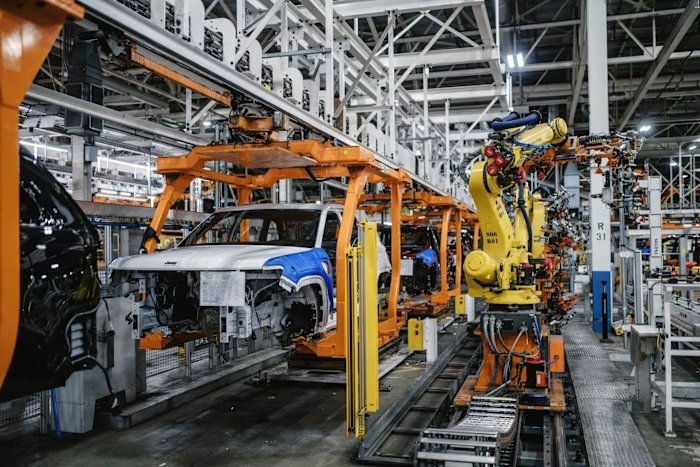
President Donald Trump has chosen to prioritize trade negotiations over immediately imposing tariffs on imports of robotics, industrial machinery and related components after an investigation into whether those goods pose a threat to U.S. economic and national security interests.
In a proclamation signed Wednesday, Oct. 28, 2026, Trump directed Commerce Secretary Howard Lutnick and U.S. Trade Representative Jamieson Greer to start or continue talks with trading partners. The aim is to decrease the United States’ dependence on foreign sources of robotics, industrial equipment and associated parts. The two officials are being instructed to update the president on their progress in 180 days.
The decision comes after the start of a Section 232 probe in September 2025. The proclamation pointed out that the United States does not manufacture sufficient robotics and industrial equipment to meet domestic requirements and that its manufacturing base cannot sustain demand.
The probe also found potential risks related to the scale of imports, including to the American manufacturing base, national security and the broader economy. The proclamation warns that dependence on foreign suppliers could erode the country’s industrial base and its long-term competitiveness in a sector increasingly important to national security.
Growing preference for negotiations post Section 232 investigations
The latest directive is part of a string of decisions in which Trump has opted to pursue trade talks rather than immediately impose new tariffs following Section 232 investigations.
Earlier this month, the president signed a similar order on wind turbine imports that directed his administration to seek negotiations with trading partners. He also directed cabinet officials last month to discuss imports of commercial aircraft, jet engines and their parts.
This method has also been applied to semiconductors. In January, Trump requested talks on trade in semiconductors, but placed a tariff of 25% on a few types of chips. Officials were to update those talks by July 1.
All of these steps together suggest a readiness to pursue negotiations as an alternative to immediate trade restrictions in selected sectors of industry, while the administration continues to review the security implications of U.S. import dependence.
An alternative to the president’s tariffs policy.
The strategy represents a departure from Trump’s earlier use of Section 232, a provision of U.S. trade law that his administration has used to impose tariffs on a range of imported goods.
Previous measures have focused on cars and car parts, drones and drone parts and polysilicon used in the semiconductor and solar power industries.
But the administration decided first to give priority to negotiations for robotics and industrial machinery. This does not preclude further trade restrictions. The proclamation makes it clear that the president can consider other options in the future, such as imposing new tariffs or changing existing ones.
Any such decision could hinge on the outcome of negotiations led by Lutnick and Greer. Their findings and progress report, due within 180 days, will thus help inform the administration’s next steps in addressing U.S. reliance on imported robotics, industrial machinery and related components.