



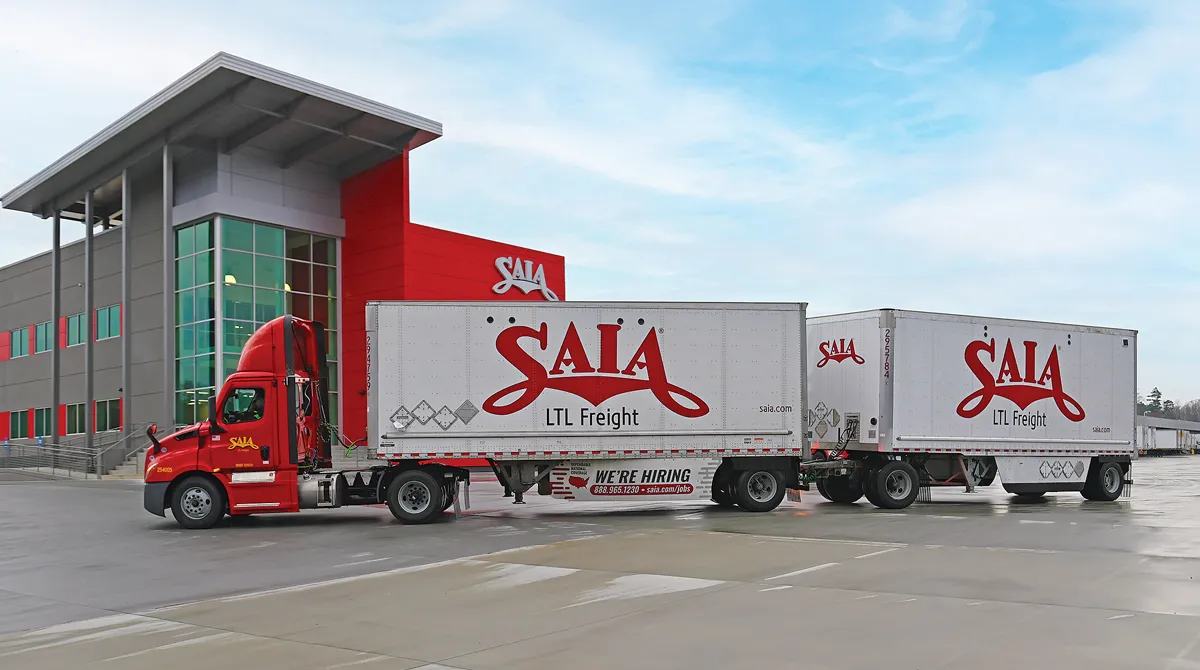
Saia’s network growth continues to show up in improved freight volumes and record financial results. In the third quarter of 2026, the U.S. less-than-truckload (LTL) carrier achieved the highest quarterly revenue and tonnage in its history, helped by new terminal capacity and improvements to its national service network.
With much of its infrastructure expansion now complete, management’s focus is now turning to improving the operating performance of new and expanded facilities.
SAIA, which trades on the Nasdaq under the ticker SAIA, reported third-quarter earnings per share of $3.41 Thursday before the market opened. That compared with 60 cents in the same period a year ago and 11 cents above the analysts’ consensus estimate. Earnings per share also benefited 10 cents year-over-year because of a $3.6 million reduction in net interest expense.
On an adjusted basis, which excludes a net $14.5 million impact from real estate gains and impairments, earnings per share for the third quarter of 2025 were $2.81.
Revenue of $983 million grew 17% year-over-year, $15 million above analyst expectations. That performance came even as diesel prices were 48% higher than the third quarter of 2025.
Freight volumes keep accelerating
tonnage increased 9% year-over-year in the quarter. That improvement came from a 1% increase in shipments and an 8% increase in average weight per shipment.
The monthly figures show growth strengthening over the period. Tonnage was up 7.8% in July, 8.7% in August and 10.3% in September over the like months of 2025. That momentum has carried into October when tonnage is 10% ahead of year ago levels to date.
Saia’s infrastructure investment has been crucial to facilitating this growth. Since 2022, the carrier has opened 45 terminals and moved or expanded 25 other facilities.
It now has a network of 219 terminals. That’s still smaller than the footprints run by some other national carriers, but management believes the investments have brought Saia onto a more competitive footing with its larger rivals.
Demand conditions have also been favorable conditions. The U.S. manufacturing sector, a key source of freight for the LTL industry, expanded in September for the ninth straight month.
Saia is also benefiting from enhancements delivered through its Saia REV initiative. The program has reduced transit times across more than 2,000 lanes, improving the company’s service offering and providing another channel for above-average volume growth.
| Saia | Q3/26 | Q3/25 | Y/Y Change | Y/Y % Change |
|---|---|---|---|---|
| LTL: | ||||
| Workdays | 64.0 | 64.0 | 0 | 0.0% |
| Total Tonnage (tons) | 1,722,000 | 1,581,000 | 141,000 | 8.9% |
| Tonnage/Day | 26,906 | 24,703 | 2,203 | 8.9% |
| Total Shipments | 2,351,000 | 2,333,000 | 18,000 | 0.8% |
| Shipments/Day | 36,734 | 36,453 | 281 | 0.8% |
| Revenue/Hundredweight (cwt) | $27.66 | $25.76 | $1.90 | 7.4% |
| Revenue/Hundredweight (cwt ex-fuel) | $21.25 | $21.72 | -$0.47 | -2.2% |
| Revenue/Shipment (ex-fuel) | $311.34 | $294.35 | $16.99 | 5.8% |
| Pounds/Shipment | 1,465 | 1,355 | 110 | 8.1% |
| Length of Haul (miles) | 885 | 894 | -9 | -1.0% |
| Consolidated: | ||||
| Revenue | $982.5 | $839.6 | $142.8 | 17.0% |
| Adjusted Operating Ratio | 87.6% | 87.6% | 0 bps | 0.0% |
| Adjusted EPS | $3.41 | $2.81 | $0.60 | 21.4% |
Revenue in millions
Saia’s key performance indicators.
Freight mix shifts impact pricing performance
With stronger volumes some pricing indicators remain under pressure.
Revenue per hundredweight, or yield, excluding fuel surcharges, fell 2% year over year. higher average shipment weights and a 1% reduction in length of haul impacted the measure.
Revenue per shipment, excluding fuel, was a better story, up 6% versus the third quarter of 2025. The increase came while the Los Angeles market, where freight bills are typically higher, remained weak.
Saia believes its increased national presence and improved service levels create additional opportunities to grow pricing and reduce the gap with competing carriers.
President and CEO Fritz Holzgrefe addressed the issue on Thursday’s analyst call, saying the company’s service levels justified its pricing stance.
The carrier announced a 7.1% general rate increase (GRI) July 6. The adjustment was 120 basis points higher than last year’s and was effective three months earlier. “Management said the measure is performing well and continues to yield positive results.
Contract rate renewals averaged 10.8% in the quarter. In the two-year stacked basis, the increase was 15.9%, showing the strides Saia has made in getting higher contract pricing.
Operating performance remains strong despite seasonal pressures
Saia’s operating ratio for the third quarter was 87.6%. It was flat from a year before and just 70 basis points worse than the second quarter.
That comparison is noteworthy because the carrier typically sees its operating ratio worsen by 150 to 200 basis points from the second to the third quarter.
This year over year comparison also had an additional labor cost burden. Saia put its regular wage increase into effect in July 2026, but the related adjustment in 2025 didn’t take place until October. So there was no such wage hike in the third quarter of last year.
Recently opened terminals are still operating at an operating ratio in the low 90% range, but have improved 40 basis points year over year.
Looking ahead, Saia expects its operating ratio to worsen by 200 basis points in the fourth quarter. Less than the normal seasonal drop of 250 to 300 basis points between the third and fourth quarters.
Based on this outlook, the company is guiding to a fourth-quarter operating ratio of 89.6%, which would be 230 basis points better than its unadjusted fourth-quarter 2025 result.
Rail partnerships simplify transportation cost management
Another key element of Saia’s operating strategy is managing purchased transportation expenses.
Cost of purchased transportation as a percentage of revenue increased 220 basis points year-over-year in the quarter. Rail and trucking partners represented 15.7% of the company’s total linehaul miles.
Still, Saia was able to limit external transportation rates per mile inflation to 4%.
Management expects purchased transportation costs to continue to increase, but cited the staggered structure of its agreements with service providers as a factor that could help spread the burden over time.
The company also intends to maintain its use of the cost advantages of rail transport in an effort to preserve operating margins.
Lower capex, new $250m buyback
“Saia is transitioning its capital allocation into a different phase now that it is completing the bulk of its major network expansion investments.
The company said on Thursday it would begin a $250 million share repurchase program, returning some money to shareholders while it continues to invest in its business.
Next year, capital spending is expected to be in the range of 13% to 14.5% of revenue. Management is looking for a longer term range of 12%-15%.
Saia now expects full-year 2026 net capital expenditures of approximately $350 million, down from its prior guidance of $350 million to $400 million.
The reduction follows years of heavy infrastructure spending. The company’s investment program is reflected in net capital expenditures of $544 million in 2025 and $1.05 billion in 2024.
“We have also improved cash generation. In the first three quarters of 2026, Saia generated more than $240 million in free cash flow and ended the period with net cash of more than $100 million.
SAIA stock outperforms market overall
Investors were pleased with the quarterly results. Shares of Saia were up 3% at 2:51 p.m. EDT Thursday, while the S&P 500 was down 0.6%.
Saia is one of the few publicly traded LTL carriers, so the company’s performance has particular relevance to the wider transportation industry.
The company’s quarterly results therefore provide a valuable window into freight volumes, pricing trends, operating costs and demand conditions in a segment of trucking for which there is still limited publicly available data.
The latest numbers underscore how network expansion and service improvements are enabling Saia to handle more freight volume. The next challenge is converting that growth into better operating efficiency as newer terminals come online and infrastructure spending slows.