



Georgia strengthens its inland freight network with new rail terminal
Georgia has expanded its freight infrastructure with the official opening of the $134 million Gainesville Inland Port. Governor Brian Kemp and representatives of the Georgia Ports Authority (GPA) marked the inauguration on Thursday, celebrating a new logistics connection designed to bring Northeast Georgia’s manufacturing businesses closer to international markets through the Port of Savannah.
Although the inauguration took place on Thursday, the terminal had already begun commercial operations on May 4. It now provides direct rail services operated by Norfolk Southern (NYSE: NSC) between Gainesville and Savannah five days a week. The connection offers regional companies an alternative to the approximately 600-mile round trip currently required to transport containers by truck.
Governor Kemp highlighted the importance of the investment for the state’s industrial competitiveness, pointing to the role of port infrastructure in attracting businesses and generating employment. He said the new facility would extend the advantages of Georgia’s maritime gateways to the northeastern part of the state, while giving local companies additional supply chain options to reach international customers and helping reduce highway congestion.
A direct connection for more than 330 manufacturers
The Gainesville facility is intended to serve a substantial industrial base. More than 330 manufacturers operate across the surrounding region, including businesses involved in poultry production, heavy equipment and forest products.
Through its rail connection to Savannah, the inland terminal gives these companies access to the port’s international shipping network, which includes approximately 40 vessel calls every week.
When operations began, Georgia Ports President and Chief Executive Griff Lynch emphasized the strategic importance of extending Savannah’s reach into Northeast Georgia. He explained that manufacturers would benefit from a direct rail connection to the port’s weekly vessel services, creating a more integrated route between regional production facilities and global markets.
26,000 containers to be moved from trucks to rail
A main goal of the project is to cut the quantity of freight moved by road. Georgia Ports projects the Gainesville Inland Port to move approximately 26,000 containers by rail in its first year of operation.
The change is expected to reduce truck traffic and the related emissions on Georgia’s highway system, including the Atlanta metropolitan area. But the authority has not yet published figures on actual container volumes at the terminal since operations began.
The project aligns Georgia with a number of other East Coast states that are developing inland logistics facilities to extend the reach of their seaports.
The Georgia Ports already operate another inland port serving the Savanna area, the Appalachian Regional Port. In neighboring South Carolina, inland ports in Greer and Dillon handle container traffic associated with the Port of Charleston. The Virginia Inland Port in Front Royal and North Carolina’s Charlotte Inland Port also link inland freight markets to major East Coast maritime gateways by rail, although with different operating and terminal arrangements.
A 104-acre facility to handle 200,000 containers a year
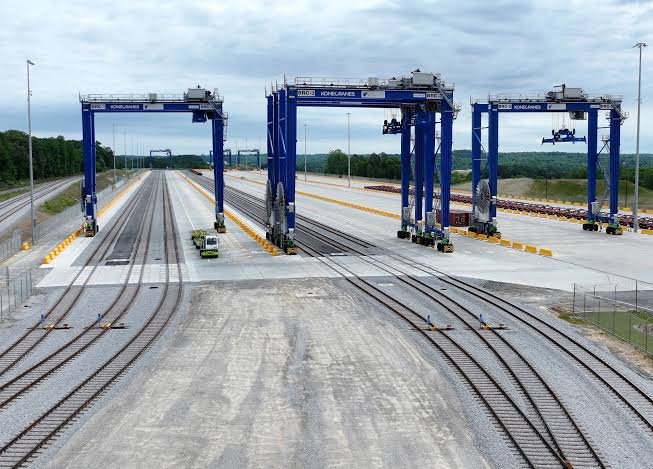
The 104-acre Gainesville Inland Port, formerly called the Blue Ridge Connector, is slated to handle up to 200,000 containers per year when complete.
Its location also gives access to two major highway corridors, Interstates 85 and 985, enhancing its linkages with regional distribution and manufacturing centers.
Outside the terminal, Georgia Ports has spent another $4.8 million on road improvements around the port. The upgrades will involve the removal of a level crossing between road and rail traffic, the relocation of an access road and the resurfacing of another roadway.
The upgrades are aimed at enhancing access to the facility and the movement of freight in the vicinity of the facility.
Industrial expansion increases the need for additional capacity
The opening comes as Gainesville and Hall County continue to draw industrial investment. Georgia Ports cites numbers showing 78 new businesses and growing companies that have either opened or expanded in the area since 2020.
Together, these developments have generated more than 4,800 jobs and attracted roughly $2 billion in capital investment. Manufacturing, processing and logistics activities now account for 33% of the local workforce, demonstrating the value of efficient freight infrastructure to the regional economy.
The Gainesville project is also part of a much broader infrastructure strategy. Georgia Ports is working on a 10-year, $5 billion investment program that would include more cargo berths at the ports of Savanna and Brunswick.
A broader plan to strengthen Georgia’s supply chains
The Gainesville Inland Port is another step in Georgia’s drive to boost its freight-handling capacity beyond the ports on the coast. The state is trying to improve access to international shipping and cut down on long-haul truck transport by connecting manufacturers directly by rail to Savanna.
The anticipated movement of 26,000 containers in the first year of the terminal’s operation would also assist in reducing road congestion, lowering transport emissions and making freight distribution across the region more efficient.
Why it matters: The new Gainesville Inland Port provides manufacturers in Northeast Georgia a direct rail option instead of trucking their containers to Savanna. The project is expected to reduce highway traffic, enhance freight connectivity, attract regional industrial investment and fortify Georgia’s place in international supply chains.






