



AI Infrastructure Emerges as Big Global Trade Driver
The rapidly expanding artificial intelligence infrastructure is altering the patterns of international trade and generating new growth opportunities for freight forwarders and third-party logistics providers. Technology companies are ramping up computing capacity, building data centers. Transportation networks are being reconfigured, particularly those linking Asia and North America, as supply chains become more sophisticated.
Asia continues to be at the heart of this transformation, as a key manufacturing and distribution hub for advanced semiconductors for artificial intelligence applications, data centers, connected devices and next-generation vehicles. Freight transportation companies are expanding their capacity to meet growing demand for fast, reliable and specialized shipments.
Two reports issued Wednesday underscore the increasing role of AI products, including semiconductors and data-transmission equipment, in international trade. These goods are spurring more sophisticated regional and global supply chains that require speed, shipment visibility, cross-border expertise and resilience.
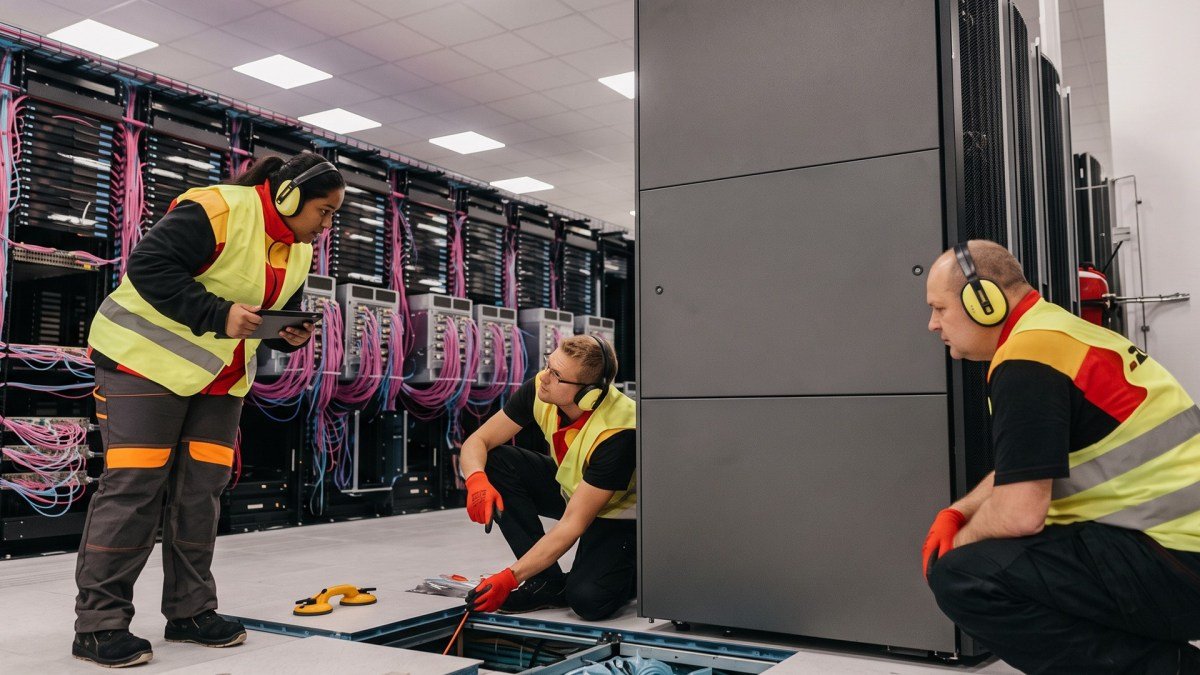
Unlike traditional consumer electronics, AI infrastructure involves the coordinated transportation, customs clearance and storage of oversized, high-value and highly sensitive equipment. These are shipments from manufacturing facilities across Asia to hyperscale data centers under construction around the world.
The Stern School of Business at New York University commissioned an annual report on globalization trends from DHL Group. It said semiconductors, data-transmission equipment and data center hardware made up 42% of the growth in global merchandise trade in 2025. Their contribution rose to about 76% in the first quarter. Trade in critical minerals, batteries and electric vehicles also grew quickly in the first quarter, the report said, citing research from the World Trade Organization and the Organization for Economic Co-operation and Development.
The increase in investment in US AI infrastructure has been a large part of the growth in imports, even as imports of other goods have declined. Without the AI investment boom, US imports would have fallen 10% in 2025 rather than experience modest growth, the Federal Reserve Bank of Minneapolis said. The second largest growth in trade activity was in East Asia and the Pacific, supported by the region’s leading role in the manufacturing of AI-enabling hardware.
“The biggest story in global trade right now is AI – not tariffs,” said John Pearson, CEO of DHL Express, in a news release accompanying the report. “When you boil it down, all the AI queries are logistics,” he said. “Chips, networking equipment and other supporting goods need to get to the right places at the right time.”
Semiconductor Demand Accelerates Across Asia-Pacific
A report released this week by Frost & Sullivan further illustrates how AI is changing trade patterns. Semiconductor production and investment in digital infrastructure are accelerating across the Asia-Pacific region, which now represents approximately 58% of global semiconductor industry revenue.
The expansion is being driven by strong demand for artificial intelligence, high-performance computing, electric vehicles and advanced communications technologies. The research, sponsored by FedEx, identifies AI and high-performance computing as the fastest-growing sources of semiconductor demand.
More than 2,000 additional data centers are expected to be built worldwide between 2026 and 2035, according to IEEE Spectrum.
FedEx (NYSE: FDX) estimates that the addressable transportation market associated with data centers and IT service equipment is worth approximately $7 billion. Chief Commercial Officer Brie Carere shared the company’s estimate during its Investor Day event in February.
DHL Global Forwarding places the data center logistics market at approximately $23 billion in 2025 and expects it to reach at least $35 billion by 2030, according to Amanda Rasmussen, the company’s chief commercial officer and data center executive lead.
The scale of investment is attracting major logistics operators. Last month, Kuehne+Nagel was appointed the primary logistics provider for Amazon Web Services, supporting data center installation and operations worldwide.
Cloud computing giants could spend as much as $525 billion on data center construction in 2026 alone, according to some estimates. Commercial real estate services firm JLL expects the broader infrastructure investment cycle to reach $3 trillion by 2030.
Consulting firm PwC projected last month that global data center capital expenditure could total $31.6 trillion through 2050, with a potential upside approaching $50 trillion if AI adoption accelerates.
Meanwhile, Worldwide Semiconductor Trade Statistics forecasts that the global semiconductor market will reach approximately $975 billion by the end of the year.
Investment is expected to continue as servers, graphics processing units (GPUs) and other information and communications technology equipment require replacement or upgrades every four to six years.
The rising complexity and value of this equipment are also changing freight requirements. Several years ago, individual servers typically cost between $100,000 and $250,000. Today, prices of $1 million to $3 million are increasingly common, and values are expected to climb further as AI workloads demand greater computing power.
Modern AI servers integrate substantially more processing capacity, custom silicon and advanced cooling systems into each unit. This makes them more valuable and more difficult to handle safely, according to logistics experts.
Beyond semiconductors, AI infrastructure requires high-density server racks, networking equipment, liquid cooling systems, fiber-optic components and large-scale power-generation hardware. These products frequently travel between multiple manufacturing, assembly and testing facilities before reaching their final destinations at data centers.
“These shipments are bulky, they are very high value and they require the specialized expertise that we have had for decades,” Carere said. She noted that many components are manufactured in Asia and shipped to North America, adding that FedEx’s leading position on the trans-Pacific route puts the company in a strong position to outperform market growth. The company has also established a dedicated data center sales team.
FedEx is already recording double-digit revenue growth in the AI sector, benefiting from business across the value chain, including manufacturers of power-generation equipment. During the company’s June 23 earnings call, Carere described how FedEx responded to an urgent request from a global technology company to transport multiple pallets of equipment to the United States. Successfully handling such one-off shipments, she explained, can generate repeat business and more predictable revenue streams.
Kuehne+Nagel also reported strong demand from hyperscalers during the second quarter, particularly on the trans-Pacific route between China and the United States, CEO Stefan Paul said during the company’s July 23 earnings call.
High-Value Cargo Creates Opportunities for Specialized Logistics
The hyperscalers are rapidly deploying server capacity to recover their investments because of the huge investments being made in AI projects and growing demand for digital services. This means that technology companies are increasingly willing to pay premium transportation rates, especially air freight where speed is critical.
This offers an attractive market for logistics providers that can offer quick reaction and specialized handling.
Companies taking on large infrastructure projects often want to know the air freight quote within two to four hours and the ocean freight quote within 24 hours, says Amanda Rasmussen, DHL Global Forwarding. In traditional freight markets, similar quotes take 24-72 hours.
That gives you an idea of how fast-paced and competitive this market is. But the industry is asking for more and more speed and agility, and so decisions have to be made quickly as well as the freight itself,” Rasmussen explained.
Trans-Pacific air cargo is already showing growth. C.H. Robinson has seen a near 60 per cent jump in air freight volumes of semiconductors and AI-related products from Asia to the U.S. in the past year. The segment is expected to continue to be the main engine of trans-Pacific air demand over the next 12 months, said Vincent Wong, director of product development for the freight forwarder.
Ocean freight and combined sea-air services are still options to move construction materials, server racks and replacement parts, Wong said.
Expeditors also reports continued demand. CEO David Wall said demand from AI hyperscalers remains very strong and is not expected to wane. Demand for freighter capacity is up. Some hyperscalers now require access to the top deck of cargo planes for server shipments.
AI-related shipments are increasingly offsetting the falling e-commerce traffic that has driven much of the growth in air cargo over the past two to three years.
“The impact of the sector should not be underestimated as AI-related goods account for less than 10pc of the total air cargo volume,” said Niall van de Wouw, chief airfreight officer at Xeneta. But a boom in semiconductor sales has propelled the trans-Pacific corridor into the strongest air cargo route this year, even as tariff pressures have crimped China-US volumes.
The trend is good for airlines, too. AI-related goods accounted for 53.5% of the total value of goods transported by air but just 7% of the volume, the International Air Transport Association said. Such a difference highlights the extremely high value density of the segment and its strategic importance for the aviation sector.
The air cargo trade value of AI-related goods increased 20% in 2025, compared to 2024.
Asian airlines have come a long way. Korean Air’s cargo revenue soared 46% in the second quarter as demand for AI got a big boost. All Nippon Airways said cargo revenues rose 38% in the period from a year earlier, helped by strong semiconductor traffic. Taiwan’s EVA Air said AI-related shipments now account for as much as half of its cargo revenue.
The expansion is also creating new dedicated services. Japan Airlines and Nippon Express said they started weekly freight flights between the United States and Asia on Saturday with a Boeing 747 freighter chartered by JAL.
The service is designed to meet growing demand for semiconductor and AI-related transportation. According to a JAL news release, the round-trip operation originates in Los Angeles and includes stops at Tokyo Narita Airport, Taipei in Taiwan, Singapore and Narita.
Despite the opportunities, capacity remains a concern. Global demand for freight transportation, particularly on routes linking Asia and North America, has exceeded capacity growth throughout the year.
Asia-Pacific’s Semiconductor Network Becomes More Interconnected
The AI investment boom is reinforcing semiconductor demand across multiple industries. Electric vehicles, which require significantly more chips than conventional vehicles, are contributing to the increase, alongside the expansion of 5G networks, connected devices, consumer electronics, medical equipment and industrial automation.
Asia-Pacific is home to four of the world’s 15 largest semiconductor companies and remains a major automotive manufacturing region. Reliable access to locally produced chips is therefore critical to the region’s industrial ecosystem.
Smaller Tier 2 and Tier 3 suppliers also play an essential role, providing specialized chemicals, precision components and testing services that support the wider semiconductor industry.
A FedEx survey conducted at a major trade show in Taiwan identified Taiwan, Southeast Asia, Greater China and Japan as the markets expected to experience the strongest semiconductor demand growth over the next three years.
Rather than concentrating production in one location, semiconductor manufacturing and related activities are distributed across specialized regional hubs.
Taiwan dominates advanced semiconductor manufacturing, accounting for approximately 60% of global foundry output. China serves as a major supplier of materials, a large consumer market and an expanding semiconductor fabrication center. South Korea leads in memory chip production, while Japan supplies essential semiconductor equipment, materials and specialized manufacturing inputs.
Southeast Asia has become an important center for semiconductor assembly, packaging and testing.
Survey findings reflect the industry’s growing interest in regional diversification. Thirty-five percent of respondents expect their companies to expand manufacturing into additional Asia-Pacific markets over the next three years. Another 25% plan to increase or diversify sourcing either within the region or globally.
This shift toward regional production is creating a more fragmented but interconnected supply chain. Smaller, customized shipments are increasingly replacing bulk deliveries as components move between specialized facilities.
Because a single semiconductor can require design, fabrication and packaging in different locations, cross-border movements of prototypes, test wafers and high-value spare parts are becoming more frequent, Frost & Sullivan said.
Logistics Strategies Shift Toward Resilience and Greater Visibility
As semiconductor and data center supply chains become ever more complex, resilience is becoming a strategic priority for hyperscalers and smaller suppliers alike.
External disruptions such as geopolitical uncertainty, regulatory complexity, tariff changes and other factors make companies vulnerable to disruptions across their supply networks. Traditional supply chain models based on lean operations and minimization of costs are increasingly supplemented by approaches for maintaining continuity.
Components can travel over 25,000 miles and cross over 70 borders before reaching the final stage of production. Under these conditions, a small delay in shipping can hold up manufacturing.
And tech companies are adding extra stock buffers and a wider set of suppliers to their just-in-time inventory strategies.
Speed and visibility are also becoming prominent in logistics decision-making. Faster international shipping was the most important capability when choosing logistics and supply chain partners over the next three years, according to 44% of FedEx survey respondents.
FedEx has already adjusted its Asian network to cope with the rising demand for high-tech shipments. The company started daily direct flights from Taiwan to South Korea last year, extending shipment cutoff times by more than three hours and giving high-tech customers more flexibility.
South Korea has emerged as one of Taiwan’s main trading partners, with semiconductors and electronic components comprising much of export flows.
This year, FedEx and UPS also upgraded logistics facilities near the main airport in Taiwan.
FedEx expanded its transshipment center to double the footprint of its previous facility. The site has a sophisticated automated system that can process up to 9,000 packages an hour, boosting throughput and productivity.
Meanwhile, UPS opened a 872,000 square foot automated distribution center, more than doubling its previous warehouse footprint in Taiwan. The facility moves freight using autonomous mobile robots.
In addition, DHL Supply Chain is expanding its data center logistics network in North America. The company announced in March it plans to open 10 dedicated warehouse locations this year, adding more than seven million square feet of capacity.
The facilities, designed for hyperscale and colocation data center operators racing to deploy new infrastructure, offer specialized handling services, server rack configuration and dedicated transportation from warehouses to project sites.
As AI investment continues to grow, logistics providers are positioning themselves to handle a rising tide of high-value, time-sensitive technology equipment. Their ability to combine specialized handling, fast transportation, shipment visibility and resilient cross-border networks will increasingly be the key to how effectively they can serve the global data center industry.