



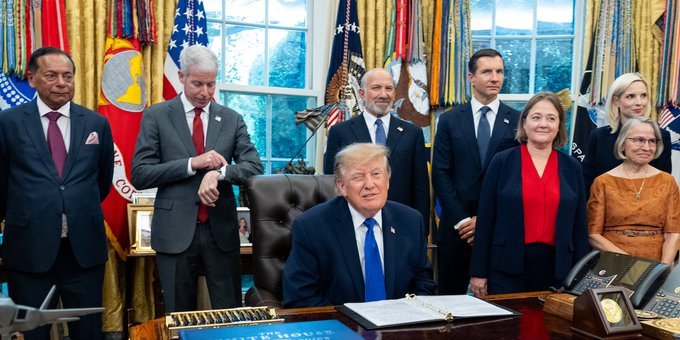
President Donald Trump on Thursday unveiled a $15 billion Iowa steel mill project, a major industrial investment led by Minnesota-based Mesabi Metallics to expand domestic steel production capacity and shore up U.S. supply chains.
The proposed facility is expected to be the largest steel mill in the United States. The project will create 1,750 jobs and add 10 million tons of annual steel production capacity, Trump said. The project is projected by its supporters to add $95 billion to the economy over the course of construction and the first decade of operation.
Mesabi Metallics, a Minnesota-based company backed by India-based conglomerate Essar Group, is building an integrated production model that will link its iron ore operations in Minnesota to the planned Iowa steel complex. The company recently opened an iron ore mine in Minnesota, which should supply pellets to the new mill once the facility is operational. Steel production is expected to begin in 2030, but there is no information on potential federal and state financial support.
Domestic steelmaking takes center stage
The project is part of an effort by the Trump administration to boost U.S. production of key industrial materials. Officials have pointed to national security and military supply needs, especially with the war with Iran ongoing, as reasons to beef up domestic metals manufacturing.
Trade policy has also been an important driver of the sector’s transformation. The administration doubled tariffs on imported metals under Section 232 to 50% last summer and later imposed adjustments to try to close loopholes and allow exemptions for some products.
The measures have raised domestic prices and reduced imports of foreign steel. While the tariffs have benefited American producers, higher raw material costs have further burdened manufacturers and led to higher prices for consumers. The United States also surpassed Japan last year as a crude steel producer for the first time since 1999, a development Trump has credited to his trade policies.
“Our steel industry is coming back to life,” Trump said Monday, adding that companies were choosing to build plants in the United States to avoid tariffs.
An integrated production model using electric arc furnaces
Mesabi Metallics plans to manufacture steel using electric arc furnace technology, combining recycled scrap with direct-reduced iron produced from Minnesota-mined ore. The approach is intended to connect domestic raw material supplies with steel production in Iowa.
The company describes the project as its first steel mill development and has presented it as the largest of its kind in U.S. history. Beyond the 1,750 permanent jobs expected to be created, construction of the Iowa facility is projected to generate approximately 6,000 additional jobs.
The investment in Iowa is part of a broader development strategy. Mesabi Metallics has separately committed another $3 billion to complete its iron ore mine in Nashwauk, Minnesota. More than 1,500 construction workers and 200 employees are already at the site, where the company aims to begin producing what it calls Patriot Pellets.
“This is a major moment for U.S. made steel,” Mesabi Metallics CEO Joe Broking said in a statement.
Public financing remains unclear
Despite the scale of the proposed investment, the White House provided few details about the project’s financing arrangements or any potential public-sector contribution.
Trump said the government was contributing “very little,” while Commerce Secretary Howard Lutnick stated that the “deal is done” and that private capital would fund the project. It remains unclear whether the Iowa development has qualified for state incentives.
The announcement reflects the administration’s broader push to attract investment in domestic metals production, with several other large industrial projects receiving presidential support.
Other major metals projects face local opposition
Last year, Louisiana Governor Jeff Landry joined Trump at the White House to announce Hyundai Steel Company’s plans for a $5.8 billion steel mill in Louisiana. Hyundai Steel subsequently held a groundbreaking ceremony for the project on September 4, marking a further step toward expanding U.S. steelmaking capacity.
Another major development is a proposed $4 billion aluminum smelter in Oklahoma, led by Emirates Global Aluminum and Century Aluminum. Trump has publicly endorsed the project as part of his efforts to expand domestic aluminum production.
Both the Louisiana steel mill and the Oklahoma aluminum facility have encountered opposition from local residents and advocacy groups concerned about potential environmental impacts and other effects on nearby communities.
The Oklahoma project has faced a particularly significant delay. Inola’s town council voted to extend an initial 60-day pause on the aluminum smelter, pushing the project back until April 2027, according to Oklahoma Voice. The town’s proposed smelting ban is also expected to appear on the ballot for a spring referendum, while the moratorium remains in force.
In response, the project’s developer released an economic impact study highlighting the potential for job creation and economic activity. The study estimates that Oklahoma Primary Aluminum could generate $49 billion for the state.
Trump continued to express strong support for the development, describing it as a major aluminum investment in one of his favorite places.
“We’re doing a tremendous aluminum plant in Oklahoma, one of my favorite places in the whole world,” he said. “That’s going to be unbelieveable.”
Taken together, the Iowa steel mill, the Louisiana development and the Oklahoma aluminum proposal illustrate the administration’s ambition to rebuild domestic metals capacity through large-scale private investment. However, the projects also highlight the challenges facing industrial expansion, including higher input costs, uncertainty over public incentives and local concerns about environmental and community impacts.