



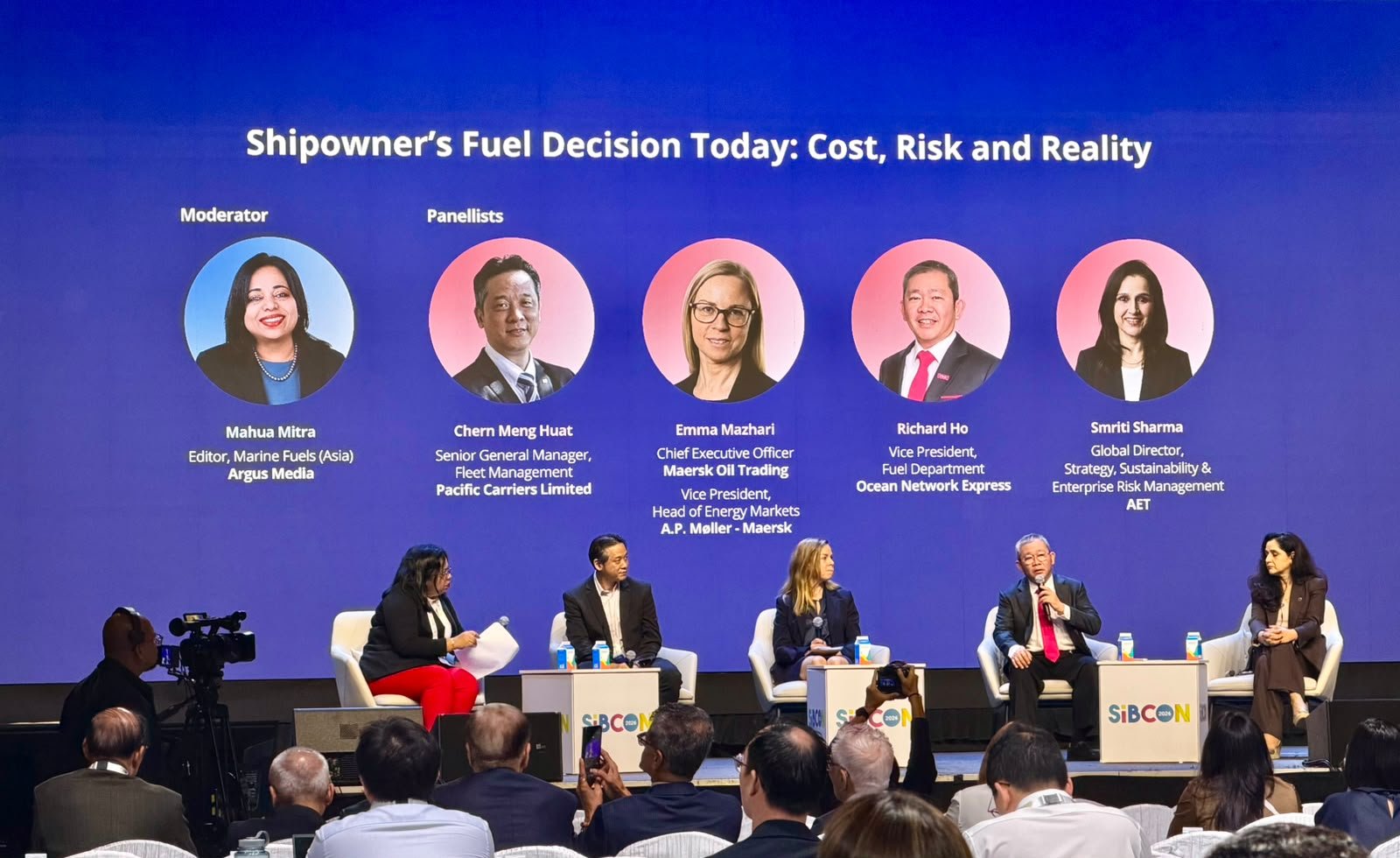
Dual-fuel vessels are becoming more common, but the use of lower-emission marine fuels is not keeping pace with the shipping industry’s technical capabilities. A key issue raised at the Singapore International Bunkering Conference and Exhibition (SIBCON) 2026 is that the gap between the alternative fuels that ships can use and the amount they actually do is still there.
As one speaker put it simply to lay out the issue: “capability does not equal consumption”.
More fleet means more fuel requirement
Alternative fuels are a regular theme at maritime conferences and more and more shipowners are investing in vessels that can run on fuels like LNG, methanol and ammonia. But the expansion of the fleet will not necessarily translate into an increase in demand for lower-emission energy sources.
SIBCON, the world’s biggest marine fuels event, is an important forum for the sector to review developments. The conference is organized by Informa Markets on behalf of the Maritime & Port Authority of Singapore (MPA) and is under the Chatham House Rule. This limits the ability to attribute individual comments, but also helps to reduce the prominence of promotional statements that may not reflect actual market conditions.
Speakers at the event cited the increasing number of alternative-fuel vessels already in operation and on order as proof of potential future demand. But they said the technical ability of a ship to burn a fuel does not mean the owner or charterer of the ship will necessarily buy it.
Fleet stats show the gap between potential and consumption
Vessels that can operate on alternative fuels account for 5.48% of the fleet by tonnage, according to DNV platform Alternative Fuels Insights.
LNG has the highest percentage share of total fleet tonnage for LNG capable vessels at 4.03% Another 0.76% are methanol and ethanol-capable ships, and 0.68% are LPG-capable ships.
Depending on what proportion of the fleet is capable of running on LNG, this could be a big contribution to the total marine fuel demand. But the real numbers tell a different story, especially in Singapore, the world’s largest bunkering port by far.
According to MPA statistics, LNG made up just 1.15% of the port’s fuel sales in the first nine months of 2026. Total volume sold was 487,100 tons against total sales of marine fuels of 42.5 million tons.
Methanol sales were much lower, at 6,300 tons in Singapore over the same period. Ammonia, which is still in its infancy as a marine fuel, had no sales.
The numbers reflect the gap between the technical readiness of the fleet and the commercial adoption of alternative energy sources. Even with Singapore’s 4.03% share of the global LNG-capable vessel fleet tonnage, it is still relatively low at 1.15% when considering regional variations and the efficiency of current dual-fuel engines.
Fuel prices still a big problem
Economics of buying marine fuel drives decisions in the industry. LNG is getting expensive. The crisis concerning Iran has caused supply disruptions and security and transit concerns through the Strait of Hormuz have affected Qatari supplies.
Owners and charterers of alternative-fuel vessels still have the cheaper alternative available and can also run them on conventional marine fuels. As conventional fuels are obviously cheaper, the commercial incentive to switch to alternative fuels is reduced.
Many of the modern dual-fuel vessels are now scrubber fitted, adding another dimension to these purchase decisions. These systems enable vessels to operate on low cost high sulfur fuel oil (HSFO) and comply with the relevant sulphur-emissions regulations.
This option has become particularly attractive lately, with the price gap between HSFO and very low sulfur fuel oil (VLSFO). HSFO dominated the Singapore fuel market in September 2026 with 42.2% of all bunker fuel sales. The actual fuel consumption was greatly affected by the price spread.
regulatory uncertainty impedes transition
It is a tall order to turn the many trials of alternative fuels that ship owners have been conducting into recurring consumption and repeat orders. For most of the industry, economic factors will probably be the main driver of procurement decisions, as long as conventional fuels remain cheaper.
The International Maritime Organization (IMO) has proposed a Net-Zero Framework that could help bridge the cost gap between traditional fuels and lower-emission alternatives. Such a framework could help change the market conditions that drive investment and shape choice.
Confidence in the regulatory initiative in Singapore, however, remains weak and sentiment around the prospects for the delayed framework to come into force looks negative.
That uncertainty adds another element of complexity for shipowners who must weigh the cost of investment in alternative fuels against the likelihood of future regulatory requirements and the availability of economically competitive fuels.
Biofuels offer a more immediate route
Market activity is more balanced between alternative energy sources such as biofuels and biofuel blends. In September 2026 they accounted for 1.7% of total bunker fuel sales in Singapore, although the share fluctuated considerably over the year.
And the fact that they are available now is definitely a boon. Biofuels are now available at some 100 ports worldwide and used by around 100 shipowners.
Biofuels do not require costly retrofits to ships, unlike some of the other alternative fuels. The chemical composition is very different from conventional marine fuels but operational behavior is usually similar.
Shipowners have not faced more operational problems and problems with the quality of fuel from biofuels and biofuel blends than they have from conventional marine fuels, SIBCON speakers said.
These characteristics suggest biofuels could be easier for operators seeking to introduce lower-emission fuels to existing operations without major vessel modifications.
The SIBCON 2026 debate ultimately shone a light on a key dilemma in the decarbonization of shipping. On one side of the transition, it’s adding more ships that can run on alternative fuels. Competitive pricing, reliable supply, real-world availability and a more certain regulatory outlook will also be critical to future adoption.