



Fleetworthy Expands Automated Roadside Inspection Capabilities Across the United States, Adding California, Michigan, Vermont and Maine to its Expedited Inspection Program. The system began in Nevada in June 2025 and the expansion to five states was announced Tuesday.
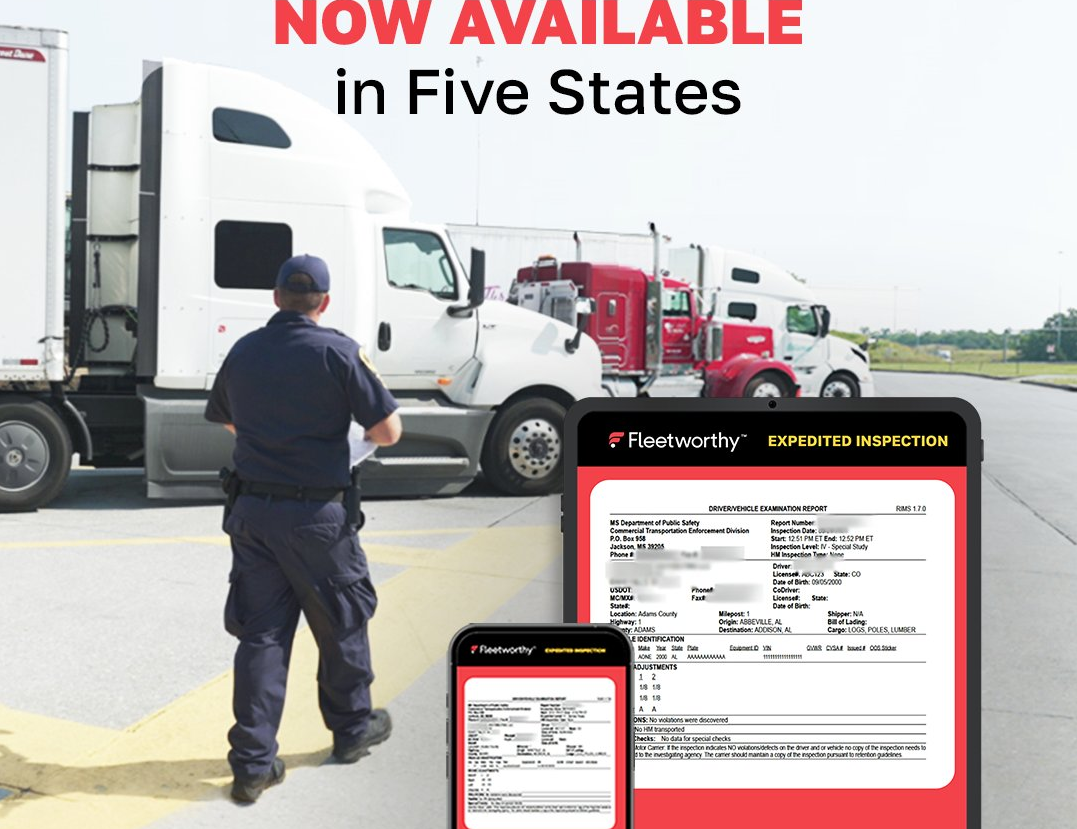
The technology is intended to facilitate roadside checking by automatically transmitting fleet information, vehicle data and drivers’ electronic Records of Duty Status (eRODS) to enforcement officers when a truck is selected for inspection.
At present, two requirements are needed to access the service. Fleets must subscribe to Fleetworthy’s Weigh Station Bypass service and use electronic logging devices (ELDs) from either Geotab or Platform Science. Drivewyze operated the bypass service until the business was acquired in 2024 by Bestpass-Fleetworthy Solutions. The purchase is part of the company’s wider expansion of its freight technology offerings.
The original Nevada deployment is the first automated roadside inspection solution of its kind in the industry, says Fleetworthy. The company says the technology is already helping enforcement personnel shave time off the inspection process.
The company’s announcement noted operational benefits, according to Nevada Highway Patrol Sgt. Scott Keane. “Every inspection is saving about 15 minutes, which means officers can spend more time on enforcement and drivers can get on their way faster,” he said.
Automating an existing electronic process
The electronic transmission of drivers’ hours-of-service records is already a part of the regulatory framework in the US. Under federal hours-of-service law at 49 CFR § 395.24, drivers must produce and transfer their ELD records when requested by an authorized safety official.
The conventional approach still requires the driver to intervene. In a standard telematics transfer, the officer provides a routing code and the driver begins the upload to a Federal Motor Carrier Safety Administration (FMCSA) server. Officers review the submitted records using eRODS, the FMCSA software used to review electronic logging device data.
This handoff is automated through the Fleetworthy Expedited Inspection system. If a truck is selected, the officer receives the driver’s eRODS file directly. The system also provides fleet information and vehicle registration data that can be used to pre-populate relevant inspection forms.
Fleetworthy announced in June 2025 that fleets will need to activate the functionality only one time with their ELD provider for the Nevada launch.
The concept is derived from an earlier initiative launched by Drivewyze. The company launched its e-Inspection solution in 2021 to enable drivers to share inspection data from their ELDs with officers during Level III inspections.
The current expansion also includes the Virtual Vehicle capabilities of Platform Science. “Virtual Vehicle Enabled” means the platform can pull live information from the telematics systems integrated in trucks.
“It allows us to make sure our officers are getting the right information when they need it, without the extra steps from a delivery standpoint,” said Emilie Campbell, vise president of marketplace for Virtual Vehicle at Platform Science.
Inspect Queue offers more flexibility to enforcement teams
Beyond the automated data transfer, Fleetworthy has added a feature called Inspect Queue that gives officers a view of all the trucks that have been flagged for inspection.
The tool also allows the officer to choose to continue an inspection on another device, providing more flexibility in how roadside inspections are conducted. The Inspect Queue is now active in all five states participating.
This system combines automated document delivery with a centralized inspection queue to reduce administrative delays and improve coordination among commercial fleets and enforcement agencies.
Calculating the financial impact for fleets of trucks
Fleetworthy estimates each inspection saves a fleet about $22.82. For operators who regularly drive trucks through participating states, these savings can really add up, according to the company.
The estimate is based on 15 minutes of time saved per inspection, and an hourly truck operating cost of $91.27. This figure is from The American Transportation Research Institute’s (ATRI) An Analysis of the Operational Costs of Trucking: 2024 Update and is the marginal operating cost.
The report, published in June 2024, uses costs for 2023, when ATRI determined the average operating cost of trucking to be $2.270 per mile.
But Fleetworthy’s calculation is based on an older baseline. Since then, ATRI has published two more editions of its cost analysis.
The July 2026 update reported the average cost to operate a truck was a record $2.336 per mile in 2025 compared to $2.260 in 2024. FreightWaves reported the increase, noting ongoing pressure on operating expenses in trucking.
The newer reports’ publicly available summaries don’t include a corresponding hourly operating-cost figure. The $22.82 figure Fleetworthy arrived at is based on the old hourly benchmark, not a calculation of the latest published per-mile costs.
Free access for participating fleets and states
Free expedited inspection is available for state transportation departments and state police. If they subscribe to Weigh Station Bypass and use a participating ELD provider, fleets can also use the service at no additional charge in Nevada, California, Michigan, Vermont and Maine.
Fleetworthy says it has plans for additional state deployments and additional ELD integrations, but has not provided a timeline for those developments.
“The roll-out from one state to five states is a great example of how the technology can scale to reduce roadside delays for commercial fleets and law enforcement,” said Miranda Leadbeater, a product manager at Fleetworthy. “Every minute saved reduces driver downtime and helps fleets run with greater predictability,” she added.
For the trucking industry, the development is another step toward automating roadside compliance procedures. Drivers are still required to provide electronic records when asked for them, but Fleetworthy’s system eliminates the need to manually initiate the transfer once a truck is selected for inspection.
That could mean quicker inspections, less paperwork and more predictable schedules. However, the system’s current reach is limited by availability in five states and compatibility with only two ELD providers, Geotab and Platform Science.