



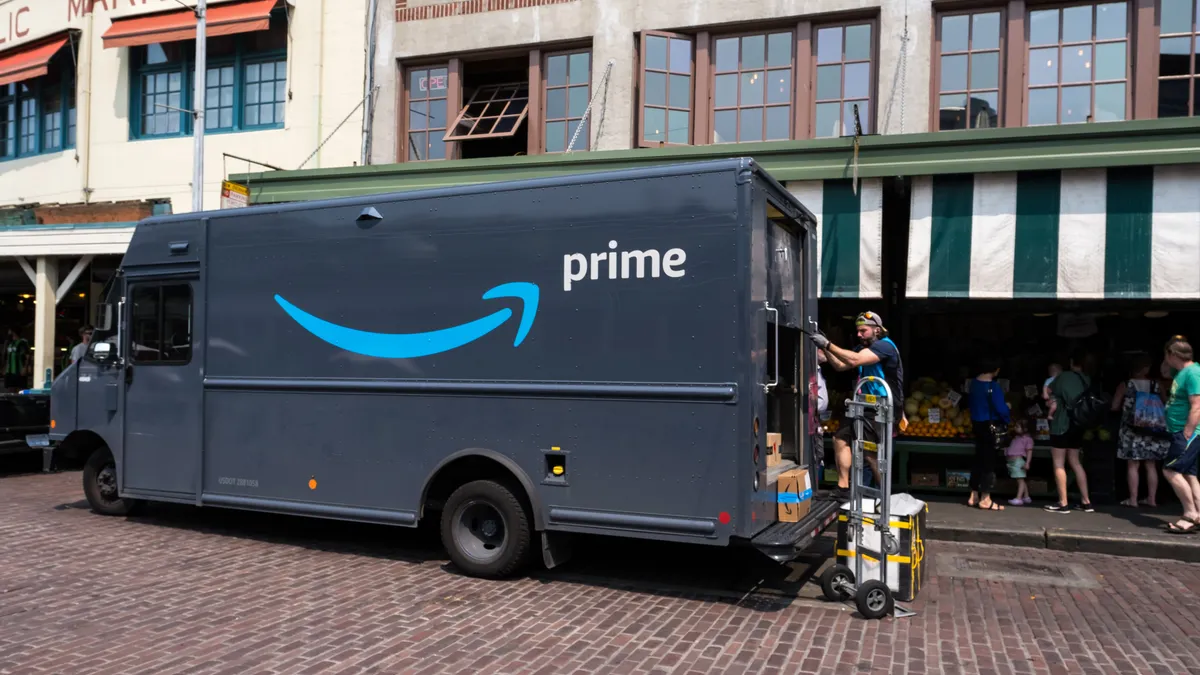
Amazon is preparing to take an even larger share of its U.S. package deliveries in-house, according to an internal planning document cited by Business Insider.
The company projects that more than 86% of packages in the United States will be delivered through Amazon’s own logistics network next year, continuing a steady expansion of its in-house delivery operation. The figure could rise to nearly 89% by 2029, according to the report published Sept. 3.
The shift would further reduce Amazon’s reliance on established parcel carriers, particularly the U.S. Postal Service and UPS.
According to the internal projections cited by Business Insider, Amazon expects the share of its packages handled by the Postal Service to decline from 10% in 2027 to 8% in 2029. UPS’ share is projected to fall from 1.8% to 1.4% over the same period.
Amazon, however, stressed that the figures should not be interpreted as final commitments.
Responding to a request for comment from Supply Chain Dive, Amazon spokesperson Steve Kelly said the company continuously plans and forecasts across its operations. He cautioned that internal projections are preliminary, can undergo significant revisions and should not be considered definitive or representative of finalized plans.
Amazon continues to build out its last-mile network
The projections come as Amazon continues to pour investment into its last-mile delivery infrastructure, giving the company greater capacity to move packages directly to customers without relying on another carrier’s network.
A major part of that strategy is its expansion into rural areas. Last year, Amazon announced a $4 billion investment aimed at expanding its shipping capabilities and said the initiative would triple the size of its rural delivery network by the end of 2026.
The move sent a clear signal to the wider parcel industry: Amazon intended to become less dependent on third-party carriers while also working to accelerate delivery speeds.
Mark Waverek, managing partner at PlaidMark Management Consulting Services, previously told Supply Chain Dive that Amazon’s rural investment demonstrated how the company was positioning its own network to support faster deliveries.
Amazon said in 2025 that the investment would allow less-populated areas to receive coverage from more than 200 delivery stations. These facilities prepare shipments for the final stage of their journey to customers.
“These are not big high-volume markets, but they’re allowing customers to put their product closer to the end consumers,” Waverek said.
That expansion is gradually changing Amazon’s relationship with other U.S. parcel carriers.
UPS and USPS increasingly pushed to the sidelines
Amazon has already taken steps to reduce the amount of volume it sends through third-party delivery networks.
The company cut the volume delivered by UPS in half this year and also scaled back its delivery agreement with the Postal Service.
Despite the reduction, USPS is unlikely to disappear entirely from Amazon’s delivery strategy. Waverek said the Postal Service will continue to be needed in certain situations, particularly for deliveries to remote or difficult-to-reach locations.
“They’re only going to give the Post Office the stuff that they just can’t do, and there’s certainly a lot of ZIP Codes,” Waverek said.
That leaves USPS with an important role in parts of the country where Amazon’s own network may not be able to provide the same level of coverage.
Amazon has already become the largest U.S. parcel carrier by volume
Amazon’s growing delivery operation has already pushed the company to the top of the U.S. parcel market by volume.
Last year, Amazon delivered 6.7 billion packages through its logistics arm, according to ShipMatrix data reported in March. That put Amazon ahead of the U.S. Postal Service, which handled 6.6 billion packages, and UPS, which delivered 4.4 billion.
Amazon is also continuing to pursue additional growth for its external delivery service, Amazon Shipping.
This year, the company has sought to attract more shipping volume by offering competitive pricing against FedEx and UPS, further expanding its presence beyond deliveries generated by its own e-commerce business.
The combination of a rapidly expanding internal delivery network, greater rural coverage and competitive pricing for Amazon Shipping points toward a parcel strategy in which Amazon increasingly controls more of the journey from shipment to customer.
Still, the company’s internal forecasts remain subject to change, and Amazon has emphasized that the projected figures are preliminary rather than finalized targets.