



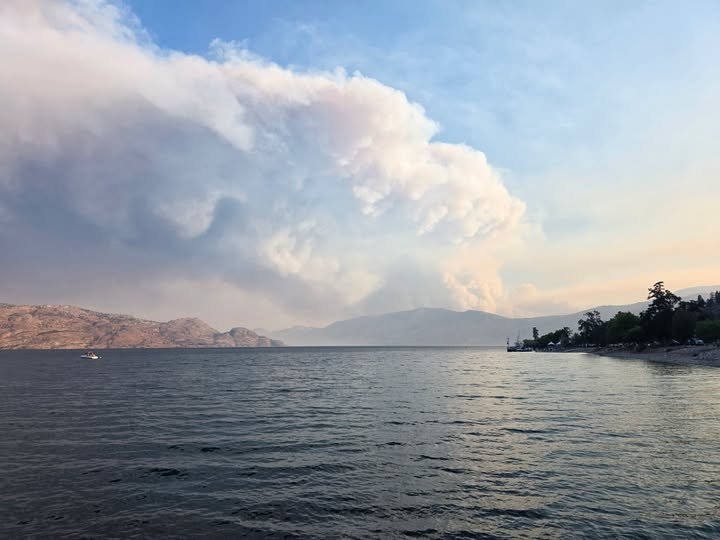
British Columbia is facing a major wildfire emergency as the Bald Range fire continues to burn near Summerland in the south Okanagan, days after rapidly expanding following its detection on August 7.
The province declared a state of emergency on August 8, with Premier David Eby describing the development as a significant shift in this year’s wildfire season.
By Tuesday, the Bald Range fire had grown to nearly 180 square kilometres, burning outside Summerland on the western shore of Okanagan Lake. Officials said the fire had also expanded slightly farther toward Peachland, approximately 22 kilometres north of Summerland.
Eby said he was told the fire initially spread with the force of something “like a bomb” as flames moved rapidly toward the community of roughly 12,000 people.
Authorities have also launched a criminal investigation into the cause of the fire. Police have warned the public against spreading misinformation after a widely circulated video showing someone lighting a bear-banger device was incorrectly linked to the blaze. Officials said the footage was recorded several kilometres from where the fire began.
Thousands forced to evacuate
The fire grew dramatically during the night of August 7, forcing approximately 20,000 people in the Summerland and Peachland areas to leave their homes.
An 80-year-old woman died while attempting to escape the fire.
The nearby community of Faulder, home to approximately 215 people, was also overrun by the flames. Images circulating online showed homes reduced to blackened foundations.
Officials have confirmed significant structural losses but have not yet released a detailed damage assessment.
While some images from Summerland show streets that appear deserted but undamaged, the lack of confirmed information has created frustration among residents.
Summerland Mayor Doug Holmes said Monday that residents should not expect to return home soon and urged them to prepare for potentially significant damage.
Firefighters face difficult conditions
Firefighting resources have been reinforced as crews attempt to contain the rapidly developing blaze.
On Tuesday, approximately 100 firefighters from Mexico arrived in the south Okanagan to support local operations. Their deployment brought the total number of firefighters assigned to the Bald Range fire to 193, supported by 14 helicopters and structure protection crews.
Hugh Murdoch of the BC Wildfire Service described the operation as a “monumental task” but expressed confidence in the available staffing.
Fire crews are dealing with extreme heat, steep terrain and hot spots capable of igniting beyond the main fire perimeter. These conditions have limited opportunities for direct attacks on the blaze.
In the Central Okanagan, Peachland firefighters are also working alongside BC Wildfire Service personnel to develop structural protection plans for priority areas, including homes.
Evacuees seek accommodation
People evacuated from Summerland and Peachland have been directed toward reception centres in nearby Penticton and West Kelowna.
The provincial government said it had booked more than 1,000 hotel rooms in Penticton, West Kelowna and Kelowna for evacuees.
Authorities are working with the tourism and hospitality industry and the federal government to secure additional accommodation as displacement continues.
The province’s evacuee helpline also experienced a record volume of calls over the weekend. Staffing capacity was increased by approximately 20 times to handle the surge in demand.
Animals also affected
The wildfire emergency is affecting far more than people.
Tens of thousands of animals, including household pets and livestock, have been caught up in evacuations.
People arriving at the Penticton convention centre brought dogs, cats and even goats with them, while other residents were forced to leave horses, pigs and chickens behind.
Social media has been filled with efforts to locate missing animals and reconnect pets recovered from affected areas with their owners.
B.C. Agriculture Minister Lana Popham said an estimated 50,000 farm animals were being affected by wildfires across 146 agricultural properties under evacuation orders, along with another 123 properties subject to evacuation alerts.
Around 100 active wildfires across B.C.
The Bald Range fire is only one part of a much broader wildfire emergency in British Columbia.
Approximately 100 wildfires are currently active across the province, most of them in the southern Interior, with around half reported to be burning out of control.
Several other major fires are also placing communities under pressure.
The Pear Lake wildfire has destroyed structures on more than 170 properties around Clinton and has burned nearly 1,500 square kilometres since it was detected on July 17.
The Brunswick Creek and Ainslie Creek fires, which form part of the same wider wildfire complex in the Fraser Canyon and surrounding areas, together cover more than 700 square kilometres.
The Ainslie Creek fire prompted the Lower Nicola Indian Band to issue an evacuation order Tuesday for its Speous 8 reserve west of Merritt. An evacuation alert was also issued for an area along the Coquihalla Highway, approximately 50 kilometres north of Hope.
An additional evacuation alert remains in effect across a large section of the Thompson-Nicola Regional District extending toward the western outskirts of Merritt, with evacuation orders applying to some properties closest to the fire perimeter.
Meanwhile, the Bradley Creek wildfire in the north Okanagan destroyed more than 200 properties before being declared “held” on August 8.
The Okanagan Indian Band said Tuesday that crews were making progress toward full containment, although authorities had not yet determined when residents whose homes survived the fire would be able to return.
With multiple large fires still active, extensive evacuations continuing and firefighting resources being deployed from outside Canada, the Bald Range emergency highlights the scale of the wildfire challenge facing British Columbia this summer.