



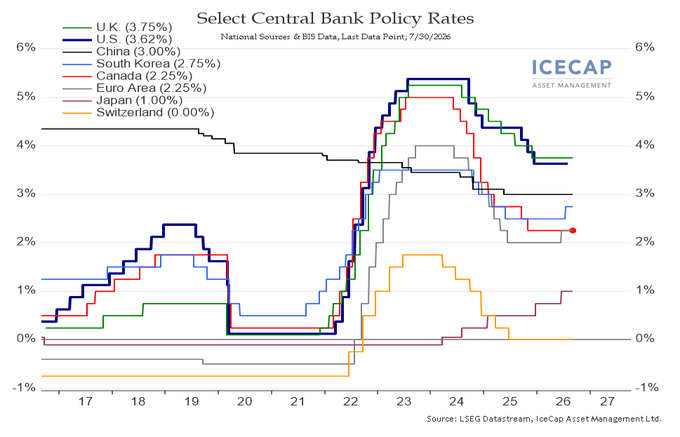
The Bank of Canada has kept its benchmark interest rate at 2.25 per cent, maintaining the same level for a seventh consecutive meeting as renewed U.S. tariffs and the ongoing war in Iran complicate the economic outlook.
The decision, announced Wednesday, was widely anticipated by economists.
Bank of Canada Governor Tiff Macklem said the persistence of the conflict in the Middle East has heightened inflationary risks, particularly as global energy prices remain elevated and continue to fluctuate.
At the same time, a renewed escalation in the trade dispute with the United States could put Canada’s emerging economic recovery under pressure. Macklem warned that the uncertainty surrounding trade policy could encourage businesses to postpone investment and hiring decisions until there is greater clarity over the future trading relationship.
“Monetary policy cannot offset the effects of tariffs or influence global energy prices. What we can do is ensure global developments don’t jeopardize price stability in Canada,” Macklem said in prepared remarks.
The Bank of Canada uses its policy rate to keep inflation under control while supporting economic growth when price pressures remain contained.
Inflation climbed to three per cent in July, following a volatile period for gasoline prices during the spring and summer that was driven in part by the war in Iran.
Economic activity, meanwhile, has begun showing signs of a rebound after stagnating for much of the previous year. Canada’s economy expanded at an annualized rate of 3.3 per cent in the second quarter, although few analysts expect growth to maintain that pace in the current quarter.
The latest trade measures are adding another layer of uncertainty. The United States imposed 50 per cent tariffs on a range of Canadian goods on Aug. 22. Macklem said the Bank of Canada does not anticipate a “large direct impact” on the overall economy from the new duties, although some targeted sectors could face significant pressure.
Canada is preparing a series of retaliatory tariffs on U.S. goods, scheduled to take effect Sept. 8. Those counter-tariffs could raise costs for Canadian businesses. Macklem said that would create an additional inflation risk if companies pass the higher costs on to consumers.
Before the latest round of tariffs, Macklem said Canadian exports had been increasing and there were indications that businesses were adapting to the changing trade environment.
“Overall, the data reaffirm our view of a broadening recovery,” he said.
With the economy developing broadly in line with the Bank of Canada’s forecasts, the governing council decided there was no need to alter the policy rate, Macklem said.
The central bank, however, is leaving the door open to future changes as economic conditions and inflation evolve.
“Governing council will assess the sustainability of the economic rebound and the outlook for inflation, and is prepared to adjust monetary policy as needed,” Macklem said.
Economists reacting to Wednesday’s decision noted that Macklem’s emphasis on renewed inflationary risks could indicate a greater bias toward future rate increases rather than cuts.
Stephen Brown, chief North America economist at Capital Economics, said in a note to clients that the central bank would probably need to see additional improvement in unemployment or economic growth before moving rates higher.
However, with global oil prices showing few signs of easing, Brown said a rate hike at the Bank of Canada’s final meeting of the year in December is now a possibility.
KPMG chief economist Ali Jaffery offered a different assessment. In a note, he said he expects the Bank of Canada to become less concerned about inflation as the risks of weaker economic growth increase in response to escalating tariffs. His forecast remains that the central bank will keep its policy rate unchanged through the end of 2027.
CIBC chief economist Avery Shenfeld said Wednesday’s decision was unsurprising given the uncertainty surrounding the trade dispute.
CIBC sees “little prospect” of any change in the policy rate this year, Shenfeld said, noting that both the U.S. tariff situation and the Iran war could develop significantly over the coming months.