



The container shipping market remains under significant pressure as strong demand for Asian exports continues to support the peak season, while severe weather disruptions and mounting congestion are creating additional strain across major trade lanes, according to the latest Ocean Freight Market Update from DHL Global Forwarding.
The logistics company identified three major developments in the current market: the peak season on the Asia–Americas trade is continuing rather than fading, port congestion has reached a new high, and container shipping lines are gradually beginning to return to the Suez Canal.
The Transpacific peak season started earlier than usual this year and has extended unusually deep into the summer. DHL Global Forwarding said the prolonged period of strong activity is being supported by inventory building ahead of the upcoming holiday season, preparations for China’s “Golden Week” in early October, and the absence of major changes to U.S. tariffs.
Capacity on services to the U.S. East Coast is also being affected by the Panama Canal. Increasing transit and draught restrictions, linked to persistently low water levels, have limited carriers’ ability to add capacity on the route.
Port congestion reaches Covid-era levels
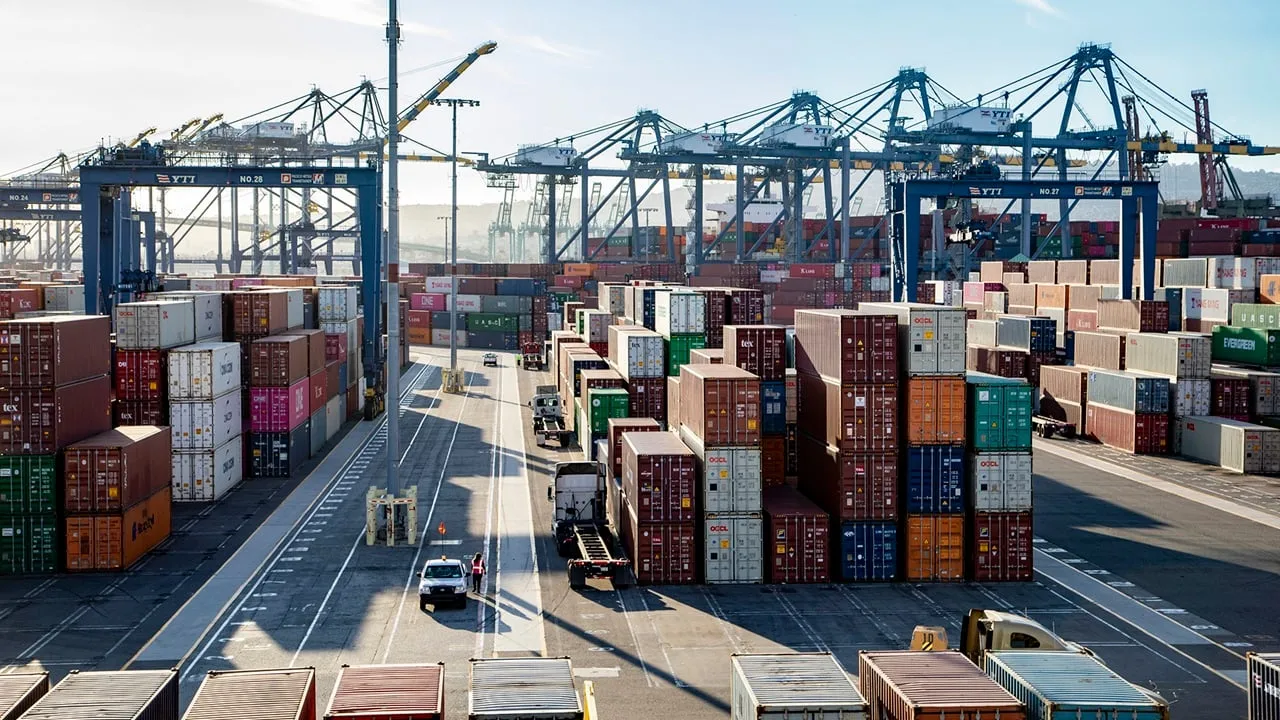
DHL Global Forwarding’s latest assessment points to severe congestion at ports globally with around 3.9 million TEU stuck in ports presently. This figure is on par with the peak of the Covid related disruption in 2022.
China has been especially hard hit by weather-related disruptions. Typhoons in July and August led to closures at key Chinese ports for several days. Only 21% of vessels arriving at Shanghai in July made it to port on time, leading to massive backlogs and ripple effects throughout global shipping networks.
In northern Europe the constraints are of a different kind. Yard capacity is still high and low water levels have impacted connectivity of inland waterways.
Meanwhile, disruption continues in the Middle East, where geopolitical instability continues to be a factor for shipping operations.
Freight rates moving differently by trade lane
DHL Global Forwarding also highlighted a growing divergence between the Asia–Americas and Asia–Europe markets.
The Shanghai Containerized Freight Index (SCFI) is currently 143% higher than a year earlier and stands 36% above the level recorded when the peak season began in June.
On the Asia–U.S. East Coast trade, rates have continued to rise as conditions around the Panama Canal deteriorate. On the U.S. West Coast, rates have stabilised, but at elevated levels. Asia–Latin America services have also returned to the high levels recorded at the beginning of the peak season.
The situation is different on the Asia–Europe trade. According to the DHL Global Forwarding report, rates are continuing to decline as demand eases in line with the normal late-summer, post-peak pattern.
Suez return unlikely to deliver immediate rate relief
Against this backdrop, shippers might have expected the combination of a gradual return to the Suez Canal and the industry’s largest-ever newbuilding orderbook to lead to lower freight rates.
DHL Global Forwarding cautions that such an outcome is unlikely to happen immediately.
The report points to the first meaningful return to Suez Canal routing after two years of diversions, with the route scheduled to be reintroduced on 18% of East–West headhaul sailings. Even without further disruption, however, the report estimates that market normalisation could take between six and 12 months.
“If Houthi ceasefire is upheld, it is realistic to expect that carriers continue to gradually scale up their return to the Suez Canal,” the report said. It also warned that overlapping vessel arrival patterns could temporarily increase congestion and create equipment imbalances at transshipment hubs and gateway ports.
The broader expansion of the container fleet is also expected to be substantial. New vessel capacity is projected to increase fleet size by 9.4% in 2027 and by 15.2% in 2028.
Even so, DHL Global Forwarding does not expect that additional tonnage to automatically translate into lower freight rates in the near term.
The company said new vessel capacity should ease capacity pressures to some extent, but trade-specific peak periods are likely to continue shaping the market, alongside port congestion, differences in demand between trade lanes, and disruptions caused by weather events or geopolitical developments.