



Canadian Pacific Kansas City (CPKC) said its core adjusted earnings per share for the third quarter of 2026 increased 16% year-on-year, helped by increased freight volumes and strong performance in grain and intermodal transportation. The railroad operator’s results, released Wednesday after the market closed, also showed higher revenues from energy, chemicals, plastics and automotive freight, but higher fuel costs pressured operating efficiency.
The Calgary-based company said it produced C$4.22 billion ($3.01 billion) in revenue for the three months ended Sept. 30, up from $2.61 billion a year earlier in its latest earnings release. Core adjusted diluted earnings per share increased to $0.91 from $0.78 and reported diluted earnings per share increased to $0.74 from $0.72. Revenue ton-miles, an indicator of freight volumes, were up 6 percent over the period.
CPKC president and chief executive Keith Creel said the performance demonstrated the strength of the company’s North American network and its commercial momentum in the face of challenging macroeconomic conditions.
“CPKC delivered solid results, driven by momentum across our unrivaled North American network, offsetting macroeconomic headwinds in the quarter,” said Creel. He said the railroad continued to operate efficiently and maintain strong service levels while expanding across major markets, including grain, intermodal and merchandise.
Growth in grain and intermodal fuel segments
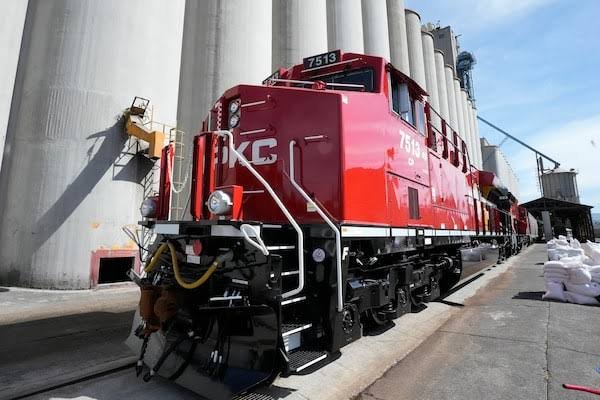
Grain transportation was one of the biggest contributors to quarterly revenue, increasing to $644 million from $500 million in the third quarter 2025. Intermodal revenues also had a good gain, rising to $581 million from $476 million a year earlier.
Other freight segments also saw gains. Energy, chemicals and plastics revenues increased to $544 million from $499 million and automotive revenues increased to $266 million from $244 million. Coal revenue was essentially flat at $181 million.
These results helped boost operating income to $1.06 billion compared with $955 million in the same quarter a year ago. However, the increase in operating income was offset by operating expenses, in particular fuel and employee-related expenses growing at a faster pace.
Fuel prices squeeze operation efficiency
Fuel costs surged to $475 million from $296 million in the same period last year. Compensation and benefits also increased to $507 million from $441 million in the third quarter of 2025.
Higher costs weighed on CPKC’s operating ratio, a key gage of railroad efficiency that compares operating expenses to revenue. Reported operating ratio improved to 64.8% from 63.5% and core adjusted operating ratio improved to 61.9% from 60.7%.
The company also said in its release that higher fuel prices added 1.7 percentage points to the reported operating ratio and 1.9 percentage points to the core adjusted measure, citing the impact of energy costs on operating results for the quarter.
Tax expenses weigh on net income
Net income attributable to controlling shareholders fell to $653 million from $655 million a year earlier helped by stronger operating income.
But earnings per share on a diluted basis advanced, helped in part by a reduction in the weighted-average number of diluted shares outstanding. That fell to 877.6 million from 911.4 million.
Income tax expense rose to $319 million from $211 million. The quarterly tally included a $67 million charge related to Canadian tax reassessments on CPKC’s 2023 purchase of Kansas City Southern. The company also took a $12 million charge for a tax settlement in Mexico.
CPKC also spent $12 million on advisory fees in connection with its analysis and advocacy concerning the U.S. Surface Transportation Board’s review of the proposed Union Pacific-Norfolk Southern merger. The proposed deal would combine two of the largest U.S. railroad companies and has raised questions about what it would mean for the North American freight network.
Declining capital spending improves cash generation
CPKC generated $1.10 billion in cash from operating activities in the quarter compared to $905 million in the comparable period last year.
Meanwhile, expenditure on additions to properties dropped to $437 million from $613 million, suggesting a fall in expenditure on property-related additions. The company also stated it spent $1.02 billion to buy common shares.
“Our disciplined execution and robust commercial pipeline continue to support our confidence in delivering our annual commitments,” said Creel.
Therefore, the quarterly results indicate continued commercial growth across CPKC’s freight network, particularly in grain and intermodal freight. Nevertheless, higher fuel costs, higher taxes and a lower operating ratio continue to impact the company’s financial performance.