




The U.S. diesel market has reached another historic milestone, with a major retail benchmark climbing to an all-time high and little evidence so far that the upward pressure on prices is about to ease.
The latest record came as diesel futures resumed their advance after briefly pulling back late last week, reinforcing expectations that the national average could soon break through the $6-per-gallon threshold.
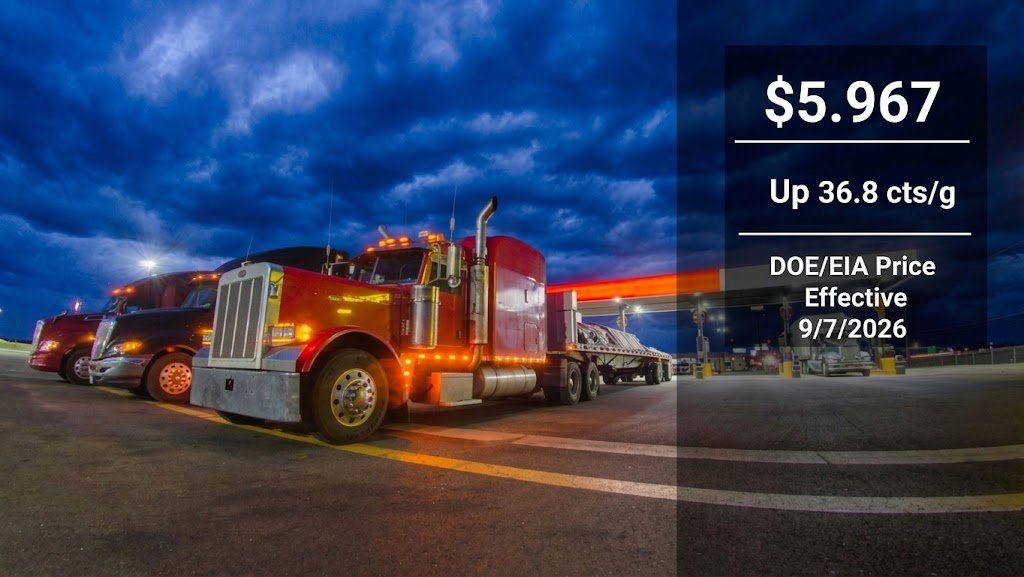
The weekly Department of Energy/Energy Information Administration average retail diesel price jumped 36.8 cents per gallon to $5.967/gallon. The figure was published Wednesday but is effective Monday. Its release was delayed by one day because of the Labor Day holiday. The EIA average is used as the basis for most fuel surcharges.
At the same time, the DTS.USA data series in SONAR, based on information supplied by truckstop.com, stood at $5.94/gallon Wednesday.
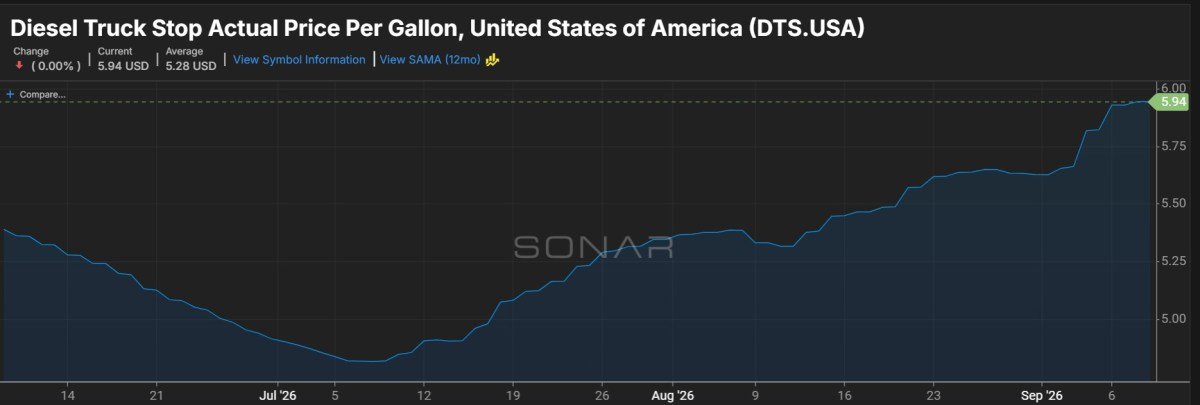
U.S. diesel prices are approaching the $6-per-gallon threshold as retail benchmarks and futures continue to climb.
The daily AAA average retail diesel price had already established an all-time record Friday, when it was published at $5.85/gallon. That surpassed the previous high of $5.82/gallon, recorded in June 2022 following Russia’s invasion of Ukraine.
AAA’s benchmark has continued climbing since then. On Wednesday, it was posted at $5.9424/gallon.
The increase is also being reflected in the futures market. Ultra low sulfur diesel (ULSD) traded on the CME commodity exchange has continued to move higher after suffering a brief two-day decline Thursday and Friday. That retreat erased roughly 15 cents per gallon from the contract, bringing Friday’s settlement down to $4.5402/gallon.
Those lower levels have quickly become a distant memory.
ULSD settled Wednesday at $4.8010/gallon, a gain of 23.32 cents per gallon, or 5.11%. Unless the market experiences a major reversal, a move of that magnitude makes it highly likely that the national average retail diesel price will break through $6/gallon within the next few days.
If the contract were to settle at that level on Wednesday, it would represent the highest settlement ever recorded, with one exception: a dramatic one-day short-covering surge at the end of April 2022 following Russia’s invasion. That rally pushed the settlement to $5.1354/gallon.
The short-covering move was intense enough to send the intraday high to $5.85/gallon at one point the following day.
But that particular surge proved short-lived.
The challenge of making a bearish oil case
For the broader oil market, the argument for a sustained bear market is becoming increasingly difficult to defend. That helps explain why a recent oil forecast from Goldman Sachs attracted considerable attention, even though the investment bank’s commodity projections are routinely closely followed.
Goldman Sachs raised its forecast for oil to $85 per barrel by the end of the year, while putting next year’s forecast at $80 per barrel. Both figures represent increases of $5 from its previous outlook. Brent crude had already crossed the $100-per-barrel mark on Wednesday.
Despite those upward revisions, Goldman also highlighted several factors that could limit the extent of a further price surge.
One of them concerns commercial inventories. Commercial land-based inventories across the Western economies of the OECD, Goldman said, “have so far barely drawn since the war began.”
The report pointed out that most inventory reductions have instead come from stocks on water, strategic inventories such as the Strategic Petroleum Reserve, and inventories in China.
Goldman also expects Middle Eastern suppliers to continue adapting to the disruption. Its outlook calls for production to gradually recover during the second half of 2027, as dark flows increase further and pipelines return to service in late 2027.
At the same time, the report identified several potential upside risks for prices.
Among them is a scenario in which Brent crude could climb to $120 per barrel if average Gulf production remains 4 million barrels per day below pre-war levels, compared with the 500,000 barrels per day reduction assumed in Goldman’s base case.
The estimate of roughly 4 million barrels per day of current lost Gulf production is broadly consistent with the general consensus on current output versus a pre-war level of approximately 20 million barrels per day.
Currie remains firmly bullish
Jeffrey Currie, the former head of Goldman Sachs’ commodities research team, has spent months making highly bullish calls on the energy market. Those forecasts have increasingly begun to materialize, particularly in diesel.
In a recent CNBC interview, Currie pointed to several product-specific disruptions that are pushing gasoline and diesel prices higher much faster than crude oil itself.
Among the factors he highlighted is the loss of approximately 3 million barrels per day of refining capacity in the Arab Gulf nations as a result of military action.
He also pointed to the reluctance to move gasoline and diesel out of the Gulf, describing the situation by saying that “the one with gasoline is a sitting time bomb.”
Currie argued that the broader crude market remains bullish because the traditional “insurance policies” supporting supply are no longer available.
As he explained, “you don’t have the insurance policies left anymore,” while there is still no clear indication of when the Strait will reopen or what volumes will be able to pass through it once it does — whether 13 million barrels per day or 15 million barrels per day.
Those supply “insurance policies” include withdrawals from strategic petroleum reserves. Strategic stock releases have helped explain why private inventories have not fallen as sharply as Goldman Sachs might otherwise have expected.
For Currie, however, the fundamental issue remains the amount of production that has been shut in.
“All I do care about is six to 7 million barrels per day of production is shut in there,” he said. “That’s not going to change anytime in the near future.”
With retail benchmarks already approaching $6 per gallon and ULSD futures accelerating again, the diesel market is therefore entering another critical phase. The combination of constrained supply, disrupted refining capacity, uncertainty surrounding Gulf production and continued geopolitical risk is keeping pressure firmly on prices.