



Emirates SkyCargo delivered a solid performance in its financial year ending March 31, supported by fleet expansion, network growth and stronger freighter activity.
Cargo revenues increased slightly to AED16.2bn, compared with AED16.1bn the previous year. Cargo volumes rose 2.5% year on year to 2.4m tonnes.
The all-cargo business performed particularly strongly, with volumes up 11.7% to 637,000 tonnes. Scheduled cargo volumes declined slightly by 0.4% to 1.8m tonnes.
General cargo, fresh produce and charter operations were highlighted as key contributors to volume performance.
However, cargo yield per freight tonne km fell 3% year on year, affected by market pressure, tariff impacts on e-commerce and increased industry capacity in some markets.
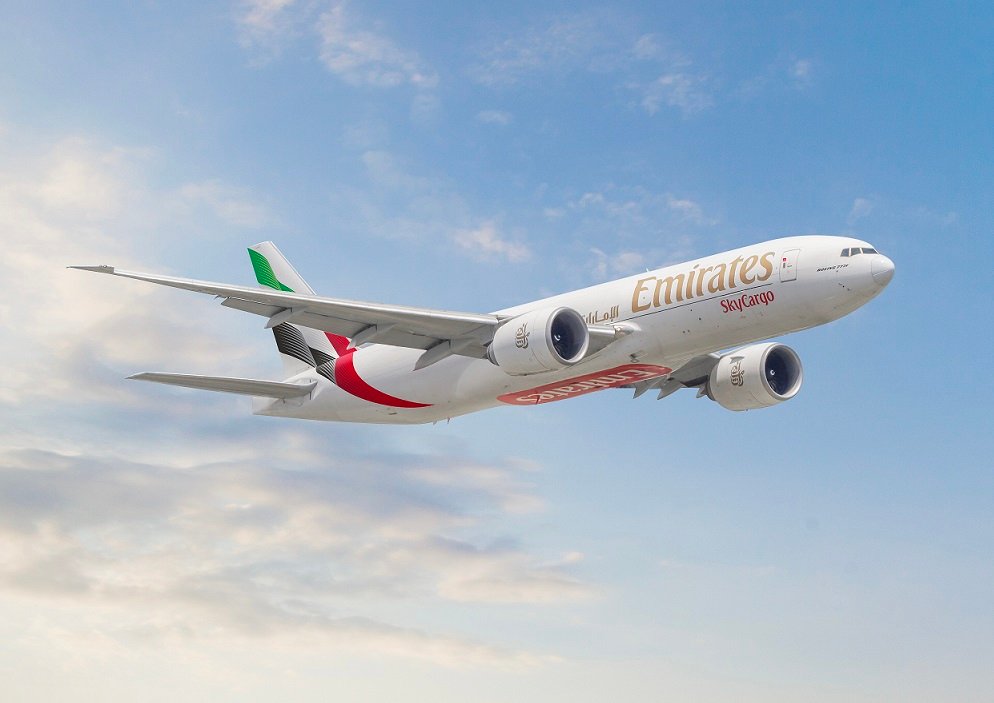
During the year, Emirates SkyCargo took delivery of five Boeing 777 freighters, increasing all-cargo capacity by 13%. Two older freighters were retired, while the airline also used an average of two additional wet-leased Boeing 747 freighters compared with the prior year.
At the end of March, the freighter fleet stood at 13 Boeing 777Fs, with eight more aircraft pending delivery. Work has also started on converting one passenger 777 into a freighter.
The carrier expanded its freighter network to 44 points, adding Bangkok, Budapest, Liege and Tokyo Narita, while also increasing frequencies and growing its trucking network.
Emirates SkyCargo also launched Emirates Courier Express, a door-to-door cross-border delivery solution, and a new Aerospace and Engineering service suite for time-critical aviation, defence, engineering and space components.
Dnata, the Emirates Group’s ground handling business, also reported growth. Cargo handling revenues rose 10% to AED3.4bn, while volumes increased 2.1% to 3.2m tonnes.
The improvement was supported by pricing, aircraft mix optimisation, the acquisition of Wymap Group, e-commerce growth in the UAE and UK, and new contracts across international markets.
In Amsterdam, dnata opened a fully automated cargo facility with annual capacity of 600,000 tonnes, representing a €70m investment.