



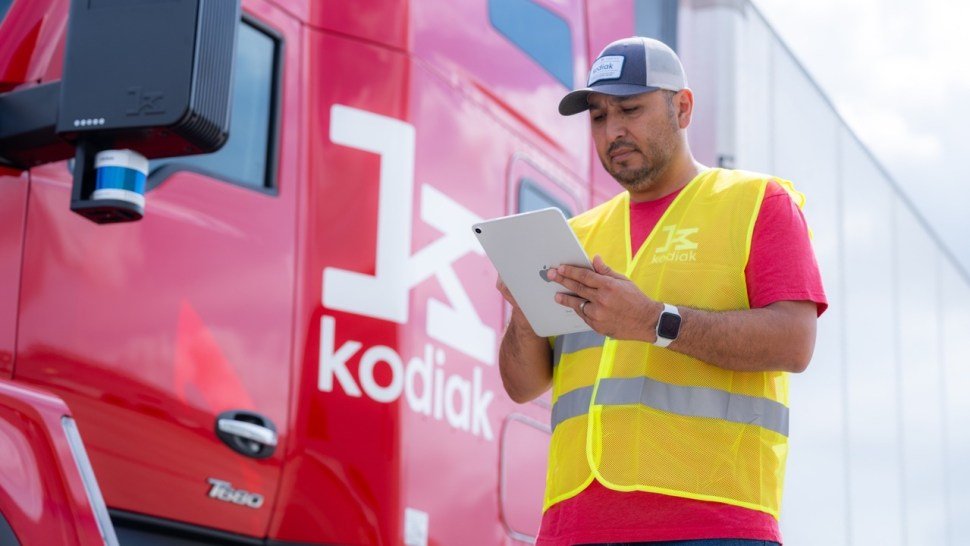
PrePass and Kodiak AI are teaming up to connect autonomous trucks with the roadside inspection and enforcement infrastructure already used by commercial fleets.
Announced Monday, the collaboration routes safety inspection records from Kodiak’s driverless trucks through the PrePass platform and into state screening and enforcement systems. The implementation starts immediately in Texas and Louisiana.
The system relies on infrastructure that commercial carriers already use for weigh station bypasses and toll payments. When a Kodiak truck approaches a participating location, its inspection information is transmitted to enforcement personnel, who review the records before authorizing the bypass. Officers can also provide additional instructions when necessary.
The final decision remains with the state.
Kodiak (Nasdaq: KDK) is targeting the launch of commercial driverless operations on public highways by the end of 2026, the same timeline the company outlined in May alongside its first-quarter results. Kodiak became a public company in 2025 through a de-SPAC merger with Ares Acquisition Corp. II.
“The next barrier to scaling driverless trucking isn’t inside the truck. It’s the infrastructure around it,” said Chas Wurster, chief technology officer of PrePass.
By working with Kodiak, Wurster said, PrePass is aiming to move driverless trucking into real-world commercial operations by connecting state agencies, roadside infrastructure and trusted vehicle data within systems already operating at scale.
A dedicated inspection process for autonomous trucks
The inspection records being transmitted through PrePass come from the Commercial Vehicle Safety Alliance’s Enhanced Commercial Motor Vehicle Inspection Program, which was developed for trucks equipped with automated driving systems.
Under the program, a CVSA-trained inspector confirms that an autonomous truck has no safety defects before it begins driverless operation. Once cleared, the authorization remains valid for up to 24 hours.
This is not the first time Kodiak has tested the concept. In 2023, the company piloted a similar approach in Texas with Drivewyze, another provider of weigh station bypass services and a competitor to PrePass.
“CVSA welcomes this collaboration between PrePass and Kodiak AI to support the implementation of CVSA’s Enhanced Commercial Motor Vehicle Inspection Program for autonomous trucks,” said CVSA Executive Director Collin Mooney.
As commercial vehicle technology evolves, Mooney added, inspection and enforcement procedures must evolve as well while continuing to prioritize transportation safety.
A network that could extend beyond Texas and Louisiana
The PrePass bypass network currently covers 581 sites across North America. For state agencies, that footprint provides a way to process autonomous trucks through established roadside systems rather than creating an entirely separate inspection process for driverless vehicles.
That existing infrastructure could also allow the Kodiak-PrePass system to expand beyond Texas and Louisiana as Kodiak moves toward broader commercial deployment.
Kodiak’s business covers long-haul trucking, industrial trucking and defense applications. The company began putting its driverless technology into customer-owned semi-trucks in 2024.
Its publicly identified commercial partners and customers include Werner Enterprises, C.R. England, Roehl Transport, Atlas Energy Solutions, Bridgestone, General Dynamics Land Systems and IKEA.
“Launching driverless service is not just about building technology. It’s about building a solution that works in the real world,” said Don Burnette, founder and CEO of Kodiak AI.
Burnette said the PrePass integration will allow Kodiak to provide critical information to commercial vehicle enforcement agencies, maintain compliance with safety requirements and expand the Kodiak Driver across the United States.
The practical challenge is straightforward: a driverless truck cannot stop and speak directly with an inspector. By moving Kodiak’s 24-hour CVSA clearance through the PrePass network, Texas and Louisiana can process autonomous trucks within existing weigh station systems.
For Kodiak, solving that roadside infrastructure issue is an important piece of the preparation required ahead of its planned driverless commercial launch by the end of 2026.