



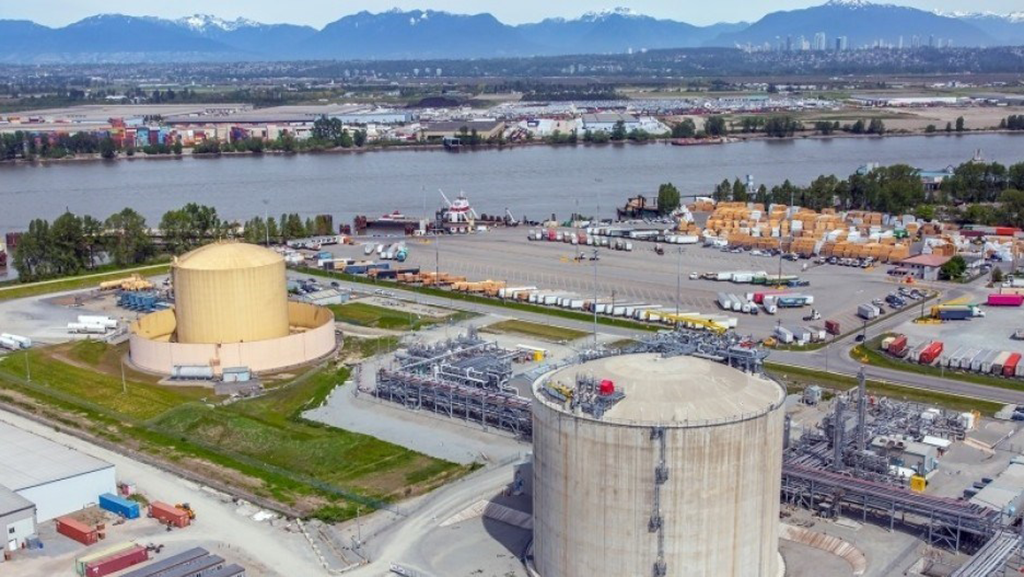
FortisBC is preparing to launch one of British Columbia’s largest energy infrastructure projects, with plans to invest nearly $6 billion to transform Tilbury Island into a major liquefied natural gas (LNG) production and marine fueling hub for Canada’s West Coast.
Construction on the expansion is expected to begin in early to mid-2027, significantly increasing the facility’s LNG production capacity by 250% while strengthening supplies for both residential heating and the growing marine fuel market.
The investment is built around three interconnected projects currently progressing through regulatory approvals: Tilbury Expansion Phase 1B, the construction of the Tilbury Marine Jetty by Fortis subsidiary Tilbury Pacific, and Tilbury Expansion Phase 2.
FortisBC confirmed that no general construction contracts have been awarded yet, as engineering work and procurement planning remain underway. The company said additional information will be released once project designs and procurement schedules are finalized.
Originally commissioned in 1971, the Tilbury LNG facility serves as one of British Columbia’s two natural gas storage sites used to help meet winter residential heating demand. The plant underwent its first major expansion in 2018 with the completion of Phase 1A, which added new storage capacity.
In recent years, however, the site has taken on a broader role as an LNG fueling center, supplying BC Ferries, Seaspan Ferries, and, more recently, LNG bunker vessels serving ships operating along the British Columbia coastline.
The upcoming Phase 1B expansion will further strengthen that role by adding a dedicated marine loading jetty capable of supporting ship-to-ship LNG bunkering.
The Vancouver Fraser Port Authority said LNG has become one of the first alternative marine fuels available at commercial scale for the shipping industry, with cruise ships, cargo vessels and container ships increasingly adopting LNG bunkering services since Seaspan Energy became the Port of Vancouver’s first accredited LNG supplier in late 2024.
Valued at approximately $2.2 billion, Phase 1B received approval from the British Columbia government on July 24, allowing the project to proceed without requiring a Certificate of Public Convenience and Necessity under the B.C. Utilities Commission Act.
FortisBC President and CEO Roger Dall’Antonia said the expansion will enable the company to produce more lower-carbon LNG to fuel the next generation of ships visiting Canada’s West Coast while highlighting FortisBC’s partnership with the Musqueam Indian Band.
The project will add approximately 0.65 million tonnes of annual liquefaction capacity, along with a new 230-kilovolt transmission line, the Tilbury Marine Jetty, and associated onshore pipeline infrastructure connecting the marine terminal to the LNG plant.
According to the British Columbia government, construction is expected to generate more than $800 million in gross domestic product and support an average of 1,100 jobs annually during the four-year construction period. Operations are targeted to begin in 2031.
The Tilbury Marine Jetty will replace the current practice of transporting LNG by truck and barge before loading vessels. Instead, LNG will be transferred directly from the plant through a dedicated pipeline to ships via a new marine loading platform equipped with a temporary floating bunker berth, mooring dolphins and an access trestle.
The facility will be capable of serving LNG bunker vessels, barges and larger ocean-going ships. Environmental and federal permits for the jetty were obtained in 2024 and construction is expected to begin in early 2027 with operations starting around 2029.
The largest part of the total investment is the Tilbury Expansion Phase 2, which has a projected cost of between $3 billion and $3.5 billion and involves the addition of a new LNG storage tank with a capacity of 142,400 cubic metres, roughly doubling the site’s storage capacity.
Phase 2 will also add up to 2.5 million tonnes of annual liquefaction capacity, with development to be in multiple stages depending on market demand.
Documents filed with the B.C. Environmental Assessment Office (EAO) say the project could boost the province’s economy by about $1.7 billion during construction.
The public consultation closed on July 27 and the environmental review is now in its final assessment phase, with the EAO expected to release its final report later in 2026.
While the expansion is predicted to deliver economic benefits, it is still met with opposition from a number of municipalities and environmental groups. Richmond-Steveston MLA Kelly Greene has also voiced concerns about the safety of the project, saying that while mitigation measures may reduce potential dangers, there are still unanswered questions about the impact of a possible incident.
If approved, the combined Tilbury developments would create one of North America’s largest LNG marine fueling hubs and would bolster British Columbia’s position in the expanding market for lower-emission marine fuels, and extend the province’s energy infrastructure for generations to come.