



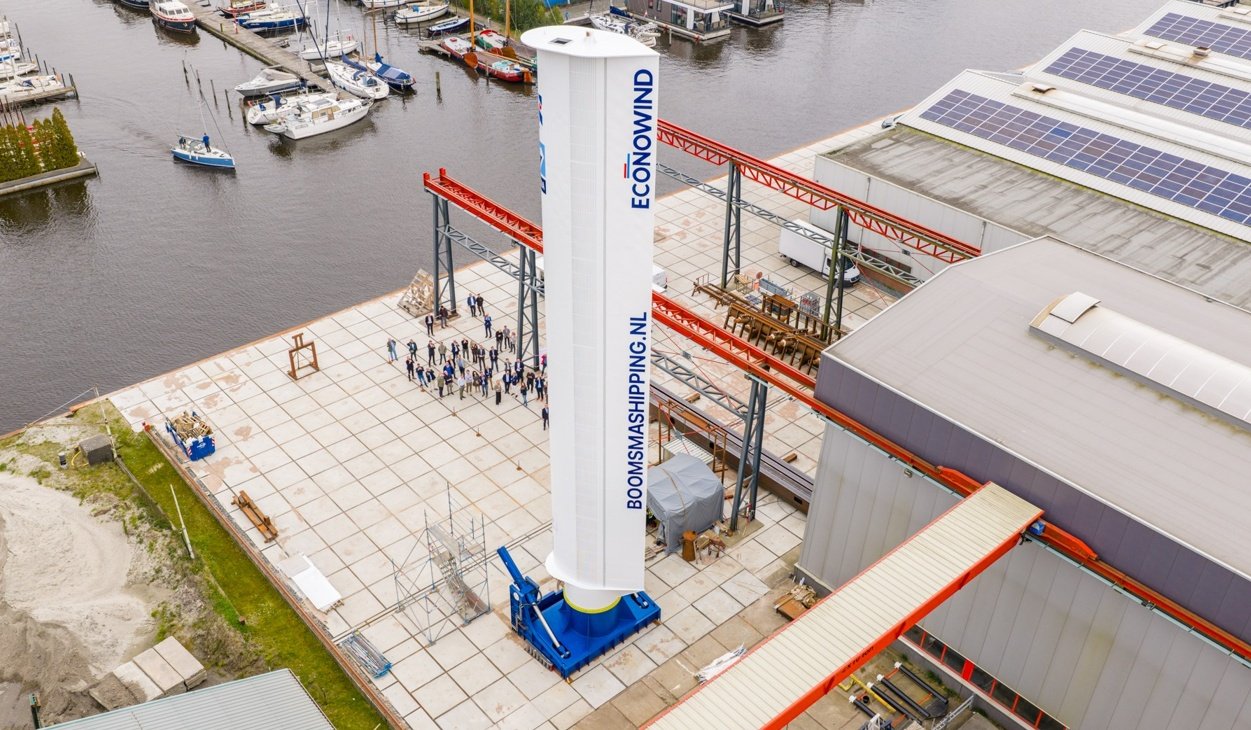
The sharp rise in bunker prices is accelerating interest in wind-assisted propulsion, according to Dutch developer Econowind, which has just launched its new Series 5 30m suction sail aimed at the deepsea market.
With clean diesel bunkers trading around the $1,000 per tonne level and IFO380 also climbing, Econowind said shipowners are showing stronger interest in fuel-saving wind technology, even if some remain cautious about investment during an economic slowdown.
Chief commercial officer Chiel de Leeuw said the market environment has improved the business case considerably. In some instances, the return on investment for wind-assisted propulsion has now fallen to less than one year.
The new 30m Series 5 suction sails will be built in Asia, closer to major newbuilding yards. Unlike the earlier aluminium-based Series 3 units, which weighed 7.5 tonnes, the new steel structures will weigh around 65 tonnes.
The first Series 5 unit is scheduled to be installed this summer on a vessel operated by Boomsma Shipping. Econowind said the order reflects shipowner confidence in VentoFoils as a practical way to cut fuel consumption.
Boomsma has already installed earlier generations of suction wing technology on its ships. Johan Boomsma said that with fuel prices rising, the next step was a logical one. He added that energy efficiency is high on the company’s agenda and that all eight of its newbuild vessels will be delivered wind-ready. The first of those, Frisian Future, is due to enter service in May.
Econowind said it is preparing to move deeper into the larger vessel market, building on 50,000 operating hours across 64 installations on 25 ships. Now in its tenth year, the company believes that both regulation and economics are increasingly favouring wind-assisted systems, while public pressure will continue to push shipping toward greater efficiency.
De Leeuw said wind propulsion offers direct energy from the wind without conversion losses, and estimated savings of around 15% with limited crew intervention.
The suction sails use sensors to identify the best wind angle, meaning the crew largely switch them on and then leave the system to operate until it is turned off again.
A visit to Econowind’s facility near Amsterdam illustrates how far the company has come from the original prototype its founder once attached to a car trailer to test the concept. The modern units are now produced with five electric fan motors and no external moving parts.
Earlier designs used a movable leading edge to help guide airflow and increase sail performance.
The company’s innovation programme is continuing, supported by an in-house wind tunnel used to test future designs.
That development work has also attracted interest from container shipping. Ocean Network Express has been trialling Econowind’s “wind in a box” technology, using 10m suction sails on its 13-year-old 1,042 teu container vessel Kalamazoo.
ONE has not released the trial data, but discussions between the two companies on further development are understood to be continuing. Wider adoption of wind-assisted propulsion in container shipping has been limited by the lack of available deck space.