



Escalating tensions in the Middle East are raising fears that the global economy could face a major energy shock if disruptions to oil and gas supply continue.
What initially appeared to be a short-lived conflict is increasingly affecting global energy infrastructure and maritime transport routes.
Loading operations at Iran’s Kharg Island terminal, responsible for around 90% of the country’s crude exports, have been halted following heavy bombing of energy facilities by the United States.
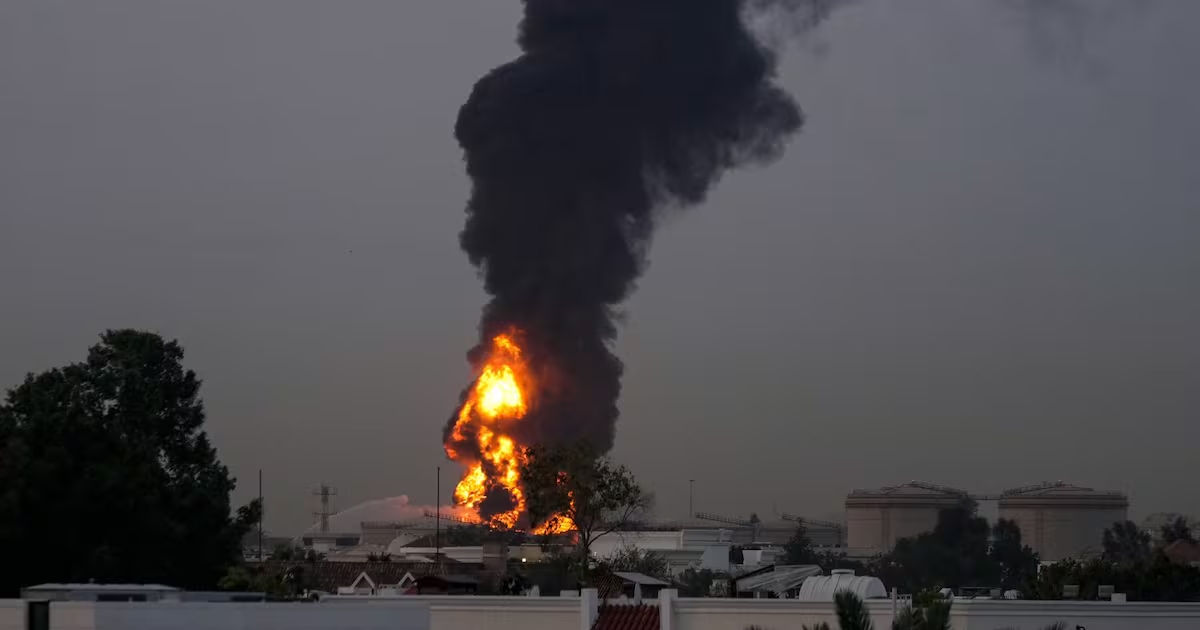
At the same time, QatarEnergy has suspended operations at Ras Laffan, the world’s largest LNG export terminal, after repeated drone attacks. The state-owned company declared force majeure on several supply contracts.
Ras Laffan alone supplies roughly 20% of global LNG exports, with China as its largest customer.
Even if hostilities were to end immediately, industry experts warn that restoring operations could take several months, given the complexity of the infrastructure involved.
The conflict has also triggered a dramatic increase in maritime insurance costs. War risk premiums for ships operating near the Strait of Hormuz have increased by up to twelve times, with insurers now offering coverage primarily on a single-voyage basis.
Traffic through the Strait has collapsed as a result. According to Clarkson Research, daily ship transits have dropped from around 125 vessels to just five, with most voyages heading out of the Gulf rather than entering it.
Only three tankers navigated the Strait last weekend, compared with the usual figure of about 40 ships.
Some shipowners are questioning whether the risks and insurance costs now outweigh the potential profits of operating in the region.
War risk coverage alone can reach 3% of a vessel’s hull value, equivalent to roughly $6–7 million for a modern LNG carrier or $3–4 million for a VLCC.
Meanwhile, analysts remain sceptical about the effectiveness of a $20 billion insurance support plan proposed by the Trump administration, which aims to provide war-risk coverage through the US International Development Finance Corporation.
Major insurers, including Chubb, are expected to play a central role in the initiative.
Beyond the shipping sector, the consequences are spreading across global industries. According to S&P Global, sectors including agribusiness, chemicals, metals, mining, oil and gas, and shipping are already feeling the impact.
If supply disruptions persist, analysts warn that higher input costs and weaker demand could ripple across a much wider range of industries worldwide.