Business Nov 4, 2026
GXO Logistics posts $3.6 billion in Q3 revenue as new contract wins accelerate
Organic revenue growth reaches its strongest level in more than three years, while declining operating income and cash flow weigh on financial performance.
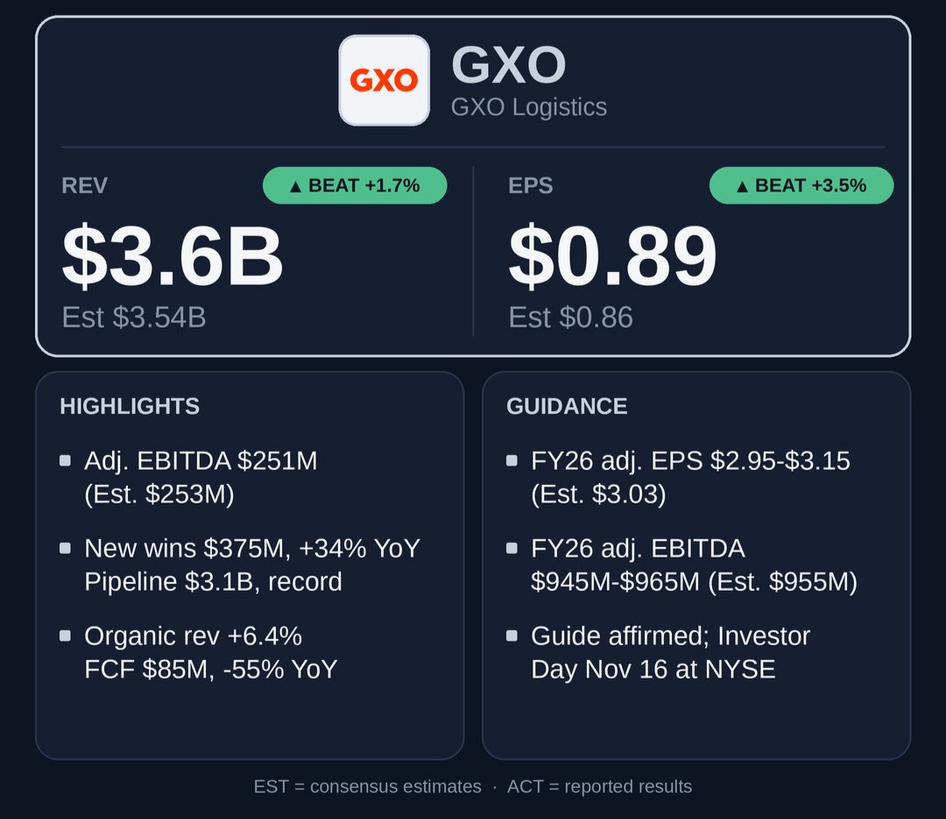
GXO Logistics reported third-quarter 2026 revenue of $3.59 billion, an increase of 5.7% from the prior-year quarter. The results reflect higher demand for outsourced logistics services, backed by a growing number of new contracts and an expanding sales pipeline that has reached an all-time high.
The Greenwich, Conn.-based contract logistics provider (NYSE: GXO) said Tuesday organic revenue rose 6.4% in the three months ended Sept. 30. This is the company’s best organic growth rate in more than three years.
"New business development also began to take off. The company signed $375 million of new contracts in the quarter, up 34% year-over-year. For the second quarter in a row, contract wins were more than 30% higher than the same period last year.
At the same time, the company's sales pipeline rose to a record $3.1 billion, up more than 30% from a year ago. The number indicates that there is still a demand for outsourced warehousing and distribution and general supply chain management solutions.
CEO Patrick Kelleher said the progress reflects the company’s strategic direction over the past year, adding that the new strategy is beginning to yield tangible results. GXO is winning more opportunities across its core markets and targeted growth industries, while getting better at converting commercial opportunities into revenue, he said.
Strong commercial momentum vs. weaker operating performance
GXO’s third quarter results indicated softening on a number of profitability and cash flow metrics, despite higher revenue and contract activity.
Net income was $65 million, compared with $60 million in the third quarter of 2025. Diluted earnings per share increased to $0.56 from $0.51.
Adjusted diluted earnings per share were up as well, to $0.89 from $0.79. Adjusted earnings before interest, taxes, depreciation and amortization (EBITDA) was flat at $251 million.
But operating income went the other way, to $96 million from $118 million a year earlier. The adjusted EBITDA margin also shrunk from 7.4% to 7%.
Cash generation was much weaker. Operating cash flow fell to $156 million from $232 million in the same quarter of 2025. Free cash flow fell to $85 million from $187 million.
"Operating expenses were elevated, adding to the pressure. Direct operating costs rose to $3.06 billion from $2.86 billion in the same quarter a year ago, outpacing revenue growth and weighing on operating profitability.
GXO's third-quarter financial results: 2026 versus 2025
The following figures cover the three months ended September 30. Financial amounts are expressed in millions of dollars, except per-share data and percentages.
Financial metric | Q3 2026 | Q3 2025 | YoY change |
|---|---|---|---|
Total revenue | $3,590 | $3,395 | +5.7% |
Organic revenue growth | 6.4% | — | — |
Operating income | $96 | $118 | -18.6% |
Operating margin | 2.7% | 3.5% | -0.8 pp |
Net income | $65 | $60 | +8.3% |
Diluted EPS | $0.56 | $0.51 | +9.8% |
Adjusted diluted EPS | $0.89 | $0.79 | +12.7% |
Adjusted EBITDA | $251 | $251 | 0.0% |
Adjusted EBITDA margin | 7.0% | 7.4% | -0.4 pp |
Adjusted EBITA | $163 | $164 | -0.6% |
Operating cash flow | $156 | $232 | -32.8% |
Free cash flow | $85 | $187 | -54.5% |
Capital expenditures | $74 | $144 | -48.6% |
Source: GXO Logistics. Third-quarter results for the three months ended September 30. Financial amounts in millions of dollars, except per-share data and percentages.
Increasing share of new contracts in strategic sectors
GXO’s commercial growth is increasingly coming from industries deemed strategic priorities. The company has won more than $1 billion in new business in the first nine months of 2026, putting it on track to match its total contract wins for all of fiscal 2025 with one quarter left in the year.
About 40% of the new contracts were in strategic growth areas such as aerospace and defense, technology, industrial operations and life sciences.
The company’s consumer electronics and technology units performed particularly well. The segment’s revenue was $498 million in the third quarter, up 18.6% from $420 million in the year-ago quarter.
Industrial and manufacturing activities produced $405 million, rising 4.9% year over year.
Omnichannel retail was GXO's largest customer segment, generating $1.69 billion of revenue, an increase of 2.7%.
Food and beverage was the lone one of the highlighted segments to see a decrease. Revenue fell 5.4% to $351 million.
The United Kingdom remains GXO’s largest market
Geographically, the United Kingdom continued to be the company’s biggest revenue market. GXO generated $1.75 billion there in the quarter, an increase of 7.6% from the third quarter of 2025.
The United States also saw a positive increase. U.S. market revenues of $846 million compared with $801 million for the same period last year, an increase of 5.6%.
These results further demonstrate the importance of GXO’s current geographic markets to its overall growth.
No change to full-year 2026 financial guidance
GXO maintained its financial guidance for the full 2026 financial year despite the worsening of operating margins and cash generation.
The company still expects:
Organic revenue growth: 4% to 5% range.
Adjusted EBITDA of $945 million to $965 million.
Adjusted diluted earnings per share of between $2.95 and $3.15.
Cash flow conversion free: between 30% and 40%.
The nine-month results add more color to this guidance. GXO revenue was $10.33 billion in the first nine months of 2026 compared to $9.67 billion in the first nine months of 2025, an increase of 6.8%.
For the first nine months, Adjusted EBITDA was $670 million, compared to $626 million a year ago.
The company also went on with its share buy-back program. In the third quarter, GXO bought back $84 million of its common stock, increasing total buybacks so far this year to $100 million.
As of Sept. 30, GXO had $340 million in cash and cash equivalents and its debt was about $2.8 billion.
The company set its third-quarter earnings conference call for Wednesday at 8:30 a.m.
Increasing demand brings profitability into focus
GXO’s latest results show two different trends in its contract logistics business. First, faster contract wins, improved organic revenue growth and a record sales pipeline indicate rising demand for outsourced supply chain operations.
In contrast, a shrinking operating profit, tighter margins and a steep fall in free cash flow show the difficulty of turning commercial growth into better financial returns.
Hence, the company’s ability to manage operating costs while turning its growing contract pipeline into profitable revenue will be a key factor to watch for when evaluating its performance over the coming quarters.
END OF REPORT