



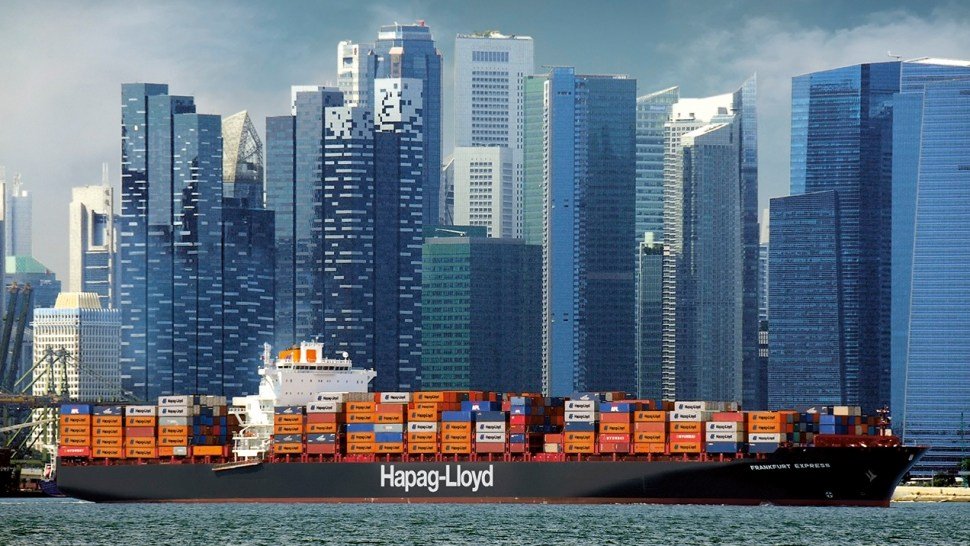
Hapag-Lloyd Chief Executive Rolf Habben Jansen says container shipping demand has held up better than expected, even as conflict in the Middle East continues to disrupt routes, push up operating costs and complicate decisions over when carriers can safely return to the Red Sea.
In recent public appearances and communications with customers, Habben Jansen has described the current operating environment as increasingly difficult to predict, with the Middle East remaining “very strained and fluid.” Hapag-Lloyd has suspended vessel transits through the Strait of Hormuz, citing the safety of its crews and employees as regional security risks continue to influence vessel deployment decisions.
The disruption has also contributed to sharp freight-rate volatility while increasing costs across carrier networks. Hapag-Lloyd said bunker fuel, insurance, container handling and inland transportation expenses have all risen. During the period covered by the company’s June customer call, disruption-related costs were running at approximately $50 million to $60 million per week.

Despite those pressures, Habben Jansen has maintained a relatively constructive assessment of underlying demand. In an August interview with CNBC, he described the resilience of container shipping as “surprisingly strong,” even as carriers dealt with continued turmoil in the Middle East and operational problems such as low water levels on the Rhine.
He has similarly argued that higher tariffs could reshape cargo flows without bringing international trade to a standstill. Tariffs in the 15% to 20% range are “not great” and weigh on global commerce, Habben Jansen said in comments reported earlier this month, but “that doesn’t stop global trade.”
According to Habben Jansen, market demand has performed better than expected following the volatility seen earlier in the year. At the same time, the pace of freight-rate declines has slowed.
A broader operational shift back toward the Red Sea and Suez Canal would nevertheless have major consequences for the container market. Bringing large numbers of vessels back from the longer Cape of Good Hope routing would shorten voyages and effectively return vessel capacity to the market.
Gemini Cooperation partners Hapag-Lloyd and Maersk (OTC: AMKBY) have already announced that four additional services are moving back to Suez Canal routings after operating on longer voyages around Africa.
The changes cover two Asia-Mediterranean services, one Asia-North Europe service and one Indian subcontinent-Europe rotation. According to analyst Lars Jensen, Gemini has now normalized three of its four Asia-Mediterranean services and one of its four Asia-North Europe services.
The routing changes come as carriers attempt to support weakening rates on European services while congestion continues to disrupt major ports. At the same time, Houthi rebels in Yemen have stepped up attacks on Saudi targets along the Red Sea.
Taken together, Habben Jansen’s comments point to an industry where cargo demand remains broadly supportive despite tariffs and changing sourcing patterns reshaping individual trade lanes.
The immediate uncertainty, however, remains tied to security. The ability of shipping lines to restore Red Sea services safely, and the speed at which ports and carrier networks can accommodate the resulting changes in vessel schedules and available capacity, will remain key factors for the market.
Hapag-Lloyd revisits Zim transaction
Hapag-Lloyd is also revising its proposed $4.2 billion acquisition of Zim, with the company placing greater emphasis on restructuring the transaction to address Israeli security concerns while maintaining its expectation that the deal can still close by the end of the year.
In an announcement on Sept. 7, Habben Jansen said Hapag-Lloyd and its partners had taken into account concerns raised by Israeli government agencies and were working on an improved proposal.
“We have listened carefully to the needs raised during our discussions with the Israeli government and the relevant authorities. Together with our partners, we are now developing an improved proposal designed to further strengthen Israel’s maritime security and independence.”
In comments reported Sept. 15, Habben Jansen said Hapag-Lloyd expects the combination with Zim to generate annual synergies of between $300 million and $500 million.
If completed, the combined operation would have more than 400 vessels, over 3 million TEUs of capacity and annual volumes exceeding 18 million TEUs.
However, the transaction would not be enough to move Hapag-Lloyd ahead of China’s Cosco (1919.HK) as the world’s fourth-largest container shipping line.