



Happy Returns has expanded its U.S. network to 10,000 drop-off locations, strengthening its position in a reverse logistics market that is increasingly shifting toward consolidated returns.
The company, owned by United Parcel Service, said it has added 1,700 new sites through Annex Brands and PackageHub Business Centers, extending a footprint that already includes UPS Stores, Staples and Ulta Beauty outlets.
For partner retailers, the model brings not only return-related activity but also additional foot traffic and transaction revenue.
According to Happy Returns, 79% of the U.S. population now lives within five miles of one of its Return Bar locations, up from 76% previously. More than one quarter of Americans now live within a mile of a drop-off point.
Chief operating officer Juan Hernandez Campos said the expansion is helping close geographical gaps, especially in states where consumers depend more heavily on cars than in dense urban areas. The company believes easier access encourages shoppers to return items more quickly, allowing retailers to put goods back on sale sooner.
The scale of the returns market remains considerable. A joint report from the National Retail Federation and Happy Returns estimated that 19.3% of online line items in the U.S. were returned in 2025. Retailers also said online return rates are 21% higher than overall return rates.
Most e-commerce returns still follow a traditional parcel model, in which the retailer issues a shipping label and items are sent back individually through parcel networks to fulfilment centers. That model remains more common among smaller merchants.
However, according to Chris Sheridan, director of supply chain services at parcel consultancy LJM and a former UPS executive with 34 years at the company, consolidation is increasingly becoming the dominant model for larger retailers.
He said returns are no longer one-size-fits-all. Big retailers are increasingly routing returned goods through consolidation networks first and then shipping them back in bulk, with the main objective being lower cost, better processing efficiency and more scalable reverse logistics.
Happy Returns is not alone in moving in this direction. Platforms such as Loop Returns and Narvar are also building return drop-off networks where items are sorted and shipped back in pallets or reusable containers.
FedEx launched its own no-box, no-label consolidated returns service, Easy Returns, last spring. It now operates around 3,000 drop-off points through FedEx Office and Kohl’s. Major retailers including Target, Walmart and Kohl’s are also using stores and regional hubs to consolidate returns before moving them in bulk. Amazon likewise offers boxless returns through physical drop-off points.
Happy Returns says its model is built around a speed-versus-cost trade-off. By using UPS’s integrated logistics network, the company says a consumer return can reach a retailer in as little as 3.6 days, with an average transit time of seven days across all customers.
Happy Returns, which pioneered QR-code returns and was acquired by UPS in 2023, now manages returns for hundreds of retailers, including Gap, OluKai, Under Armour and Shein.
Before launch, the company integrates custom software into partner systems, provides training to store associates and phases locations into the network over time.
At store level, the process begins with staff scanning the barcode, physically verifying the return and issuing an immediate refund. In the background, an AI-based fraud detection system applies behavioural risk scoring using internal data and retailer data linked to the shopper’s return history.
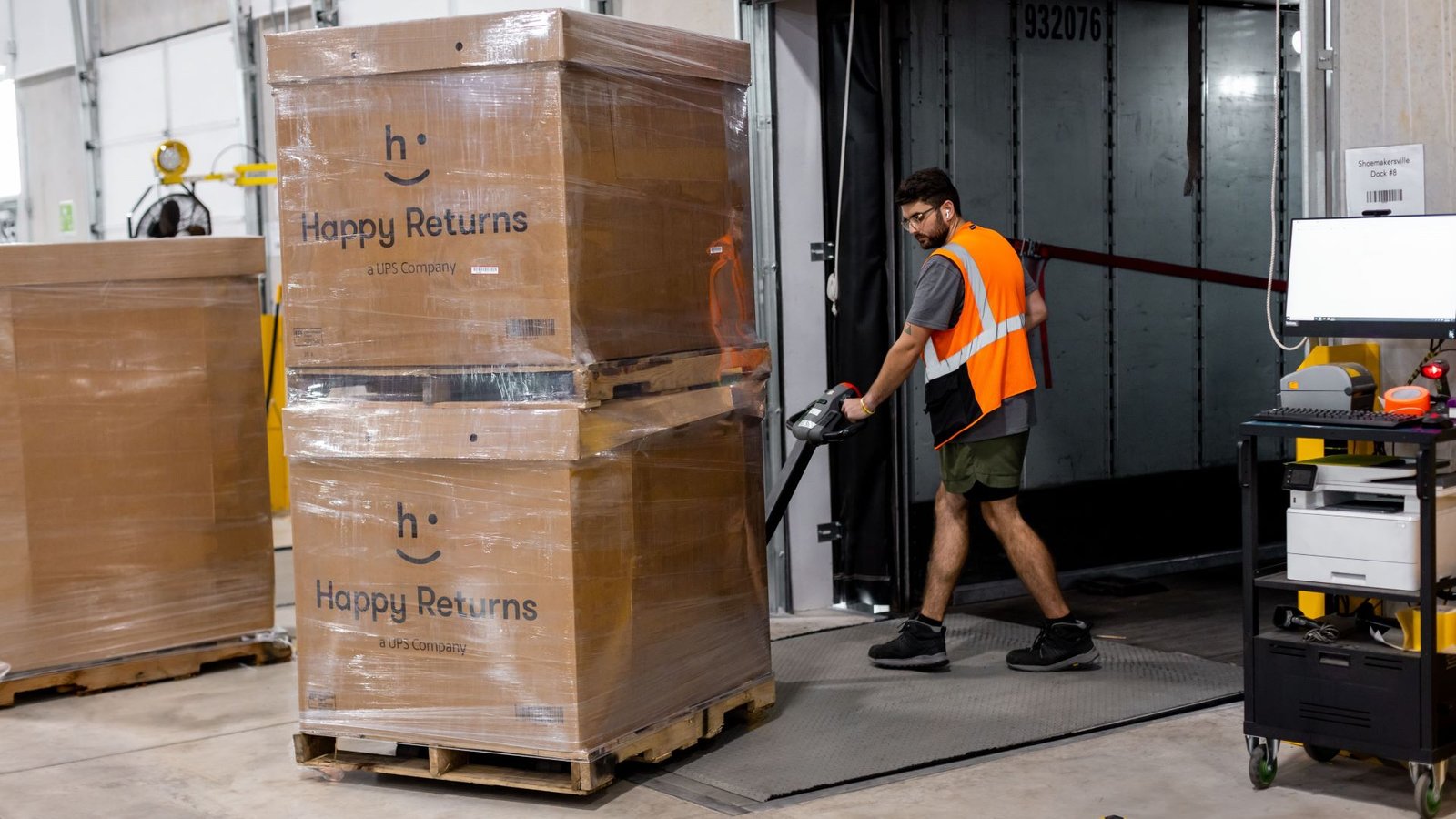
Returned items are placed in poly bags and then loaded into 18-by-18-inch containers. UPS vans pick up those containers and move them to Happy Returns distribution centers.
The company operates three automated returns facilities: one in Valencia, California, near Los Angeles; one in South Haven, Mississippi, near Memphis; and one in Shoemakerville, Pennsylvania.
At those sites, returns are sorted and then moved back to merchant warehouses in bulk using truckload or less-than-truckload transport depending on volume. Happy Returns says its software and automation also allow shipping schedules to be tailored to retailer needs, including same-day departures for some large accounts.
Campos said the economics of reverse logistics depend heavily on volume density. For a B2C returns network to be both profitable and effective for retailers, enough volume must flow through each access point to generate economies of scale.
Without that volume, returns arrive too slowly, consolidated loads take too long to fill, and items can sit idle for days — or even a week — before leaving the drop-off point. From there, several more days may pass before the goods reach the retailer and return to inventory.
For smaller e-commerce customers, Happy Returns is sometimes used purely as an intake solution, with goods then shipped individually by parcel from Return Bars rather than being consolidated.
Campos also said more non-consolidated offerings are on the way. UPS’s broader objective is to rationalise its returns services under one umbrella, with Happy Returns software serving as the backbone of the model.
Consolidated returns work particularly well for soft goods such as apparel and footwear. But there is also demand for simplified digital returns in categories that are less well suited to bulk handling, especially fragile or high-value goods such as electronics, where speed and careful treatment are more critical.
In those cases, the value lies less in consolidation itself and more in enabling easy online returns, simple drop-off and a process that avoids the need for customers to print labels.
Fraud remains another major battleground. The NRF and Happy Returns estimate that 9% of all returns are fraudulent.
In label-based systems, some scammers alter the address on the shipping label or PDF to make it appear the item was delivered to the retailer’s warehouse when in fact it went elsewhere. QR-code systems close that loophole, but other fraud techniques remain common, including empty boxes, item substitution, exaggerated quantities and other forms of process abuse.
To tackle this, Happy Returns uses an AI system called Return Vision. It begins anomaly detection as soon as the customer initiates a return online, looking for suspicious behaviour such as returns requested shortly after delivery, multiple linked email addresses or prior irregular activity.
The system also compares images of returned goods against catalogue images to verify authenticity. Someone trying to return 10 pairs of Nike shoes in different sizes, for example, would be flagged as an abnormal case.
Campos said the AI can detect subtleties that human reviewers may miss, such as fabric type or the number of buttons on a garment. Even so, the final decision on whether to reject a refund remains with human staff at the returns centers.
Happy Returns sees this anti-fraud capability as a major differentiator from other parcel carriers. After launching a pilot with four customers in November, the company says most customers now receive a risk score on every return.
At present, it flags just under 1% of returns for review and identifies fraudulent products in around 20% of those flagged cases.
Campos said many other operators either outsource this function or do not manage it at all. Happy Returns, by contrast, is actively investing in collecting and combining information from 3PLs, customers and its own systems in order to reduce both cost and risk for retailers.
The company’s longer-term goal is to continue enriching that data set, bring more customers and partners onto the anti-fraud platform and build a more complete end-to-end returns ecosystem that is increasingly insulated from abuse.
In Campos’s view, if bad actors are serious about committing fraud, Happy Returns should become one of the last places they turn — simply because it will be too difficult.