



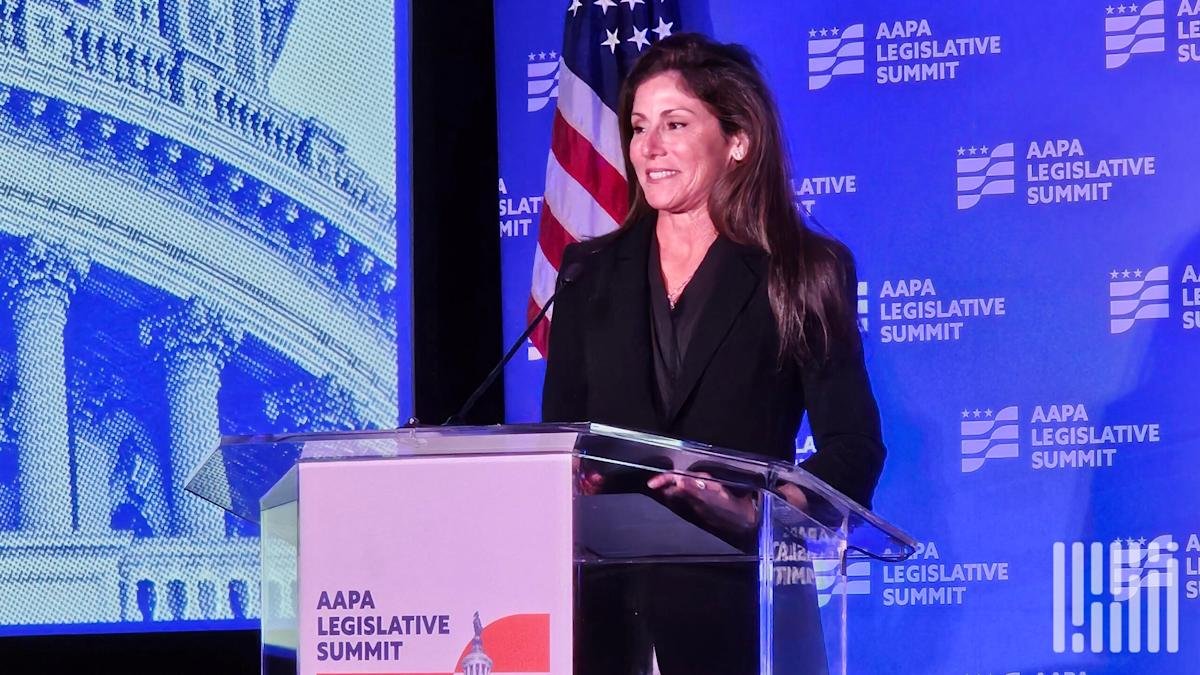
Less than six months into her tenure at the helm of the Federal Maritime Commission, Laura DiBella is already confronting a maritime agenda defined by overlapping crises, both domestic and international.
Speaking from FMC headquarters in Washington, DiBella said the maritime sector now sits at the heart of almost every major geopolitical flashpoint.
According to her, nearly every major conflict or issue unfolding globally now has a maritime dimension, whether it is the Middle East, the Strait of Hormuz, the Panama Canal, Chinese ship detentions, flags of convenience or tensions involving Spain. In her view, the maritime space has become impossible to separate from the wider movement of global trade, and especially from the efficient movement of U.S. cargo.
DiBella’s rise has been unusually fast. In the span of just four months, she moved from FMC nominee to commissioner and then to chair. President Donald Trump tasked her with leading the regulator at a moment when, alongside the Maritime Administration, it finds itself directly exposed to what she described as the global shipping storm.
The commission’s priorities, she said, were reshaped by the supply chain crisis that emerged during the pandemic. As a result, the FMC has been forced to adopt a broader and more international perspective. What is commanding most of the agency’s attention right now, she noted, is no longer what is happening within the continental United States, but what is happening abroad.
That wider geopolitical lens was central to the FMC’s recent decision to reject Maersk’s request — for the third time — for special permission to impose emergency fuel surcharges without observing the statutory 30-day waiting period.
Maersk and other carriers had argued that the sharp rise in bunker prices following the outbreak of the Iran war in late February was putting severe strain on operations. DiBella, however, said the carriers should have anticipated the risk more clearly.
She said she understood the pressure of absorbing those costs and acknowledged that carriers are absorbing part of the increases just as shippers are. But she stressed that the disruption was particularly severe for shippers, especially in the early stages of the conflict.
Maersk’s requests were ultimately rejected because the company failed repeatedly to provide sufficient detail showing how the higher fuel costs were affecting its business.
DiBella, whose background includes serving as Florida Secretary of Commerce and heading Enterprise Florida, said one of the problems is that shipper concerns can be overshadowed when public attention is focused on crude oil and naval blockades.
In her view, the war did not emerge without warning. There had been growing awareness that conflict was possible, as well as repeated threats linked to Trump’s stance should negotiations collapse. That meant, she argued, that certain charges already had an element of inherent risk built in.
She also noted that this case served as an important first test after authority over special permission requests was shifted away from staff level and elevated to a commissioner vote. For DiBella, that change strengthens accountability across the board — not only for the FMC itself, but also for carriers and shippers. She said the commission wants to be as transparent as possible with the shipping community about why it votes the way it does.
That, she added, is consistent with the FMC’s broader public service role, especially in terms of consumer protection. Her message to the market was that not every request will automatically be rejected, but applicants need to provide better information if they want the commission to reach a positive decision.
DiBella also drew attention to a different challenge: the extraordinary complexity of regulating the logistics chain beyond the ship.
Perhaps surprisingly, she said she speaks less regularly with ocean carriers than with shippers and truck drivers. Much of what she hears concerns the difficulties surrounding last-mile transitions, transfers from terminals and rail yards, and the movement onto intermodal chassis.
She described the underlying system as extremely complicated and deeply local. Because it is tied to ocean contracts, the FMC has authority over it, but broad regulation remains difficult to implement in practice. Conditions at Maher Terminals in Newark, she said, are entirely different from those in Memphis. That makes a universal regulatory fix unrealistic.
The situation is made more complex still by the growing number of carriers moving into the multimodal transportation operator space. As carriers vertically integrate and offer origin-to-destination services across more than one transport mode, the FMC’s oversight expands with them.
DiBella pointed out that once cargo leaves the vessel, the network of actors broadens rapidly. Terminal operators may be charging detention and demurrage, port authorities have their own role, and relationships with chassis companies add another layer of complexity. In that environment, she said, it becomes extremely difficult to identify a single regulation that would work for everybody.
Her approach, therefore, is rooted in information-sharing and a deeper understanding of how the maritime supply chain actually functions. She believes many of the pain points have already been identified, but insists that the problem has to be fully understood before workable solutions can be developed. She made it clear that the goal is not to pile on more regulations unnecessarily, but rather to stay alert to the constant evolution of shipping practices.
To support better communication, DiBella also highlighted the FMC’s Consumer Affairs and Dispute Resolution Services unit, or CADRS. She described it as an underused resource that can help shippers engage with the FMC before problems escalate, offering practical guidance in an environment marked by uncertainty.
In her view, many in the shipping public remain unaware that the FMC has experts with transportation experience who are available to provide advice free of charge. At a time when uncertainty is acute, she sees that service as an important way to move from reactive problem-solving to proactive support.
Looking ahead, DiBella expressed cautious confidence about the broader U.S. maritime agenda, including the SHIPS Act and the Trump administration’s Maritime Action Plan. While those efforts are being advanced through the Maritime Administration, she said the overall conversation on Capitol Hill appears to be moving in the right direction. The next step, in her view, is to direct sufficient resources toward the effort.
Although rebuilding American shipping and shipbuilding capacity is often seen as a generational project, DiBella argued that meaningful change does not necessarily have to take decades. She cited India as a case in point, noting that the country has already secured its first orders for large vessels, expanded its registry to include major liner operators, and developed plans for a national carrier.
What has happened in India, she said, is remarkable — and proof that this kind of transformation can be achieved in years, not decades.