



Healthcare logistics is becoming a direct factor in whether patients can access treatment. But the development and availability of a medicine do not automatically guaranty that it will get into the hands of those who need it. Physical access, affordability, clinical acceptance and appropriateness all need to converge before a treatment can deliver its intended benefit.
At the same time, health care systems are under growing pressure. Aging populations, long treatment periods, increasing complexity of diseases and healthcare professional shortages are widening the gap between the demand for treatment and the ability of health systems to deliver it.
Innovation brings another layer of complexity. The pharmaceutical industry is increasingly moving into biologics, messenger RNA, vaccines, precision medicine, gene therapy and AI-driven approaches. These therapies typically have lower volumes, higher values, higher complexity, tighter temperature requirements and more challenging delivery windows.
Geopolitical developments are also changing the pharmaceutical landscape as China advances up the value chain and countries rethink where medicines should be developed and manufactured.
From availability toward accessibility
Healthcare access can be seen as a five-stage process. The first question is whether there’s a treatment, and whether it’s available. Once that happens, patients have to physically be able to get it. They also have to be affordable and accepted and adopted by patients and health care professionals. Finally, the treatment must be appropriate to the condition being treated.
The scale of the challenge is already considerable, with billions still without access to basic health care. Developed markets are under a different but equally important pressure, as aging populations and longer periods of treatment increase demand and costs.
In addition, Western Europe is facing a shortage of healthcare professionals, increasing the disparity between the need for treatment and the ability of healthcare systems to provide it.
We are aging, we are living longer and we need longer treatments and the treatments are becoming more complex. “There is a trend upwards to higher healthcare costs,” said Frank Van Gelder, Secretary General of Pharma.Aero on Day One of the 2026 Pharma.Aero Masterclass at the Frankfurt University of Applied Sciences.
Van Gelder also pointed out that we need to go beyond the simple question of whether a medicine is available.
Even if the product is available, can the patient physically get to it? Affordability: affordability is a function of access and availability. “Acceptability is when the patients, clinicians and clinical programs accept them, and last but not least, is it appropriate,” he said.
Five forces changing healthcare
Demography, climate, geopolitics, science and technology, and infectious disease are five forces transforming healthcare.
These are not trends that are completely new. What is different is their speed and, increasingly, their interactions with one another.
Geopolitics is important because pharmaceutical policy decisions made in one market may affect availability in another. A recent change in US pharmaceutical policy illustrates the possible effect. If drug makers can earn much higher returns in the United States than in Europe or Asia, steps designed to ensure lower prices and greater availability in the United States could have unintended consequences.
This could affect where companies decide to launch and supply new medicines, and could increase disparities in how quickly patients can get access to innovative treatments.
Currently, it takes about 560 days on average for new drugs to reach patients in Western Europe, but the route is faster in the United States.
“Geopolitical scenarios can begin to affect the availability of medication,” Van Gelder explained. So why would they not do that if they are a pharma company, if they make more money in the U.S. than they would make in Europe? “This can have a very big impact and trigger effects on availability for other markets,” he said.
China moves up the value chain in pharmaceuticals
How China’s role in pharmaceutical supply chains is changing rapidly.
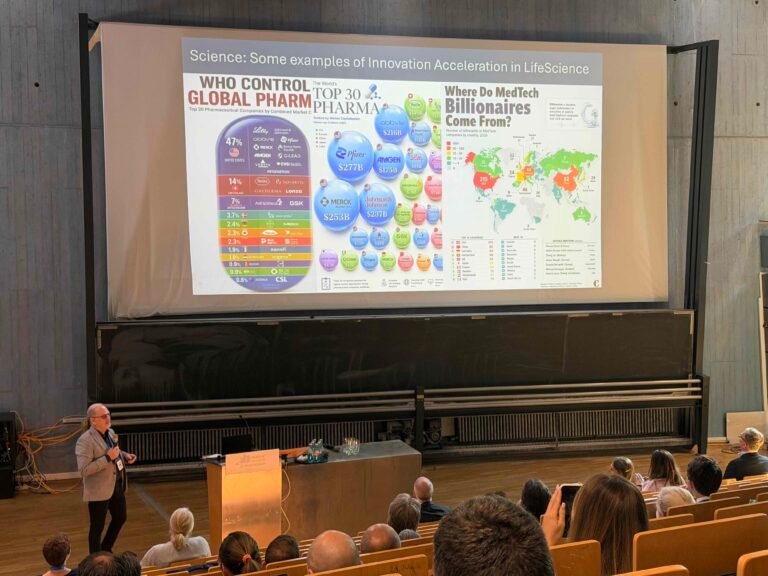
Van Gelder characterized the country’s transition from China 1.0, which was largely centered on APIs and raw materials, to China 2.0, as exemplified by the rise of CDMOs and large-scale manufacturing. It is now moving into China 3.0, a greater role in innovative medicines and advanced therapies.
This evolution is important because pharmaceutical innovation itself is changing the structure of supply chains.
The industry is moving away from traditional high-volume, relatively standard products to therapies that involve smaller volumes, significantly higher value, greater complexity and much stricter temperature requirements.
“We’re going from small volume and small molecules to biologics, messenger RNA, vaccines, precision medicine, gene therapy and AI and data,” Van Gelder said. We are seeing it now and it gives us higher value, lower volume, higher complexity, more temperature sensitivity and more time sensitivity.”
That’s a fundamental change for logistics providers. Traditional pharmaceutical networks that are built for high volumes could increasingly be replaced or complemented by specialized supply chains for rare diseases, customized medicine, and advanced therapies.
China’s growing pharmaceutical and medical technology capabilities also indicate that the geographical map of future pharmaceutical production may look very different from today’s.
Therefore, the industry needs to look not just at where medicines are currently manufactured, but where future treatments will be developed, produced and ultimately made available to patients.
The innovation paradox
“More science capability doesn’t equal more patient access.
The clearest example of this paradox is antimicrobial resistance. Antibiotics are easily available and overused, which can lead to them becoming ineffective. However, there is little commercial incentive to develop novel antibiotics because responsible stewardship intentionally limits their use and hence their volumes.
“The better you manage antibiotics, the harder the traditional volume-based business model works,” Van Gelder said.
It creates a tension between credibility, commercial value and social value. It also illustrates the need to go beyond traditional commercial measures in the assessment of pharmaceutical supply chains.
Scientific progress may make a treatment possible, but healthcare systems still need the financial resources, reimbursement mechanisms, logistics infrastructure and clinical capacity to transport, administer and deliver it.
So the challenge is no longer just about the cost or the service performance; The question is whether the whole healthcare system can turn innovation into actual access for patients.
Global networks to regional resilience
The days of pharmaceutical manufacturing relying on one dominant geography are coming to an end.
Instead, companies will require portfolios of connected regional nodes that can balance cost, resilience, regulatory requirements and access to individual markets.”
This is a generalization of the traditional supply chain equation. Cost, quality and service are still important, but resilience and accessibility are increasingly issues that cannot be separated from the same strategic decisions.
This is especially important as treatments become more specialized and populations become more geographically dispersed.
“We’ll also do tomorrow lower volumes, more expensive, more variable, time-critical, advanced, small and rare populations, spatially driven and treatment delivery,” Van Gelder said. “Logistics shows that it becomes a player in direct availability of healthcare and the access to it.
This has massive implications for pharmaceutical logistics. Networks will have to meet ever more fragmented demand, while ensuring the temperature control, speed, regulatory compliance and reliability demanded by advanced therapies.
Get to the measure
The shift to more regionalized pharmaceutical manufacturing does not have to be a rejection of globalization. Rather it modifies the function of global networks and the standards by which they are designed.
Where medicines are made is becoming a strategic market decision as well as one of cost, scale and innovation. Regulation and patient access and resilience are all equally important considerations.
The goal is, therefore, not just to create a pharmaceutical supply chain that is resistant to disruption. The goal is to create a network that can continue to provide treatments to patients as demand for healthcare, technology and geopolitical conditions change.
“Without access, innovation has no patient health,” Van Gelder concluded. “The future is not one manufacturing geography, but a strategic portfolio of connected regional nodes and network design must ensure balanced costs, resilient regulatory policies and markets”
It is a fundamental change in the role of healthcare logistics. “Logistics is not just the function that gets a medicine from manufacturer to patient. More and more, the design and resilience of the network determine whether that medicine can even reach the patient.