



Japan’s maritime industry is poised for a new milestone in shipping decarbonisation, as major companies team up to establish what they say will be the world’s first integrated commercial ammonia fuel supply chain. The initiative aims to enable four ammonia-fuelled car carriers under construction and operation by the participating companies, with the entire system to be completed by 2030.
The project will be implemented in the Chubu region of Japan, and will cover the entire supply chain, from ammonia purchasing and receiving facilities to ship-to-ship bunkering operations. The partners will work to make ammonia a viable alternative fuel for international shipping through coordination of fuel production, infrastructure and vessel construction.
New infrastructure for importing green ammonia
The power generation company JERA will take the lead for sourcing fuel, including green ammonia from renewable energy sources in India and elsewhere. The company will also build ship-loading facilities at a receiving terminal near its Hekinan Thermal Power Station.
The terminal is expected to be a major centre for ammonia bunkering activities. It would also enable the loading of trucks, distribute ammonia to other businesses and promote its wider use other than maritime transport, apart from supplying vessels.
This infrastructure will be the upstream basis of the project, ensuring that ammonia can be received and transferred efficiently before it is loaded onto ships.
2030 target is dedicated bunkering vessel
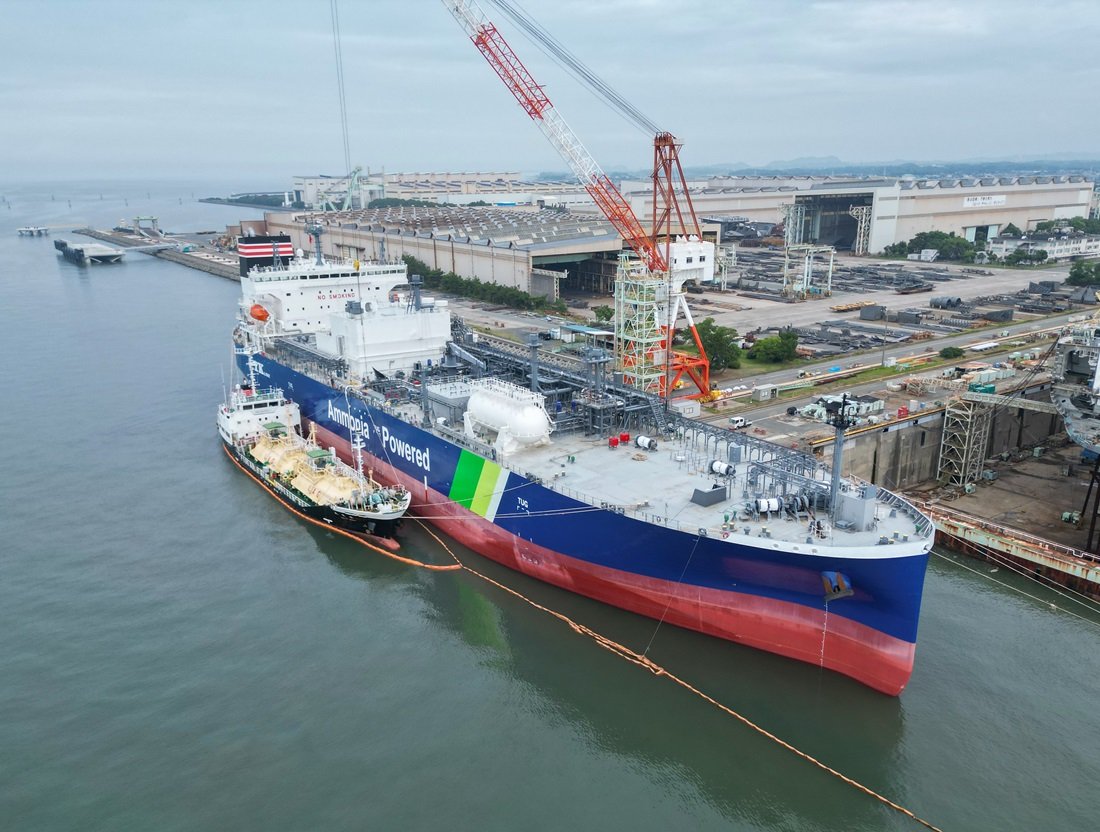
The next step is the construction of a dedicated ammonia bunkering vessel. Kyokuyo Shipbuilding is constructing the vessel. Delivery is scheduled for 2030 and it is expected to provide ammonia direct to other vessels via ship-to-ship (STS) bunkering.
NYK will own and operate the bunkering vessel. The shipping company will also form a 50/50 joint venture with K Line for fuel sales to supply ammonia to the participating car carriers.
Both companies will use their operational experience and expertise in handling ammonia and liquefied natural gas (LNG). The aim is to develop an efficient fuel distribution system with high safety standards that is key to the commercialisation of ammonia as a marine fuel.
Four ammonia-fueled car carriers planned
The bunkering infrastructure will be for Japan’s first four ammonia-fuelled car carriers, with NYK and K Line expected to take delivery of two vessels each in 2030.
The ships will be powered by dual-fuel engines capable of running on ammonia. Their fuel capacity will also be enough to complete a trans-Pacific voyage using only ammonia, showing the project’s ambition to support long-distance shipping with an alternative to conventional marine fuels.
Japanese shipbuilding companies have split ship design and construction responsibilities.
Shin Kurushima Dockyard will do the basic design of the vessels. According to the project structure chart, the company also has the shipbuilding contract for NYK’s two car carriers.
The two vessels are to be built by Imabari Shipbuilding and Nihon Shipyard (NSY) for K Line. This division of labour unites shipping operators and shipbuilders in a collaborative effort to design the ships and the infrastructure needed to run them.
An integrated model for maritime decarbonisation
The project partners believe that combining ammonia procurement, receiving facilities, bunkering operations and vessel construction will establish the world’s first integrated commercial supply chain of this kind.
Beyond supporting the four car carriers, the initiative is intended to encourage wider adoption of ammonia in industrial and other applications. The companies also see the project as an opportunity to help develop a low-carbon ammonia market while strengthening Japan’s contribution to the decarbonisation of international shipping.
In a joint statement, the partners said the initiative would advance maritime decarbonisation through collaboration across Japanese industry while promoting broader ammonia utilisation. They added that the project aims to contribute to a sustainable society and support the development of a low-carbon ammonia market.
With the 2030 target bringing fuel supply, infrastructure and vessel deployment together, the initiative represents a coordinated attempt to establish the commercial foundations for ammonia-powered maritime transport.