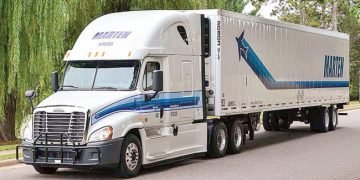




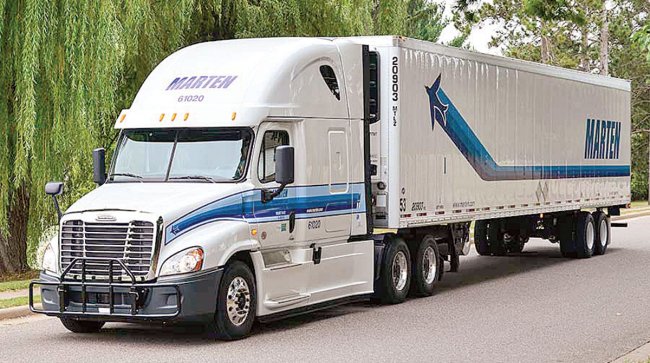
Marten Transport is seeing clear signs of recovery in the refrigerated truckload market, with tighter industry capacity helping the carrier secure higher freight rates and become more selective about the loads it accepts.
Reporting its second-quarter results, the Wisconsin-based company said the truckload market is emerging from what it described as the longest freight recession on record. CEO Randy Marten attributed the improving conditions in part to increased regulatory enforcement, which has removed noncompliant and unqualified drivers from the market, reducing available trucking capacity.
The company does not hold quarterly earnings calls, but its financial results point to a more favorable operating environment for refrigerated transportation.
Revenue from Marten’s non-dedicated truckload fleet increased 9% year over year to $116 million. Excluding fuel surcharges, revenue remained stable at $93 million. Although the average number of tractors in service declined by 8% as the company continued to optimize fleet utilization, revenue generated per tractor increased 9%.
Revenue per loaded mile also improved, rising 6% year over year to $2.81, while the segment recorded an operating ratio, excluding fuel, of 97.4%, representing a modest improvement of 10 basis points compared with the same period last year.
The company’s dedicated fleet delivered weaker results. Revenue excluding fuel surcharges fell 14% from a year earlier, largely due to a 17% reduction in truck count. A 3% increase in revenue per tractor partially offset the decline, but revenue per loaded mile dropped 5% to $2.36. The segment’s operating ratio worsened by 430 basis points year over year to 95.4%.
Marten’s brokerage division posted revenue of $40 million, unchanged from the previous year. A 2% increase in shipment volumes was offset by a 2% decline in revenue per load. The brokerage segment reported an operating ratio of 94.8%, 160 basis points weaker than a year ago. The company noted that rapidly rising spot-market transportation costs have increased the price of purchased capacity, while contractual selling rates have yet to fully catch up.
On a consolidated basis, second-quarter revenue totaled $224 million, down 3% from the same period last year and approximately $4 million below market expectations. Excluding fuel surcharges, revenue declined 9%.
The comparison was also affected by the sale of Marten’s intermodal business to Hub Group in 2025, which reduced quarterly revenue by $11.7 million.
Net income reached $5.3 million, or 7 cents per share, down from the prior year and one cent below analysts’ expectations. Earnings were also impacted by a $3.5 million year-over-year decline in gains from equipment sales, creating a three-cent headwind for earnings per share.
For the first half of 2026 cash flow from operations was $61 million, a decrease of 12% on the prior year. But it maintained a debt-free balance sheet, further bolstering its financial position.
The company’s tractor fleet had an average age of 2.5 years, slightly older than the 2.1-year average reported a year earlier.
Following the earnings release, Marten Transport shares fell approximately 2% in early Friday trading, while the S&P 500 declined 0.1%.
As the only publicly traded carrier focused exclusively on refrigerated freight, Marten Transport is widely viewed as a benchmark for the reefer market. Its latest results suggest that conditions in the refrigerated truckload sector are improving, with tighter capacity beginning to strengthen pricing and overall market fundamentals.