



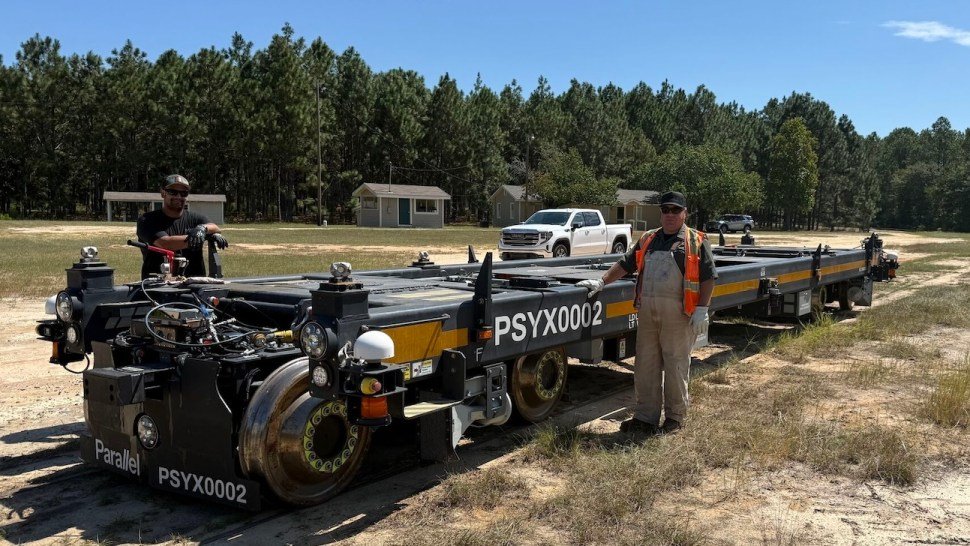
Parallel Systems has moved its autonomous battery-electric railcar program into a broader second phase of testing in Georgia, expanding beyond the company’s initial two-mile demonstration as it works toward establishing a lower-cost rail option for short-haul container freight.
The Los Angeles-based company completed the first stage of its Federal Railroad Administration (FRA)-approved test program on a two-mile section of Genesee & Wyoming’s (G&W) Heart of Georgia Railroad. It has now begun a second phase covering 30 miles between Vidalia and an area east of Helena, Georgia.
The expanded testing territory includes 43 public grade crossings. During the tests, flaggers are being used to protect the crossings as Parallel Systems increases the distance and complexity of its autonomous operations.
“This phase introduces a major unlock: Remote supervision as opposed to line-of-sight supervision in the field, opening the door to centralized operations across rail networks,” the company said on social media.
Parallel Systems also said the second phase will significantly increase the distance covered by its automated runs while introducing more complex railway infrastructure, including diamond crossings.
Moving beyond line-of-sight supervision
The company’s self-propelled rail vehicles are designed to transport containers individually or travel together in digitally controlled platoons. The concept is aimed at giving railroads a more economical way to serve smaller-volume and shorter-distance freight lanes that are typically handled by trucks.
Parallel Systems is not alone in pursuing autonomous rail freight. Rival Intramotev has already deployed its autonomous railcar technology in commercial operations, including at a mining operation in Pennsylvania and with short-line operator R.J. Corman.
For Parallel Systems, however, the Georgia operation remains a structured testing and regulatory program rather than unrestricted commercial freight service.
Seven-stage program covers 160 miles
Georgia represents the first U.S. commercial pilot for Parallel Systems’ technology. The overall program is divided into seven phases covering a 160-mile corridor across two G&W lines.
Each phase is designed to introduce a higher level of operating complexity. The Federal Railroad Administration must determine that the requirements of one phase have been satisfied before the program can advance to the next stage, according to an earlier report by Trains.
The approved territory begins near Cordele, Georgia, on the Heart of Georgia Railroad and runs east through Vidalia before continuing along Georgia Central toward Pooler, near the Port of Savannah.
The FRA has said the program is intended to evaluate both Parallel Systems’ technology and its operating approach for short-haul container movements.
The testing program is also taking place against the backdrop of Parallel Systems’ plans for commercial deployment. The company reportedly said in 2025 that it had a backlog of more than 300 vehicles and expected initial commercial operations in 2026, subject to the results of testing and the necessary regulatory approvals.
$38 million Series B supports commercialization
Parallel Systems announced its Georgia pilot alongside the closing of a $38 million Series B financing round. The company said the funding would support the commercialization of its Generation 3 vehicle and autonomous rail system.
At the time, Parallel Systems said its cumulative fundraising had reached approximately $100 million.
The latest testing phase therefore represents more than a simple extension of the company’s original two-mile demonstration. By moving toward remote supervision, longer automated runs and more complicated railway infrastructure, Parallel Systems is continuing to build the operational and regulatory case for autonomous battery-electric railcars in short-haul freight markets.