



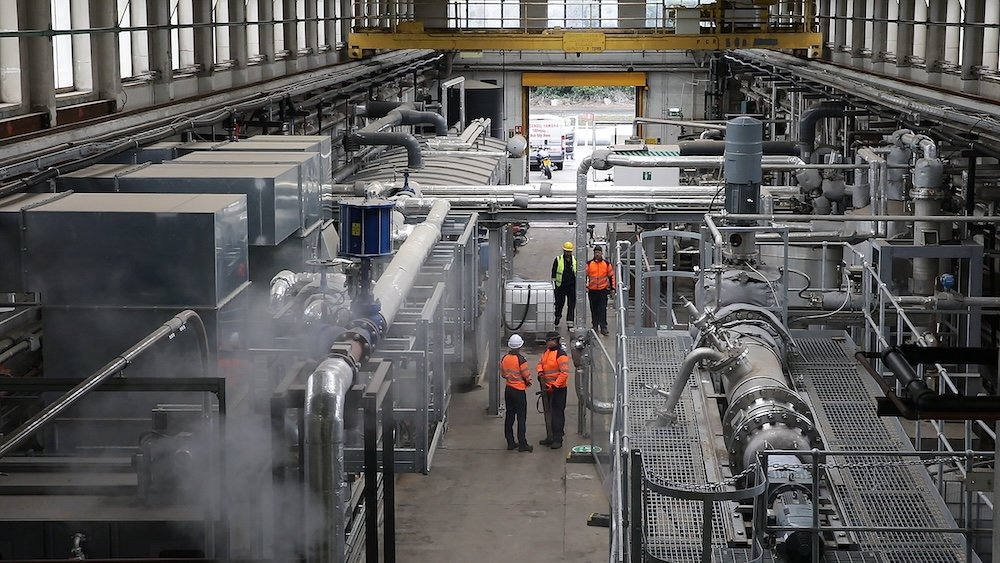
UK sustainable aviation fuel developer Nova Pangaea Technologies has completed a series of successful endurance trials at its Teesside demonstration plant as part of its drive toward the commercialization of its technology for producing SAF from waste biomass.
The most recent trials showed stable continuous operation for up to 72 hours, and production yields were above the company’s targets. The plant processed up to 3 tons of feedstock a day from softwood residues generated by timber processing.
The results are expected to help Nova Pangaea’s plans to build its first commercial-scale production plant as airlines and fuel producers seek more sustainable feedstocks to meet growing demand for SAF.
Aviation fuel from waste biomass
Nova Pangaea’s REFNOVA technology turns waste products – wood chips, sawdust, wheat straw – into ethanol. The ethanol can then be used to produce sustainable aviation fuel and renewable diesel.
The process also yields biochar, a carbon-rich material that can sequester carbon permanently. The company said the combination could make the overall process carbon negative, pulling more carbon dioxide out of the atmosphere than the production process puts out.
The technology is being developed with LanzaJet and British Airways under Project Speedbird, a UK government-backed program to produce carbon-negative aviation fuel from locally sourced waste biomass.
As part of the project, Nova Pangaea plans to build four UK facilities to produce bioethanol from local waste streams to be converted into SAF.
Further trials to be held
The latest endurance tests follow smaller-scale trials in early 2025 that demonstrated the technology’s ability to operate outside a laboratory environment.
Nova Pangaea intends to conduct further trials next year to optimize the process further and improve the design of its first commercial-scale plant.
The company sees the potential to diversify the SAF supply chain, which relies heavily on limited sources such as used cooking oil, by enabling the use of a wide array of waste biomass.
SAF demand is still rising
The aviation industry is increasingly under pressure to use more sustainable aviation fuel. UK and European rules are set to see the required share of SAF in aviation fuel leap in the coming decades, with some targets suggesting this could reach as high as 70% by 2050.
But the supply of used cooking oil and other traditional SAF feedstocks is limited, prompting concerns about whether existing sources will be able to meet demand in the future.
Alternative feedstocks could help Europe and the UK produce around 30 million tons of SAF in 2030, the International Air Transport Association (IATA) says, with the potential of available waste biomass.
Preparing for commercial development
Nova Pangaea has so far raised more than £21 million from investors and funding from the UK government. Backers include International Airlines Group, PXN Ventures, Mercia Ventures and the early Northern Powerhouse Investment Fund.
The company is now seeking to raise additional capital to move its first commercial facility forward.
“The latest trials provide further confidence in the technology at a time when the SAF sector needs to diversify its feedstock base and scale up production capacity,” CEO Stewart Stewart said.
Nova Pangaea aims to provide an alternative approach to increasing SAF production and reducing aviation’s dependency on fossil-based fuels by converting locally available waste biomass into aviation fuel, while sequestering carbon through biochar.