



As Canada prepares for more than $100 billion in major infrastructure projects, many of them involving extensive underground construction, a British Columbia-based startup is betting that better data could help owners and contractors avoid delays and cost overruns on some of the industry’s most complex and expensive projects.
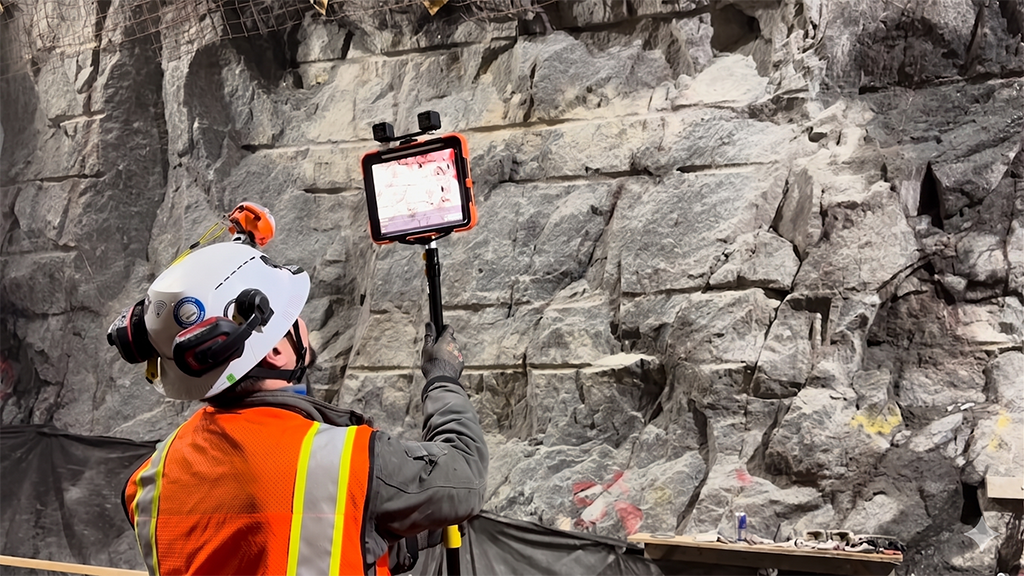
GroundedAI, led by CEO Shelby Yee, has developed technology designed to capture underground data and turn it into a 3D picture that connects field teams below ground with decision makers above it on a daily basis.
That capability can be particularly valuable in mining and tunnelling operations, where ground conditions can change unexpectedly and quickly create construction or excavation delays.
Yee, a geo-engineer with 10 years of experience in underground data capture, says the company’s technology not only allows teams to gather underground information more quickly, but also collects data that can be used to understand how a project is evolving over time.
The startup recently secured a $2 million investment from a group of investors led by Stand Up Ventures. GroundedAI plans to use the funding to accelerate its entry into the tunnelling market.
One potential application, Yee says, is transit tunnelling projects such as Toronto’s Ontario Line. The 15.6-kilometre project was originally estimated to cost just under $11 billion in 2019. That figure has since risen to approximately $34 billion.
Turning underground uncertainty into usable data
For Yee, one of the fundamental problems with underground construction is that conditions can be difficult to predict.
Below grade is “full of surprises,” she says, while probing underground in advance of excavation in a dense urban environment is generally limited to “some samplings.”
At the same time, some tunnelling projects continue to depend on traditional paper logs, spreadsheets and disconnected tools to document underground conditions and project activity.
The difficulty is that construction teams can enter a project with only a relatively narrow expectation of what lies ahead.
“As you go into construction you may only have a linear line of what you think is going to happen in the next hundred metres but the reality is the ground is much more variable than a perfect linear line.”
GroundedAI’s digital technology is designed to close that information gap. The system provides progress reports while allowing teams to compare actual ground conditions with what was originally expected.
That ability to establish a reliable record of underground activity can also have commercial implications.
By creating “a definitive 3D picture of what happened at a specific time,” Yee says owners and contractors can have the information needed to address disputes before they become more serious.
The technology can support geotechnical and geological decisions, but its potential application extends beyond technical issues. GroundedAI’s equipment can also examine aspects of the supply chain, including the ground support materials and systems being introduced underground.
“We are bringing proof of record of the underground not only for technical decisions but also for commercial decisions.”
Two platforms at the core of GroundedAI
The company’s technology is built around two main components.
Lithos is an iPad-based LiDAR application designed to capture underground data. Strata, meanwhile, is a web-based platform used for geo-referencing, mapping and identifying variances between project budgets and ground models.
Together, the systems are intended to provide project teams with a more connected view of what is happening underground and how actual conditions compare with expectations.
GroundedAI has already gained experience across a range of infrastructure tunnel projects in Canada, the United States and overseas. The company has worked as a consultant for engineering firms including Hatch and Schnabel Engineering.
Yee says the need for this type of technology is becoming increasingly apparent as infrastructure projects face growing cost pressures.
She points to research by Bent Flyvbjerg, a Danish economics professor and a leading scholar on megaprojects, which shows that the average cost overrun for rail and urban transit projects stands at 45 percent.
Technology is only part of the challenge
Despite the progress made so far, Yee says GroundedAI still has work to do to achieve its broader ambitions.
Developing an application that captures data and a platform capable of examining schedules represents only half of the challenge. The company must also support construction management teams throughout the day-to-day and month-to-month realities of a project, as well as across its entire lifecycle.
That means turning underground data into information that construction teams can use continuously rather than simply collecting it and reviewing it after the fact.
Interest from the tunnelling sector, however, has been strong.
Yee describes the industry’s response to GroundedAI’s technology as “quite phenomenal,” arguing that the interest demonstrates both the financial opportunities associated with better project information and the willingness of underground construction teams to adopt new technology.
“It really shows that there are not only opportunities to improve costs but that there are teams working underground that want to adopt technology.”