



Several oil tankers have changed their routes in the Red Sea after Yemen’s Houthi movement warned that ships calling at Saudi ports could become targets, adding another layer of uncertainty to global energy shipping.
On July 20, the Houthis’ Humanitarian Operations Coordination Center (HOCC) sent notices to shipping companies stating that vessels loading or unloading at Saudi ports were now considered “banned.” According to the warning, ships could face sanctions and even be targeted anywhere within the operational reach of the Yemeni Armed Forces.
The announcement drew immediate responses from a number of ships working in the area.
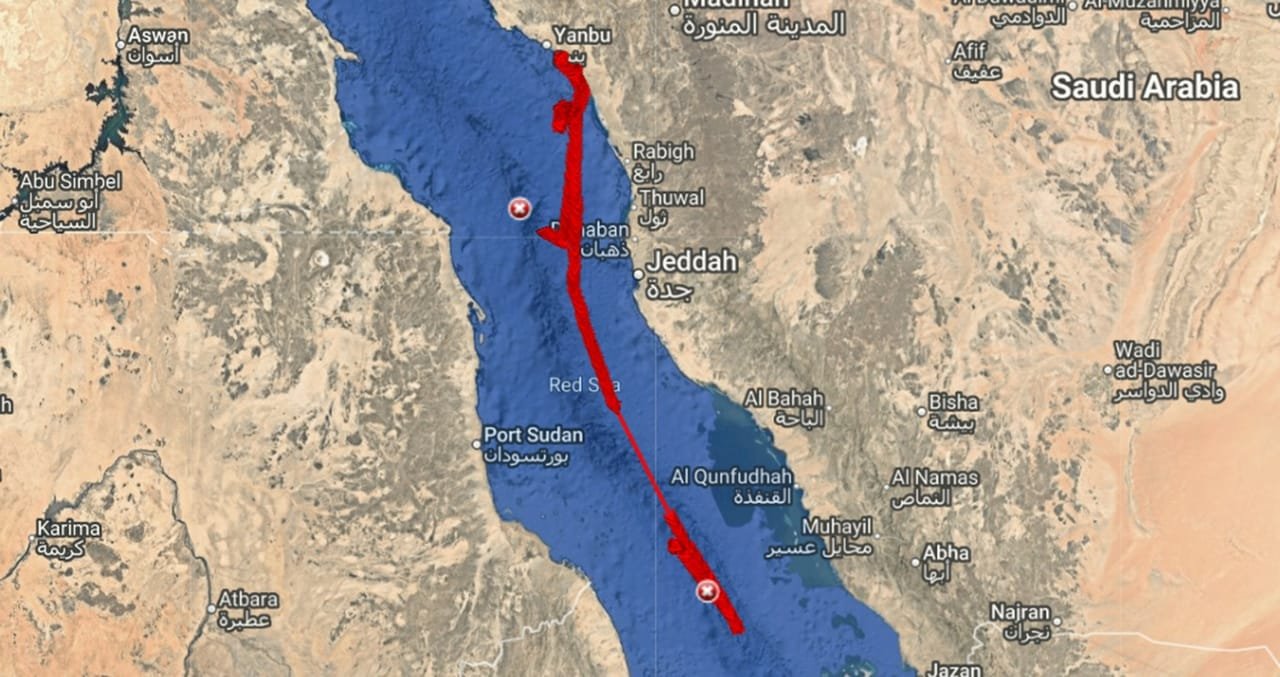
Pole Star Global’s AIS tracking data showed the Liberian-flagged VLCC Rodos changed course July 21, shortly after leaving Yanbu, Saudi Arabia. The vessel is now listing Suez, Egypt, as its destination.
Another very large crude carrier, the Singapore-flagged Xin Long Yang, was also seen reversing course after leaving Yanbu before later resuming its southbound voyage toward Qinzhou, China.
Meanwhile, the Hong Kong-flagged New Prime suspended its voyage while sailing toward the Gulf of Aden.
Yanbu has become an increasingly important export terminal for Saudi crude oil since tensions between the United States and Iran disrupted shipping through the Strait of Hormuz. Many tankers have been using the Red Sea route instead, sailing south through the Bab al-Mandeb Strait after loading their cargo.
That route now faces renewed uncertainty.
The Houthis have previously targeted commercial vessels they believed were linked to Israel, and any attempt to block ships departing Saudi ports could significantly disrupt crude oil exports from the region.
Fully loaded VLCCs cannot transit the Suez Canal because of draft restrictions. Instead, some operators partially unload cargo at Ain Sukhna on the Red Sea coast, transport the oil through the SUMED pipeline, and reload it at Sidi Kerir on the Mediterranean before continuing their voyage.
If shipping were effectively disrupted in both the Strait of Hormuz and the Bab al-Mandeb Strait, global crude oil trade would face severe logistical challenges.
The situation could also impact container shipping but the effects are likely to be more limited.
Many container lines have already shifted services from ports in the Arabian Gulf to Saudi ports on the Red Sea. However, most Asia-Europe services continue to avoid the southern Red Sea, sailing around the Cape of Good Hope or using the Suez Canal while bypassing the most dangerous areas because of ongoing security concerns that have persisted since late 2023.
According to maritime analyst Alphaliner, the latest Houthi threats are likely to have a much greater impact on oil transportation than on container shipping.
The firm noted that the commercial implications are primarily linked to crude oil movements through the Bab al-Mandeb Strait, although the warning comes at a time when some container operators have started cautiously returning to Red Sea routes. CMA CGM was the first major carrier to resume trans-Suez services, with Maersk following in recent weeks.