



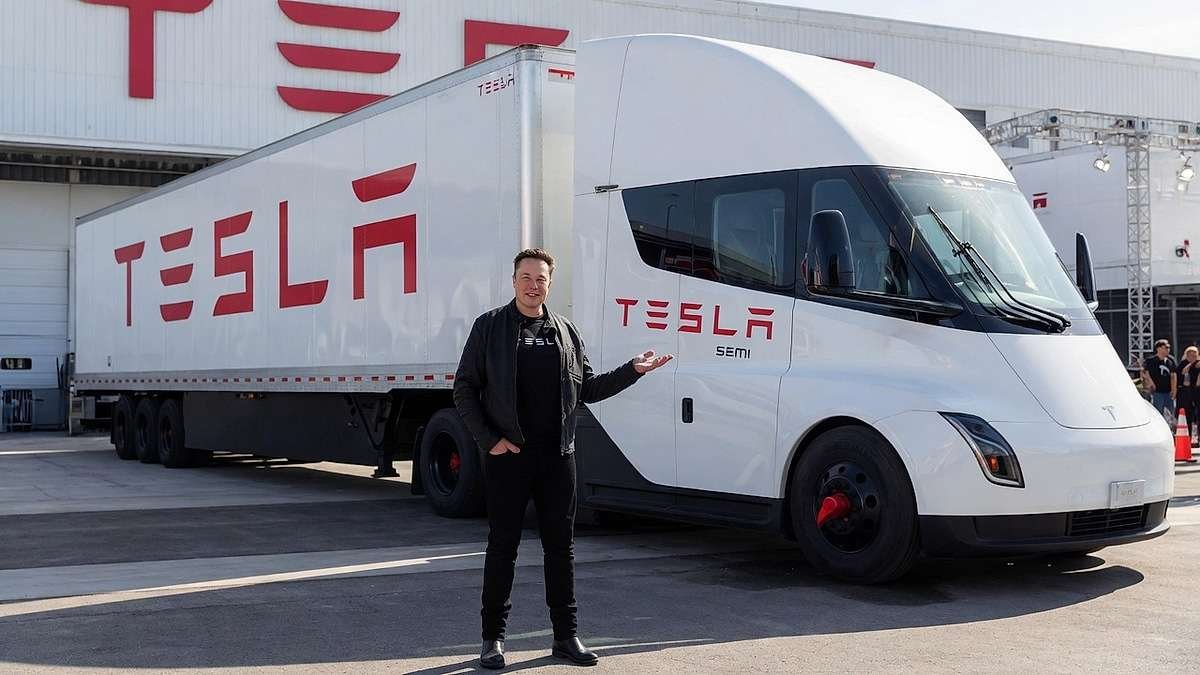
Tesla has begun volume production of its all-electric Semi heavy-duty truck, a key milestone in its effort to expand into commercial operations in North America and prepare for a European launch targeting 2027.
The milestone was confirmed in the third quarter 2026 earnings report released Wednesday, October 21, by the Austin, Texas-based electric vehicle company. Tesla’s presentation shows that its Nevada plant has an annual manufacturing capacity of 25,000 Semi trucks. CEO Elon Musk also mentioned the development during the company’s earnings call with analysts, confirming that production of the Class 8 truck started in the third quarter.
The manufacturing update comes as Tesla is set to move beyond limited fleet deployments and make its electric heavy-duty vehicle more broadly available to commercial customers. But the company has not disclosed how many Semis were made or delivered in the quarter. Therefore, the stated annual capacity should not be taken as the current production rate of the factory.
Tesla’s latest earnings presentation highlighted the truck’s operating range and energy efficiency, two factors that could affect its competitiveness in freight transportation. The company says the top-of-the-line Semi can travel up to 500 miles on a full battery charge while operating at a gross combination weight of 82,000 pounds. It has a reported energy consumption of 1.7 kWh/ mile.
This efficiency, Tesla says, allows the Semi to use about one-third of the energy needed by a similar diesel truck hauling the same payload. Energy use is a large portion of the operating cost per mile, and the company believes the truck’s lower energy requirements will be a significant economic benefit for fleet operators.
Tesla’s results were about more than just the Semi launch and they painted a mixed picture. Revenue in the third quarter was about $28.05 billion, essentially flat from $28.1 billion in the same quarter of 2025. Adjusted diluted earnings per share decreased 4 percent from $0.50 to $0.48 and GAAP diluted earnings per share decreased 44 percent from $0.39 to $0.22.
GAAP accounting net income attributable to common stockholders was down 43% year over year from $1.37 billion to $787 million. Operating income fell 56% to $718 million, while operating expenses rose 39% to $4.78 billion. Even with the pressure on profitability, Tesla generated $1.53 billion in free cash flow, and ended the quarter with roughly $45.45 billion in cash, cash equivalents and short-term investments.
| Metric | Q3 2026 | Q3 2025 | Change |
|---|---|---|---|
| Adjusted (non-GAAP) diluted EPS | $0.48 | $0.50 | -4% |
| GAAP diluted EPS | $0.22 | $0.39 | -44% |
The company’s overall manufacturing performance is a bit more context for its investment plans. Tesla produced 464,391 passenger vehicles in the quarter and delivered 486,532, a roughly 2% decrease in deliveries from the third quarter of 2025. And these numbers are for passenger vehicles, not the Semi.
Tesla also revised its 2026 capital spending guidance to approximately $20 billion. The planned spending supports continued investment in manufacturing capacity, artificial intelligence, robotics and energy infrastructure as the company advances several projects across its businesses.
Europe is the Semi’s next big market. Tesla intends to start customer deliveries there by the end of 2027 following a demonstration program in the first half of the year.
Tesla’s head of its Semi program, Dan Priestley, told the IAA Transportation conference in Hannover, Germany, in September that Tesla was looking for prospective customers to test the truck in demonstrations. Those trials are meant to give operators a chance to put the vehicle through its paces in their own operations ahead of delivery, with the end of 2027 remaining the target for initial customer shipments.
The first Semis bound for Europe will be built in Tesla’s Nevada plant. The company also plans to have over 100 Megacharger stalls in operation across Europe by 2027, each capable of providing up to 1.2 megawatts of charging power.
Tesla has yet to choose a dedicated Semi production plant in Europe. Priestley earlier cited capacity available at the Nevada factory as one reason the company has not committed to local production. During the third-quarter earnings presentation, there was no mention of a new timetable for deliveries in Europe, nor the number of trucks that would be allocated to the market.
This production milestone comes after Tesla was selected as the lead supplier for a battery-electric Class 8 order of 2,500 trucks announced in September. The procurement effort is being coordinated by Catalyst Mobility and Smart Freight Center through ZET SCALE – Zero-Emission Truck Shipper-Carrier Alliance Leading Electrification. The alliance has not said how many of the vehicles in the total order will be Tesla Semis.
The move to volume production gives Tesla a stronger manufacturing base for its commercial vehicle ambitions, while its range and energy-efficiency claims are key to the operating-cost proposition it is putting in front of freight operators. However, without disclosed Semi production and delivery figures, the real speed of the ramp-up is unclear as the company heads into its planned North American expansion and European launch.
Key figures from Tesla’s third-quarter 2026 report
| Metric | Q3 2026 |
|---|---|
| Semi installed annual manufacturing capacity | 25,000 trucks |
| Semi maximum stated range | 500 miles |
| Semi stated energy consumption | 1.7 kWh/mile |
| Total company revenue | $28.05 billion |
| GAAP net income attributable to common stockholders | $787 million |
| Operating income | $718 million |
| Free cash flow | $1.53 billion |
| Passenger vehicle deliveries | 486,532 |
Why it matters: Moving the Tesla Semi from limited deployments into volume manufacturing could intensify competition in the electric Class 8 truck market. The scale of that impact will depend on how quickly Tesla converts its installed capacity into actual production, customer deliveries and sustained commercial operations.