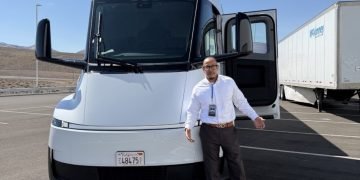




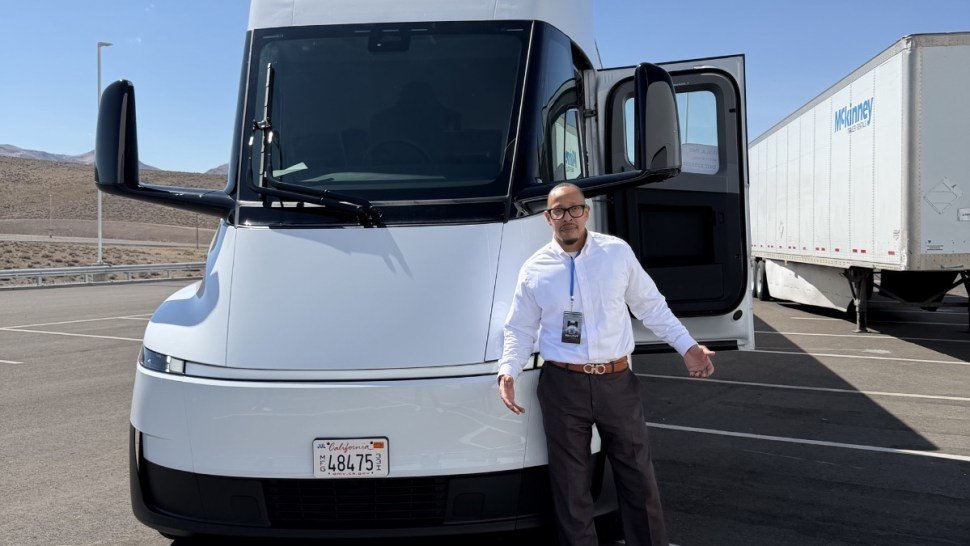
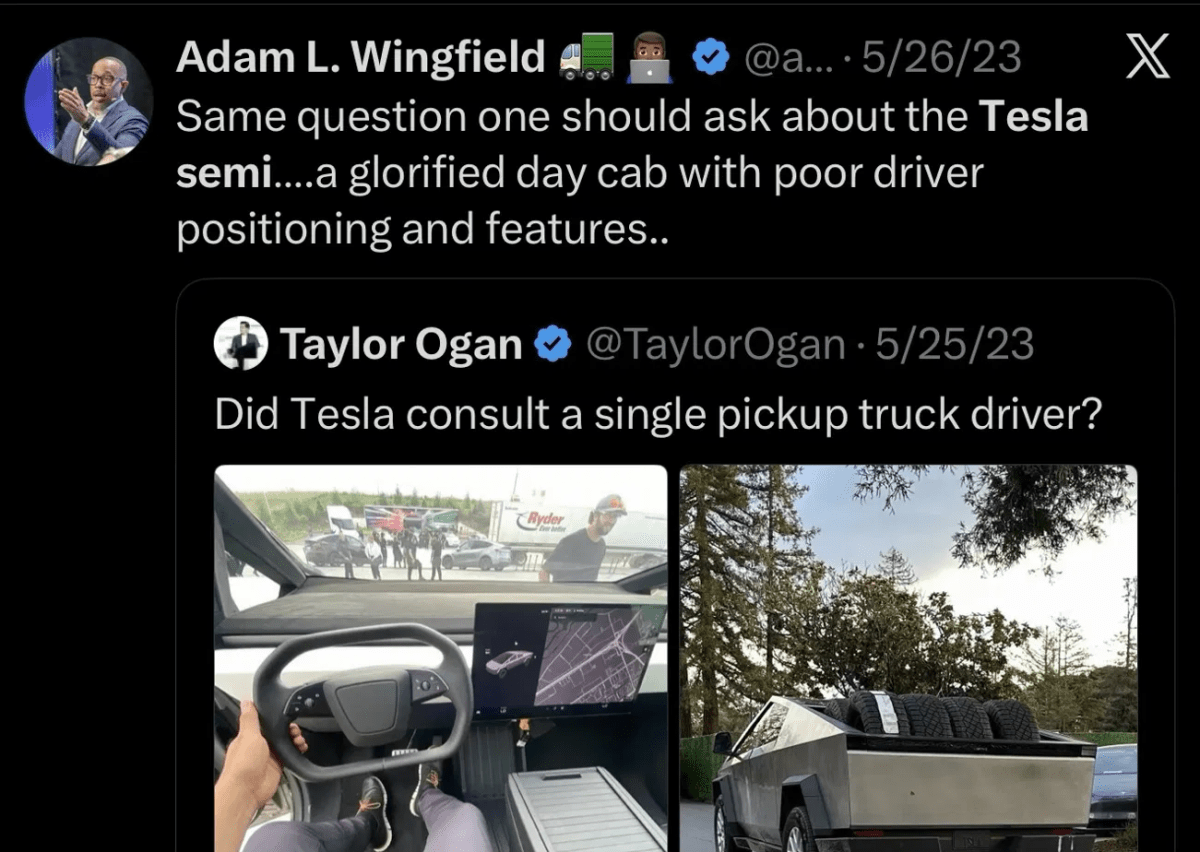
Back in May 2023, I described the Tesla Semi as little more than a glorified day cab, with questionable driver positioning and a weak feature set. By July 2025, my view was still that, beyond its electric drivetrain, the truck had little to offer from a driver’s perspective. Conventional cab designs, I argued, were still far more comfortable, particularly as legacy manufacturers began introducing electric trucks without abandoning the cab standards they had established with their diesel models.
Then, in February of this year, I acknowledged that electrification could eventually prove to be the cheaper route, while continuing to argue that the Tesla Semi itself was overhyped and not particularly attractive. In April, when a video circulated showing a Frito-Lay Semi pulling away from a gate with what someone described as a “massive trailer,” I called the whole thing rage bait and pointed out that snack-hauling operations commonly use lift axles because the cargo fills the trailer long before it reaches its weight limit.
So there was never much ambiguity about where I stood.
I have held a Class A CDL with a hazmat endorsement for most of my adult life and have spent nearly three decades around the trucking industry. I have also been one of the louder skeptics of Tesla’s truck.
Then I drove one. Loaded.
Here is what survived that experience and what did not.
What I was actually worried about
My doubts came down to three fundamental questions.
First, could the advertised range hold up once the truck was dealing with actual freight and real-world weight?
Second, did a company best known for passenger cars really understand what trucking demands from a driver across a fourteen-hour workday?
And third, what about the center-mounted driver’s seat? From the outside, it looked like a decision made by people who had never had to back a 53-foot trailer into a difficult dock.
One of those concerns remains.
The other two started falling apart within the first few miles.
The seat I was prepared to hate
You climb into the Semi and find yourself sitting directly in the middle, with screens positioned on both sides.
Every instinct I have says that arrangement should feel wrong. I have spent my career with a door and a window on my left and a lot of truck on my right. That layout has become muscle memory after decades behind the wheel. Sitting in the center feels like walking into a familiar room and discovering that somebody has moved all the furniture.
Tesla’s argument is that the conventional side-by-side driving layout dates back to the horse-and-buggy era, while modern trucking is overwhelmingly done by a single driver. Build the cab around that person, Tesla’s logic goes.
It is difficult to dismiss that reasoning. Team operations exist, but most trucking is still performed solo.
And in actual use, the forward view is better than anything I have experienced in a truck.
Because you are looking directly along the centerline of the vehicle rather than from one side of it, you are no longer estimating where the right side of the truck sits. You can actually see it.
Lateral visibility relies on a combination of cameras and mirrors. The honest assessment is that it works. It is also different, and different takes time.
I was not going to become completely comfortable with a camera-and-mirror system in a single driving session, and neither would anyone else. But the blind-spot problem I expected to encounter simply did not materialize in the way I thought it would.
That was the first major hit to my old argument about poor driver positioning.
The window tells you more than the brochure does
Sometimes a small change reveals more than an entire specification sheet.
Earlier versions of the truck had a pop-out window. The production version has a window that rolls down.
That change came after customer feedback, with Tesla acknowledging that the original decision was wrong.
The explanation is straightforward. Badge readers, toll booths, call boxes and security shacks are all positioned around window height. A small pop-out window can make every one of those interactions unnecessarily difficult.
The production window still is not as large as the one in a conventional truck, but it is large enough to be useful and, importantly, it rolls down.
That matters to me more than many of the headline specifications.
It means Tesla listened to people who actually pull up to gates for a living. It also means the company was willing to admit publicly that it had made the wrong call.
That kind of response is not especially common in the trucking industry.
The brake pedal changed my opinion
This was the biggest surprise of the drive and the feature I would put at the top of the list when discussing my first impressions.
You barely need the service brake.
Regenerative braking does so much of the deceleration that it completely changes the rhythm of driving. Lift off the accelerator and the truck slows decisively, even when it is loaded.
This is not the gentle coast you get when you lift off a diesel and use the low setting on the Jake brake. It is much closer to having the engine brake working hard on a grade, except the effect is happening constantly in traffic, on ramps and as you approach a dock.
Think about what that could mean for drivers who spend their days running mountain grades.
Brake fade. Heat. Constant snubbing on descents. Watching air pressure gauges. Hoping the driver ahead of you understands what he is doing.
I did not run the Tesla Semi down a mountain grade, so I am not going to claim regenerative braking eliminates those concerns.
What I can say is that, on flat ground with a loaded trailer behind me, the service brake became something I used at the very end of a stop rather than something I relied on throughout the entire process.
The maintenance implications are obvious enough to calculate yourself.
Shoes, drums, air-system components and the labor associated with maintaining them all represent costs. If regenerative braking handles the majority of deceleration on a regional route with frequent stops, that could move a meaningful maintenance expense in the right direction.
I am not assigning a dollar figure to it because I do not have one. Anyone producing a precise number today is making the same kind of guess I was making before I drove the truck.
Steering, turning and the power everyone keeps talking about
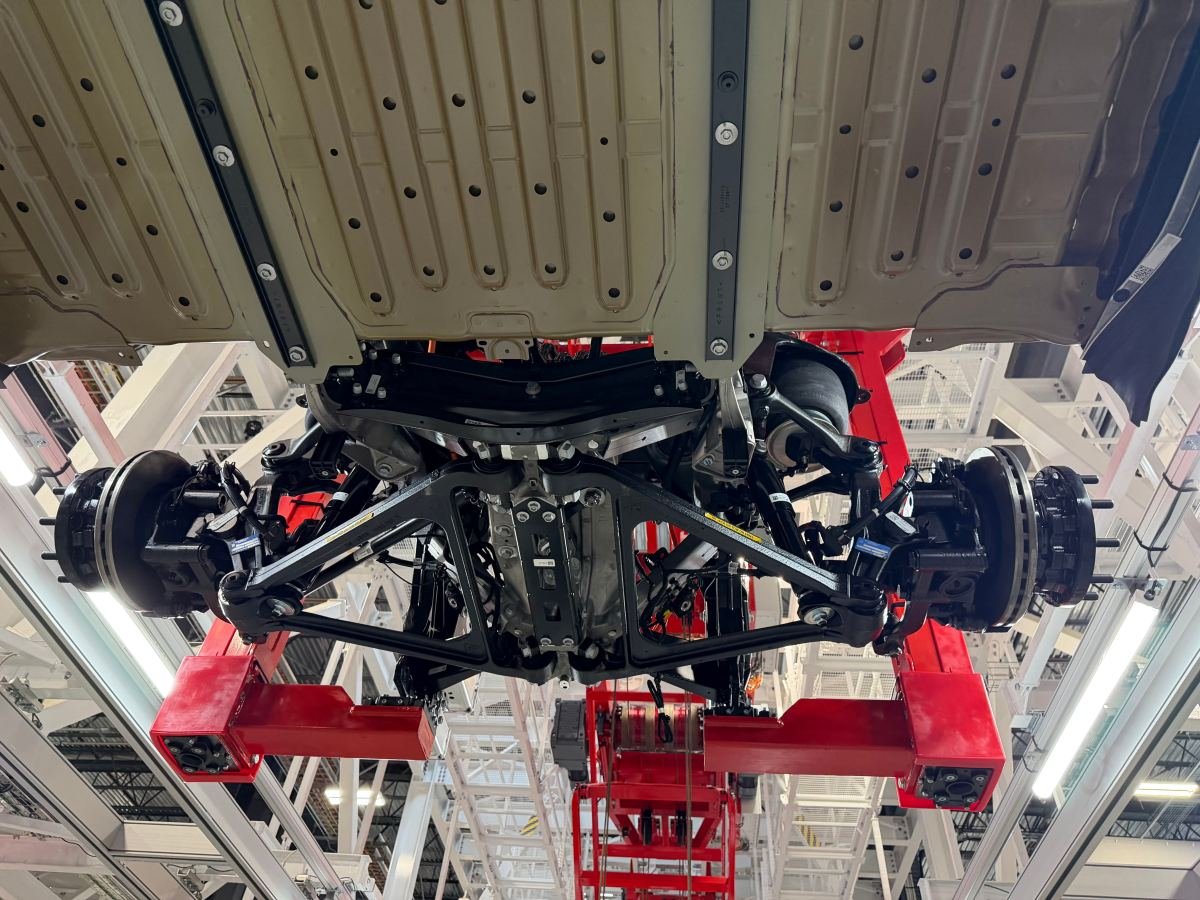
The Tesla Semi uses a fully electric steering system with redundancy and no hydraulic loop anywhere in the truck.
You notice that immediately.
Steering response feels quicker and more precise than any Class 8 I have driven. Instead of aiming the truck and then correcting, you put it where you want it and it goes there.
Tesla also says the steering geometry gives the truck a turning radius close to that of a Model Y. In tight spaces, that makes a real difference.
For a professional driver, steering precision is not a luxury item. It can mean the difference between coupling a trailer successfully on the first attempt in a crowded yard and getting out of the cab three times to check your positioning.
Then there is the power.
It does everything Tesla says it will do.
When I connected to a loaded trailer, I actually asked the engineer riding with me whether the trailer was really loaded because the truck felt as though it had almost nothing behind it.
He told me to check the onboard weight display.
The weight was there.
Tesla lists 800 kW of drive power from three independent rear motors, and once you are behind the wheel, the acceleration with a load is undeniably impressive if your frame of reference is diesel trucks.
But acceleration is the most heavily marketed characteristic of virtually every electric vehicle, and that was one of the reasons I originally considered the Semi overhyped.
Yes, merging with a loaded trailer is significantly easier, and there is a legitimate safety argument to be made for that.
But acceleration still is not the reason I would buy this truck.
Ride quality is far more interesting.
The cab is hard mounted rather than air mounted, which, on paper, should make the ride worse.
It does not.
Because there are no differentials mounted at each drive axle, you do not get the familiar cab rise associated with torque transfer. Road noise is noticeably lower, and the truck uses acoustic glass as well.
After eleven hours behind the wheel, lower noise stops being a luxury and becomes a comfort feature.
That was the second major blow to my earlier assessment, because I had previously said conventional cabs were dramatically more comfortable than the Tesla.
The features drivers would actually notice
The driver profile follows you.
Walk up to another truck in the fleet with your phone, open the door and the vehicle brings your seat, mirrors and other settings with you.
Anyone who has dealt with a slip-seated truck knows the frustration of climbing into the cab and spending several minutes getting the seat, mirrors and personal preferences back into the position your body needs.
The Tesla eliminates a lot of that hassle.
The pre-trip inspection is different too.
Much of what you check is presented on a screen, while some of the components you would normally inspect simply are not there anymore.
There is no hydraulic steering circuit, so there is no steering-fluid leak to hunt for.
Three different oils have been reduced to one.
The wheel hubs run dry.
The refrigerant lines that normally extend forward through a conventional truck are gone.
Fewer components mean fewer things that can leak.
That is not really a Tesla marketing argument. It is simply what happens when you remove parts.
The broader engineering philosophy is essentially Tesla’s longstanding idea that the best component can be the component you do not need in the first place.
The trip planner is another important part of the package. It takes weather, traffic and changes in payload into account, adjusting the range estimate after a pickup or delivery instead of leaving the driver to guess whether the original estimate still applies.
The dock is where I really changed my mind
Backing the truck is the ultimate test.
It is the first thing many drivers think about when they hear the words “center seat,” and it was the part of the truck I expected to dislike the most.
There is a genuine disadvantage.
From the center position, you lose the traditional move of leaning out the driver-side window and looking directly down the driver’s side of the trailer.
That is real, and I am not going to pretend otherwise.
But the center position gives you something in return: symmetry.
Both sides of the truck are the same distance from the driver. The camera views are equivalent on both sides. You no longer compensate for the driver-side bias that you have spent years learning to work around.
Combine that with the steering precision and the tight turning geometry, and the overall result was better than I expected.
Setting up for the backing maneuver required fewer corrections.
The truck went where I pointed it.
I would still tell a fleet to give an experienced driver a couple of weeks before making a final judgment, because moving to the center means unlearning habits that have been built over years.
But the issue I criticized most aggressively turned out to be the issue on which I was most wrong.
Where my skepticism still stands
There are still two major areas where I remain unconvinced, and neither one has much to do with the actual driving experience.
The first is weight and freight.
Tesla’s published specifications put the Long Range version at 500 miles of range with a curb weight of roughly 23,000 pounds. The Standard Range version is rated at 325 miles and weighs less than 20,000 pounds.
Both are rated at a full 82,000-pound gross combination weight, reflecting the 2,000-pound federal allowance for electric trucks.
The issue is obvious.
The version offering the range most likely to interest regional operators is also the heavier version. That means the available payload declines when the freight actually weighs out.
And that is exactly why my earlier Frito-Lay argument still stands.
Snack freight fills a trailer long before it reaches the vehicle’s maximum weight. That is why this kind of operation naturally showcases the Semi in a favorable environment.
Show me one hauling 46,000 pounds of canned goods all day, and then we can have a different conversation.
The second concern is infrastructure.
There is no sleeper cab, and Tesla is fairly direct about the reason.
Until there is a dependable over-the-road charging network, putting a sleeper on the truck does not make much sense. The chassis, however, is designed to accommodate one when conditions eventually change.
The operating model is straightforward on paper.
Run the truck down through its available range, recover about 60% of the battery in roughly 30 minutes using 1.2 MW charging during the break you were going to take anyway, and continue the trip.
The model works provided the charger is exactly where you need it, it is functioning when you arrive, and another truck is not already occupying it.
Every driver knows how realistic those assumptions can be at a busy truck stop on a Monday night.
What changed after the drive
That is where I ended up after finally driving the Tesla Semi, and honestly, it surprised me.
My remaining doubts are no longer primarily about the truck itself.
They are about everything surrounding it.
The vehicle is further along than I gave it credit for.
The infrastructure is not.
And no amount of engineering inside the cab can solve what is missing outside the truck.
I will also say one thing plainly, given how long I have been on the record about this vehicle:
It is still not as beautiful as a classic Kenworth W900.
I just would not make that the lead argument anymore.
Why it matters
I climbed into the Tesla Semi expecting to find a piece of technology designed by people who had never actually done the job.
Instead, I found a truck whose most consequential changes are often the things Tesla removed rather than the things it added.
That is exactly the engineering instinct you want from anyone who understands that a truck sitting in a repair bay is not making money.
So if you get an opportunity to drive one, judge it by the brake pedal and the steering before you judge it by acceleration.
Those are the two areas where it became obvious that someone had seriously considered the person sitting in the driver’s seat.
Then judge everything else against the routes you actually run, the freight you actually haul and the infrastructure you actually have to use.
A truck can be impressive and still be a poor match for a particular operation.
But it should not be judged before it is driven.