Maritime Nov 10, 2026
Tristar calls on maritime industry to strengthen crew protection amid conflict and isolation
Safety at Sea conference puts seafarer mental health, shore leave, visible leadership and onboard solidarity at the heart of shipping's safety agenda.
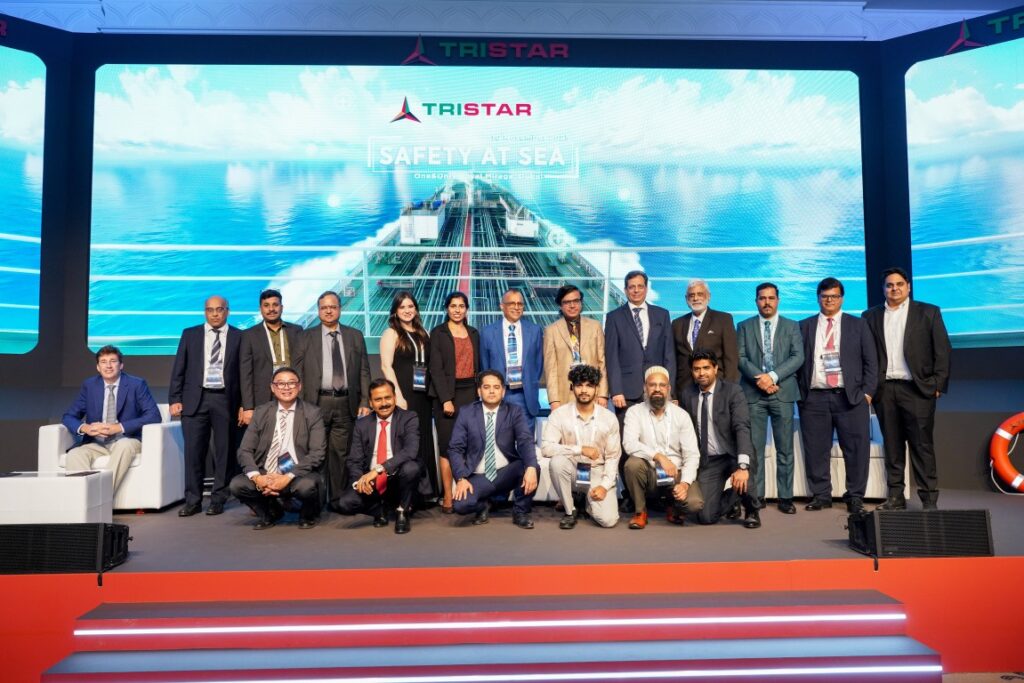
The growing impact of geopolitical tensions, social isolation and mounting operational pressures on seafarers has become a major concern for the maritime industry. At Tristar's Safety at Sea conference, industry representatives called for stronger measures to protect crew members, improve mental health support and establish a safety culture in which every seafarer, regardless of rank, feels empowered to speak up.
The conflict in the Middle East was a central concern throughout the event, attended by industry professionals in person and dozens of seafarers participating remotely from Tristar offices and vessels worldwide. Before proceedings began, the venue manager delivered a safety briefing covering emergency procedures and assured participants that no specific threat had been identified in the UAE at that time.
Addressing the human consequences of the regional conflict, Dr Emmadi Vashnu Vardhan Reddy, India's consul general, highlighted the severe toll on Indian maritime personnel who continue to play an essential role in maintaining international trade and economic activity.
He reported that nearly 12 Indian seafarers had lost their lives, two remained missing and 17 had sustained serious injuries. In addition, 172 seafarers had been repatriated to India for various reasons.
Reddy urged shipping companies and industry stakeholders to establish working environments in which crew members can openly discuss their difficulties without fear. He also stressed the importance of making professional support systems accessible to all seafarers and ensuring that company culture is driven by visible commitment from senior management.
The relationship between psychological wellbeing and operational safety was also a major theme in the keynote address delivered by HE Abdullah Al Hashmi, global COO, parks and economic zones, DP World. He argued that mental health should receive the same level of attention as equipment inspections, routine safety exercises and risk assessments.
Al Hashmi also pointed to the Jebel Ali International Seafarers Centres as valuable facilities for crew members seeking rest and opportunities to maintain social connections while their vessels are in port. The centres provide services that include counselling and medical check-ups.
Shore leave remains a persistent challenge
Access to shore leave continues to be one of the recurring concerns identified by the Seafarers Happiness Index. Tight port turnaround schedules, security restrictions, demanding workloads and transport difficulties frequently prevent crew members from spending meaningful time ashore.
Ben Bailey, director of programme at Mission to Seafarers, discussed the issue on the sidelines of the conference with Seatrade Maritime News. He explained that shore leave had historically been difficult to obtain in the Middle East and that the current regional instability had made the situation even more complicated.
Bailey also stressed that the problem extends beyond the region. According to him, shore leave opportunities have never fully returned to their pre-pandemic levels, raising concerns not only about seafarers' mental health and wellbeing but also about vessel safety and the security of the maritime routes on which they operate.
The welfare of the crew is increasingly becoming a business priority
Conference participants also highlighted the responsibility of shipping companies to foster workplace cultures where seafarers feel respected, supported and confident to raise safety concerns, as well as to improve access to support services and shore leave.
Anurag Agarwal, who leads portfolio management for global transportation group at JP Morgan, looked at the issue from a financial and investment perspective. He said that the wellbeing of the crew should be a core business priority, not an optional expense.
“The quality and management of crewing is an important factor in risk assessments and investment performance,” he said, as the decisions and actions of a seafarer can create value or generate additional costs.
JP Morgan’s maritime exposure comprises a fleet of around 200 vessels with 3,500 seafarers. The group also has exposure to another 1,000 vessels and some 30,000 seafarers through its stake in OSM Thome.
Agarwal said indicators that were traditionally tracked via financial and operational metrics like crew retention and safety performance have become measurable indicators of business performance increasingly. He said crew wellbeing and safety are now standard starting points in board discussions and management is updated on the condition of personnel onboard.
Seafarers are the human, most valuable asset of the company’s balance sheet and it is important to protect and retain this workforce, he said.
Leadership and freedom to speak up as indicators of safety
While participants in the conference agreed on the importance of crew wellbeing in general terms, they pinpointed different methods of assessing whether shipping companies are effectively turning their commitments into everyday practice.
One of the clearest indicators of a company’s safety culture is the number of junior seafarers who raise safety concerns and invoke their stop-work authority, according to Tristar Maritime Logistics CEO Tim Coffin.
Coffin values especially the willingness of the lowest-ranking personnel to step in. This demonstrates that safety responsibilities are shared throughout the vessel and that employees are not prevented from acting by hierarchical considerations.
He said a ship has 20 pairs of eyes to spot hazards. "Risk is no respector of rank," he added. All of the crew’s observations therefore warrant equal weight. “The effective use of stop-work authority by junior sailors is a strong indication that safety principles are truly embedded in onboard operations,” he said.
The complimentary view came from Salvatore d’Amico, chairman of Ishima, who focused on the relationship between senior management and the people across its fleet.
“How well does the workforce know the senior executives that would be my yardstick for how committed a company is to its seafarers,” he said. For d’Amico, knowing the workforce means looking beyond operational and financial figures and recognizing the people behind them.
Agarwal stressed the importance of crew retention as a key indicator for both vessel management and the quality of life for seafarers onboard.
“The fact that you have the same crew members coming back to vessels means that you are doing the right things with the ships, you are maintaining ships the right way, and the personnel feel supported enough to come back and work for the company,” he said.
This indicator is being closely watched by JP Morgan and at present stands at 97%, said Agarwal. Even with the high retention rate, he said there was room for improvement in the remaining three percent.
The discussions at Tristar’s Safety at Sea conference reinforced a broader message for the maritime industry: the protection of the seafarer requires more than formal safety procedures. Mental health support, access to shore leave, management engagement and the ability to raise concerns without fear must all become integral elements of responsible shipping operations.
END OF REPORT