



UN Trade and Development (UNCTAD) has issued a fresh warning over the mounting economic consequences of disruption in the Strait of Hormuz, saying the waterway remains effectively closed and that the fallout is now extending well beyond shipping.
In a rapid assessment report supported by a series of infographics, UNCTAD said average daily transits through the Strait fell by 95% between February and March. From an average of 129 vessels per day in February, traffic dropped to just six per day in March.
The reopening of the Strait has become a major geopolitical priority, with multiple heads of state now focused on restoring flows through one of the world’s most strategically important shipping lanes. UNCTAD noted that Iran has effectively shut the route, while still allowing selected transits for vessels linked to its allies and customers.
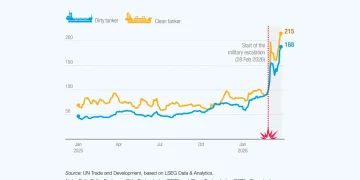
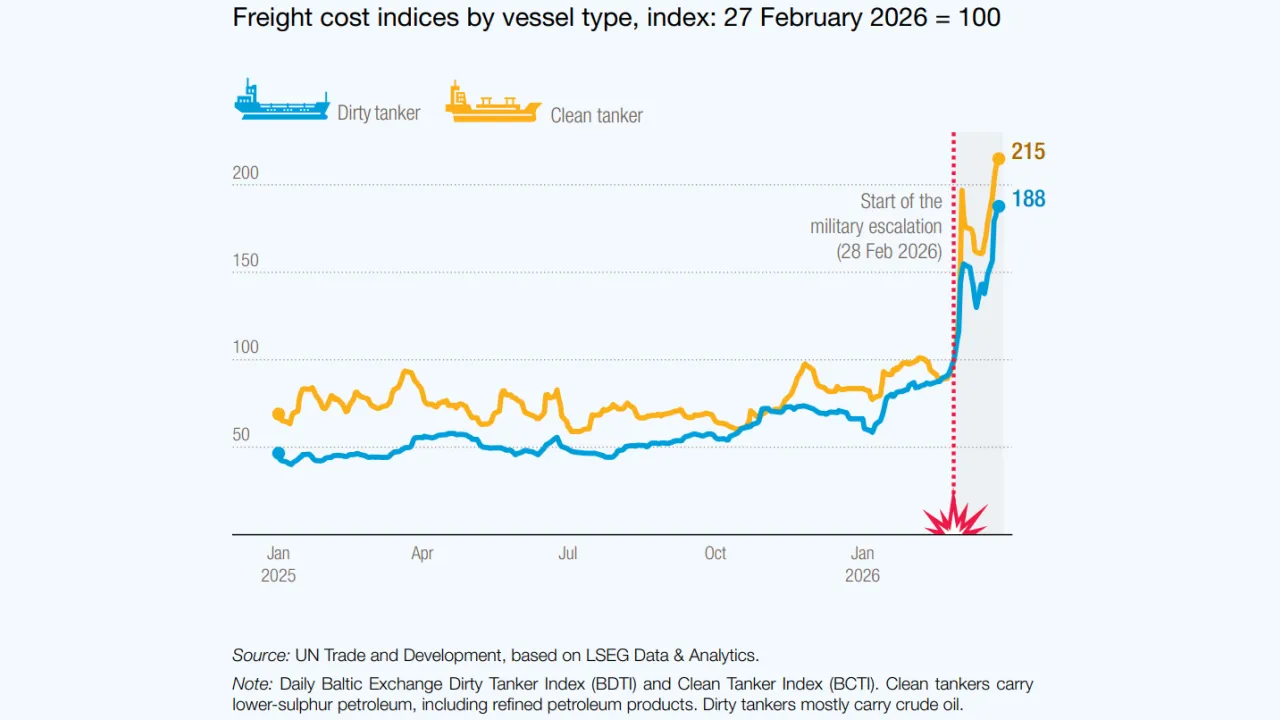
The disruption has already sent shockwaves through energy and freight markets. According to UNCTAD’s graphics, both oil prices and the cost of transporting oil have risen sharply since US and Israeli attacks on Iran began on February 28. Using February 27 as a benchmark index of 100, dirty tanker rates had climbed to 188 by late March, while clean tanker rates rose even further, reaching 215.
Beyond maritime transport, UNCTAD’s analysis points to wider macroeconomic stress. Its charts highlight the historical relationship between oil prices and inflation, showing that while inflationary trends tend to follow similar patterns across countries, the impact is consistently more severe in developing economies.
That pressure is now expected to weigh on trade and growth through the rest of the year. UNCTAD forecasts annual merchandise trade growth in real terms will slow to between 1.5% and 2.5% in 2026, a sharp drop from the estimated 4.7% growth recorded in 2025.
Global GDP is also expected to weaken. UNCTAD projects world economic growth of 2.6% in 2026, made up of 4.1% growth in developing economies and 1.5% in developed markets.
Currency markets are also reacting. The trade body said the appreciation seen in some developing countries during the first two months of 2026 has now reversed, with sharp depreciation against the US dollar across Africa, Latin America and the Caribbean, as well as developing economies in Asia and Oceania.
To limit the wider fallout from the war in Iran, UNCTAD is urging governments to adopt a policy mix aimed at stabilising prices as inflationary pressures intensify, particularly for more vulnerable populations. It also recommends measures to prevent systemic risk from spreading across the energy, trade and financial systems, while calling for development banks to be given greater scope to provide emergency lending support.