



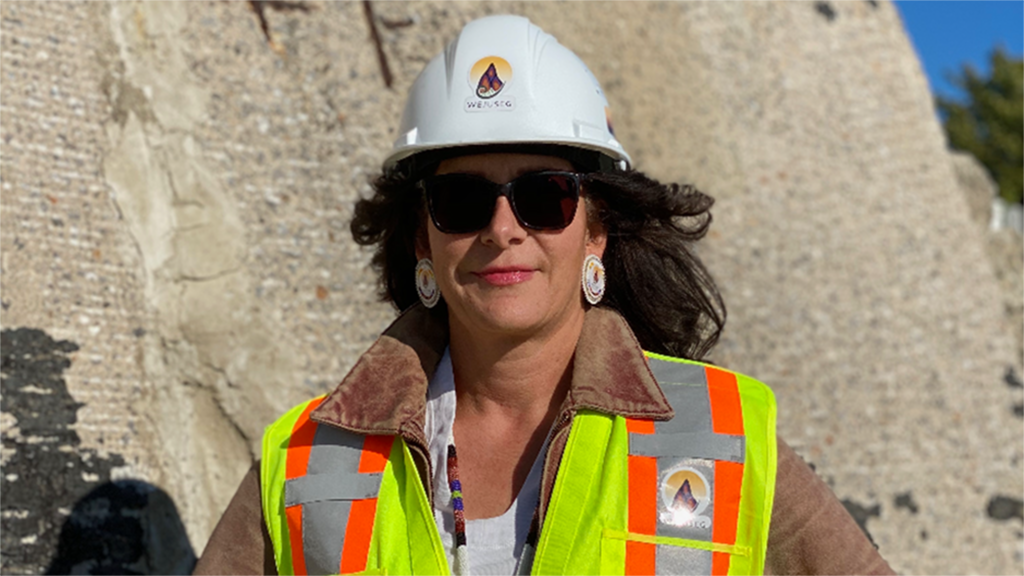
Victoria LaBillois built a construction company on her own, with little guidance, and now she is focused on helping the next generation of Indigenous entrepreneurs overcome the challenges she faced when she started her business.
In 2011, LaBillois made history as the first Mi’gmaq woman to start and operate a construction company outside her home community of Listuguj, Quebec. She started Wejipeg Excavation and went into the business with no experienced mentors to walk her thru the realities of running a construction business.
Instead, she used sheer determination, a Master of Business Administration (MBA) and countless hours of on-the-job training to navigate regulatory requirements, pricing strategies and industry networks.
LaBillois says much of her journey was a trial and error process, looking back on those early years. She believes an experienced mentor could have saved hundreds of hours and given her a valuable sense of confidence during the company’s formative years.
That experience is one of the main reasons she will be attending the Rezolution Summit, in Toronto on August 11 and 12, where Indigenous wealth creation and economic sovereignty will be the central themes.
Mentorship is one of the key themes of the summit. The organizers have encouraged participants to bring their mentees along, highlighting the value of sharing knowledge between experienced business leaders and up-and-coming entrepreneurs.
Before the conference, LaBillois will host a pre-summit workshop on social capital, or the relationships and professional networks that often dictate success in business. She will be providing practical tips on how to cultivate meaningful connections and asks that attendees actively implement those networking techniques during the event.
LaBillois says she’s seen improvements over the last decade in opportunities for Indigenous entrepreneurs, especially in remote communities, but she’s still sure mentorship is key to business success.
“You’re seeing more economic development officers, Indigenous financial institutions, regional support organizations that now give entrepreneurs better access to business resources, financial literacy programs, and professional guidance,” she says.
For LaBillois, entrepreneurship has always been part of the Indigenous culture.
She often says to young entrepreneurs that First Nations communities had big trade networks across North America before modern business systems, stressing that investing, trading and wealth creation are deep-rooted traditions, not new ideas.
Despite the progress, Indigenous business owners still face major hurdles, LaBillois says.
She came from almost 20 years in Indigenous public service and experienced discrimination first hand before founding her company. She recalls being called ‘the Indian loader’ on a building site, and being refused a commercial fuel account because a supplier said it did not do business with the reserve.
She also points out that Indigenous-owned companies can still struggle more than many other businesses to get insurance.
She says while there is a growing awareness of these issues, racism is still too often ignored until it cannot be ignored.
Rather than let those experiences define her career, LaBillois says she’s always kept her focus on producing quality work and pushing thru barriers.
She also says that while she never saw being a woman as a barrier in construction, gender inequality still exists across the industry, even if things are slowly getting better.
“Indigenous women now lead roughly 23% of Indigenous businesses, a growth rate that is outpacing the growth rate of women-owned businesses in the non-Indigenous economy,” said LaBillois.
She also believes Indigenous youth are a key solution to Canada’s labor shortages. “Increasing access to training, employment and entrepreneurship opportunities could be a major boost for the construction workforce with Indigenous people being the largest demographic in the country under the age of 25,” she said.
LaBillois sees Indigenous participation in major infrastructure and construction projects increasing in the future, with more businesses taking equity positions in large-scale developments, instead of just as contractors.
Her long-term hope is for Indigenous inclusion to be a matter of course, rather than a specific requirement for hiring or procurement.
Indigenous businesses already contribute almost $50 billion annually to Canada’s economy and LaBillois said she remains optimistic about the future and believes the momentum toward greater Indigenous economic participation will continue to accelerate.