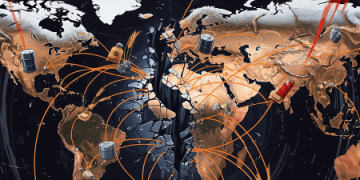




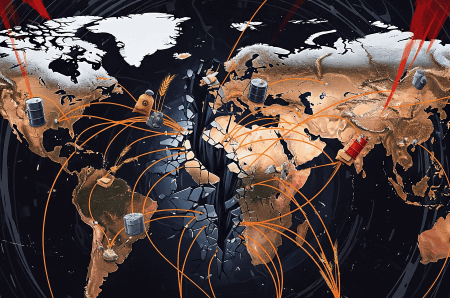
The global supply chain no longer operates in an implicit “single market.” It is sliding toward a bloc structure, where the economy, trade, and transport are increasingly organized around regional spheres of influence. This is one of the major signals highlighted by Seatrade: geopolitics is reshaping routes, investment decisions, and even capacity strategies.
In this reading, the military event mentioned in the analysis is presented as a symptom: beyond the targeted country, it is a message of power in a broader competition for influence. The central idea is that this evolution is not a one-time reaction, but the result of a long movement: the rise of new investment zones, the redeployment of economic alliances, and the repositioning of states on strategic corridors.
For freight professionals, the consequence is immediate: uncertainty becomes structural. The risks are no longer limited to congestion or fuel costs; they include the possibility of regulatory disruptions, forced redirections, or commercial priorities dictated by politics rather than pure optimization.
This fragmentation also implies a transformation of transport procurement: more partner diversification, more redundancy on routes, and increased attention to compliance (sanctions, controls, restrictions). In clear terms: the high-performing supply chain of 2026 will not only be “cheaper,” it will primarily be more resilient—with operational backup plans, multi-regional networks, and quick trade-offs between reliability, cost, and delivery time.