



Carbon capture at sea is taking on a new dimension, with a project that links maritime emissions reduction directly to agricultural production on land.
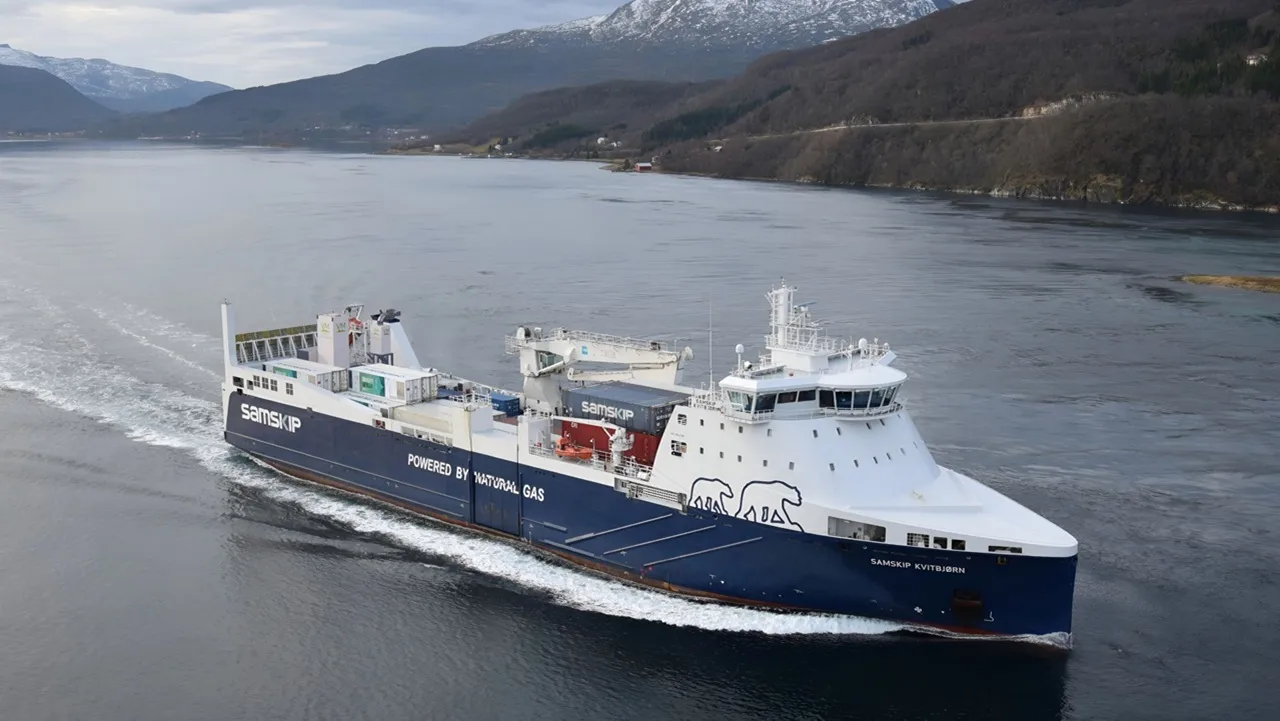
Value Maritime, together with its partners in the Maritime Efficient & Easy Carbon Capture (ME2CC) consortium, has secured funding to install a compact carbon capture and storage system on board the Samskip Kvitbjorn. The vessel is a 4,900 dwt con-ro powered by a 4MW LNG unit, with 900 lane metres of ro-ro storage and capacity for 220 teu.
Because the Samskip Kvitbjorn runs on LNG, it does not require a scrubber for high-viscosity fuel, making it suitable for what is described as the first standalone CCS system of its kind, with captured carbon stored on board.
According to the company, the ME2CC project is designed to create a scalable and compact CCS solution using patented techniques that reduce the system’s height and footprint by up to one-third compared with conventional absorption technologies, while still maintaining low pressure drop.
Installation of the system is expected to begin next year. Michela Bassignani, commercial manager at Value Maritime, said the solution is especially well suited to smaller operators with frequent port calls, although the company also intends to make it attractive to larger vessels over time. In its current form, the system is expected to capture up to 75% of emissions from engines in the 3MW to 20MW range.
For ships on shorter routes, amine and carbon solutions can be stored in 20ft ISO containers with a capacity of about seven tonnes. Value Maritime has developed the system as a scalable modular solution. These containers can be offloaded regularly, while larger ships would require retrofitted fixed tanks. In those cases, captured carbon could be discharged quayside either to a truck or via pipe to a barge positioned alongside.
The Samskip Kvitbjorn operates on a fixed 14-day rotation between Rotterdam and Hammerfest in Norway, creating a practical framework for a sea-to-land carbon recovery chain. In Rotterdam, the amine and carbon liquid can be unloaded at a land-based handling plant, where heat is used to separate the carbon from the amine solution. The recovered gas is then transferred to a neighbouring tomato production facility.
This arrangement means much of the large processing equipment can remain ashore rather than on the vessel. It also creates a circular model: the tomato grower, which uses extensive greenhouses and is located next to Value Maritime, can reduce its dependence on externally sourced CO2 and instead use lower-cost, lower-impact carbon recovered from the Samskip vessel. The company also noted that the carbon does not need to be liquefied and can be processed when conditions are optimal.
The ME2CC consortium is led by Value Maritime and includes Samskip, B2B Marine, Fusie Engineers, Devoteq, Brusche Process Technology, Heatmaster, Yard Energy Group and the crop farm involved in the project.