

• Latest
  • Trending
Why mid-haul intermodal is gaining ground in modern supply chains

Why mid-haul intermodal is gaining ground in modern supply chains

April 14, 2026
FedEx Freight bets on scale, technology and targeted sectors for post-spin growth

FedEx Freight bets on scale, technology and targeted sectors for post-spin growth

April 14, 2026
PVH expects to double tariff mitigation in 2026 as duty costs remain a major risk

PVH expects to double tariff mitigation in 2026 as duty costs remain a major risk

April 14, 2026
ADVERTISEMENT
UPS expands RFID programme across U.S. network to improve visibility and cut manual scans

UPS expands RFID programme across U.S. network to improve visibility and cut manual scans

April 14, 2026
Sportsman’s Warehouse sharpens focus on inventory timing to improve turns

Sportsman’s Warehouse sharpens focus on inventory timing to improve turns

April 14, 2026
Port of Los Angeles says Iran conflict is being watched closely but trade remains stable

Port of Los Angeles says Iran conflict is being watched closely but trade remains stable

April 14, 2026
CBP sets April 20 launch for tariff refund portal tied to IEEPA rulings

CBP sets April 20 launch for tariff refund portal tied to IEEPA rulings

April 14, 2026
SkyCell launches 6500X for larger multimodal pharma shipments

SkyCell launches 6500X for larger multimodal pharma shipments

April 14, 2026
Hong Kong stays on top as ACI reveals 2025’s busiest cargo airports

Hong Kong stays on top as ACI reveals 2025’s busiest cargo airports

April 14, 2026
Euroairlines turns to AI through strategic partnership with Sopra Steria

Euroairlines turns to AI through strategic partnership with Sopra Steria

April 14, 2026
Thule to centralise European distribution with new automated warehouse in Poland

Thule to centralise European distribution with new automated warehouse in Poland

April 14, 2026
OOCL sees first-quarter earnings weaken as freight rates continue to normalise

OOCL sees first-quarter earnings weaken as freight rates continue to normalise

April 14, 2026
Washington permanently bars public funding for port automation

Washington permanently bars public funding for port automation

April 14, 2026
  • Home
  • About Us
  • Press Room
  • Podcasts
  • Media Kit
  • Contact Us
  • Careers
Wednesday, April 15, 2026
  • Login
  • Register
The Logistic News
  • Logistic
  • Air
  • Maritime
  • Land
  • World
  • Business
  • Tech
  • Events
  • Advertise
No Result
View All Result
  • Logistic
  • Air
  • Maritime
  • Land
  • World
  • Business
  • Tech
  • Events
  • Advertise
No Result
View All Result
The Logistic News
No Result
View All Result
Home EchoChain

Why mid-haul intermodal is gaining ground in modern supply chains

Rising visibility, stronger security and better economics are making intermodal a viable option far beyond traditional coast-to-coast lanes.

The Logistic News by The Logistic News
April 14, 2026
in EchoChain, Land, Logistic
Reading Time: 3 mins read
0
Why mid-haul intermodal is gaining ground in modern supply chains
ADVERTISEMENT

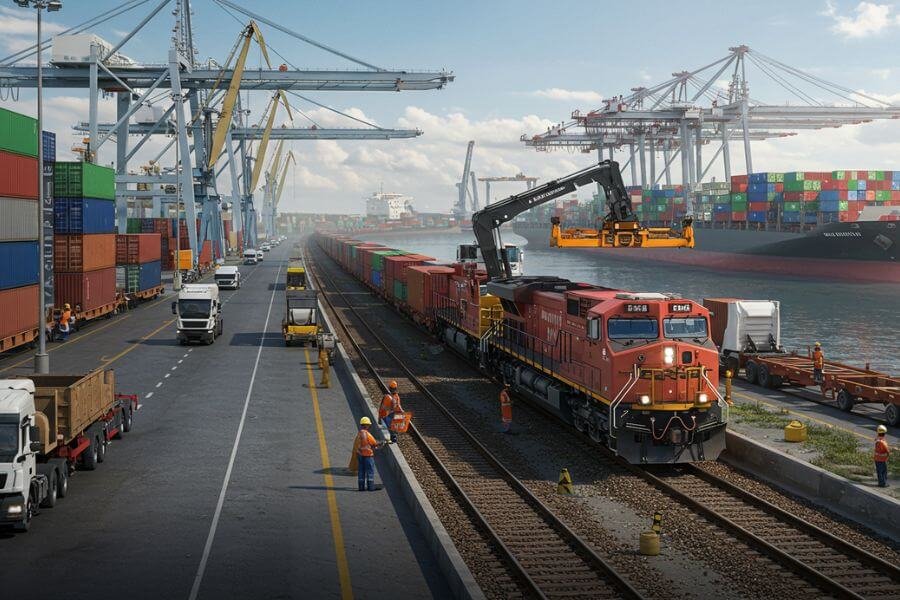
Intermodal is increasingly being repositioned from a slow, long-haul alternative into a practical and strategic option for a much broader range of freight movements, including regional and mid-haul lanes.

For years, intermodal was widely seen as best suited only to coast-to-coast transport where shippers were willing to sacrifice speed and visibility in exchange for lower cost. That view is now changing as service quality, security and tracking capabilities improve.

Today’s intermodal offerings can combine end-to-end visibility, strong sustainability performance, enhanced security and competitive transit times, even on lanes of 600 to 1,000 miles. In a market shaped by fuel volatility and tightening truckload capacity, that is making intermodal an increasingly valuable tool in supply chain design.

ADVERTISEMENT

According to Nate Browne, senior vice president of intermodal at Werner Enterprises, the 600- to 1,000-mile segment is emerging as a new sweet spot. He said it gives shippers a way to avoid volatility in the spot truck market on routes that are long enough to challenge solo truck transit in one day but short enough to preserve high-velocity service.

Intermodal has been the fastest-growing major rail traffic segment over the past 25 years, helped by continued investment in GPS-enabled equipment, high-security technologies and systems that build on its traditional advantages of lower cost and significantly reduced CO2 emissions compared with trucking.

That evolution is expanding the range of lanes where intermodal makes sense. Werner points to corridors such as southern Georgia or northern Florida into Miami-Fort Lauderdale, routes not traditionally viewed as natural intermodal territory. Through partnerships such as its link with Florida East Coast Railway, the company says it can now compete with truck-only solutions on both cost and transit.

Intermodal is also becoming more competitive in traditional backhaul lanes such as the northeast to Chicago or Atlanta, where it has historically struggled to match truck transit on shorter lengths of haul.

A major part of that shift is visibility. Intermodal was once criticised for “dark periods” when shippers lost sight of cargo between origin and destination. Carriers are increasingly using GPS-enabled containers and integrated data systems to provide tracking that rivals or, in some cases, exceeds road transport.

Werner says its proprietary EDGE platform combines rail EDI data with GPS tracking on private assets to provide a single-pane-of-glass view across terminals, shipping points, receiving points and key checkpoints.

Transit performance is also improving. On some dense regional corridors, modern intermodal service now runs at roughly truck-plus-one-day timing, while expedited rail options can in some cases match over-the-road service altogether.

The environmental case is also strengthening. The Association of American Railroads has found that rail is around four times more fuel-efficient than trucks, meaning a shift from road to intermodal can reduce CO2 emissions by up to 65%. For shippers under pressure to cut Scope 3 emissions, that has become a major advantage.

Security and asset control have also advanced. Werner’s model includes more than 600 private containers and incorporates GPS cargo sensors, cargo cameras, door sensors, high-security seals and dedicated locking systems. The company says its facilities in Laredo and El Paso are C-TPAT certified and equipped with controlled access and continuous surveillance.

Operationally, regional intermodal is also helping some shippers reduce dependence on volatile truckload markets, especially during seasonal surges. By shifting the long-haul segment to rail, companies can support Hours of Service compliance for drivers while keeping drayage operations within local or regional radii, allowing drivers to complete shifts safely and return home daily.

The broader point, according to Werner, is that intermodal is no longer simply a booking decision but an engineered supply chain solution, combining technology, owned assets and strategic rail partnerships.

Browne said Werner’s model aims to deliver that through one-stop accountability, noting that the company owns both the drayage trucks and a private container fleet, an approach he says traditional brokers cannot match.


Previous Post

FedEx Freight bets on scale, technology and targeted sectors for post-spin growth

Leave a Reply Cancel reply

Your email address will not be published. Required fields are marked *

A D V E R T I S E M E N T

Popular News

  • Drone Delivery Takes Flight: Amazon Partners with UPS for Trial Program

    Drone Delivery Takes Flight: Amazon Partners with UPS for Trial Program

    0 shares
    Share 0 Tweet 0
  • Rail Cargo Group Strengthens European Network with Captrain Netherlands Acquisition

    0 shares
    Share 0 Tweet 0
  • Automotive Inbound Logistics Market: Navigating Future Challenges

    0 shares
    Share 0 Tweet 0
  • Global Inflation Cools to Target After Three Years, Central Banks Face Policy Dilemma

    0 shares
    Share 0 Tweet 0
  • Dubai Mercantile Exchange Rebrands as Gulf Mercantile Exchange Following Saudi Tadawul Group Acquisition

    0 shares
    Share 0 Tweet 0

Recent News

Why mid-haul intermodal is gaining ground in modern supply chains

Why mid-haul intermodal is gaining ground in modern supply chains

April 14, 2026
FedEx Freight bets on scale, technology and targeted sectors for post-spin growth

FedEx Freight bets on scale, technology and targeted sectors for post-spin growth

April 14, 2026
PVH expects to double tariff mitigation in 2026 as duty costs remain a major risk

PVH expects to double tariff mitigation in 2026 as duty costs remain a major risk

April 14, 2026

Discover a new era of logistics reporting with The Logistic News, your go-to platform for breaking news, insightful features, and exclusive interviews shaping the global logistics and freight landscape. Trust us to deliver accurate, timely, and relevant information that empowers professionals and enthusiasts alike in navigating the intricacies of this vital sector.

Navigation

  • Home
  • About Us
  • Press Room
  • Podcasts
  • Media Kit
  • Contact Us
  • Careers
  • Privacy Policy
  • Terms of Use

© 2024 - thelogisticnews.com

Welcome Back!

Login to your account below

Forgotten Password? Sign Up

Create New Account!

Fill the forms below to register

All fields are required. Log In

Retrieve your password

Please enter your username or email address to reset your password.

Log In

SIgn Up Newsletter

This will close in 20 seconds

Manage Cookie Consent
We use technologies like cookies to store and/or access device information. We do this to improve browsing experience and to show (non-) personalized ads. Consenting to these technologies will allow us to process data such as browsing behavior or unique IDs on this site. Not consenting or withdrawing consent, may adversely affect certain features and functions.
Functional Always active
The technical storage or access is strictly necessary for the legitimate purpose of enabling the use of a specific service explicitly requested by the subscriber or user, or for the sole purpose of carrying out the transmission of a communication over an electronic communications network.
Preferences
The technical storage or access is necessary for the legitimate purpose of storing preferences that are not requested by the subscriber or user.
Statistics
The technical storage or access that is used exclusively for statistical purposes. The technical storage or access that is used exclusively for anonymous statistical purposes. Without a subpoena, voluntary compliance on the part of your Internet Service Provider, or additional records from a third party, information stored or retrieved for this purpose alone cannot usually be used to identify you.
Marketing
The technical storage or access is required to create user profiles to send advertising, or to track the user on a website or across several websites for similar marketing purposes.
Manage options Manage services Manage {vendor_count} vendors Read more about these purposes
View preferences
{title} {title} {title}
No Result
View All Result
  • Logistic
  • Air
  • Maritime
  • Land
  • World
  • Business
  • Tech
  • Events
  • Advertise

© 2024 - thelogisticnews.com



