



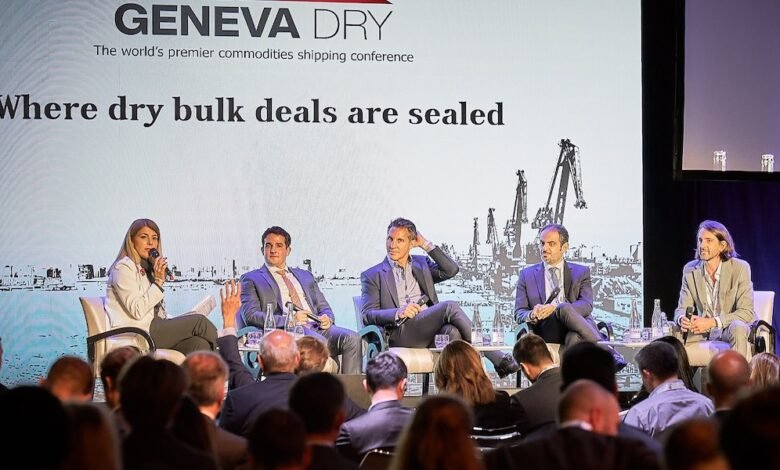
The agri-commodities panel at Geneva Dry last month offered a clear-eyed view of how the ongoing Middle East conflict and disruption around the Strait of Hormuz are reshaping global food and fertiliser supply chains.
Moderated by Maryana Yarmolenko Stober, the discussion brought together traders, operators and market analysts who largely agreed on one point: global trade flows are not collapsing, but they are being significantly re-engineered at rising cost and complexity.
From a trading perspective, Filipe Gonzaga described how sourcing patterns have shifted rapidly in response to instability. His firm, historically focused on Ukrainian grain flows into North African markets, has been forced to diversify origins.
“We see more and more demand out of South America, especially for future crops, and also unusual flows for US cargoes out to the Mediterranean markets,” he said, highlighting how previously secondary routes are becoming core supply lines.
On the operational side, Rob Aarvold pointed to extreme volatility in the bunker market as one of the most immediate consequences of the Hormuz crisis for dry bulk operators.
He noted that marine gasoil (MGO) prices in some regions, including Brazil, had surged to “300 or 400%” above levels seen just two months earlier. He also stressed that congestion and slot scarcity at the Panama Canal have added further strain, with booking windows now extending two to three months ahead, making freight pricing increasingly unpredictable.
“The market has been almost unhedgeable,” Aarvold said, adding that there is now a “complete dislocation” between swap pricing and physical delivery levels.
Bahri Dry Bulk vice president of commercial, Abdullah Bin Eid, offered a broader historical perspective, arguing that commodity flows tend to adapt rather than break.
“History showed that grain flows don’t stop. They reroute. What we are seeing today is not a collapse of trade, but a re-engineering of it,” he said.
He also highlighted how Saudi Arabia is increasingly moving beyond its traditional role as a commodity importer, taking a more strategic approach to sourcing, shipping and storage. While force majeure declarations have appeared in some segments particularly oil and gas and in cases where vessels cannot enter the Arabian Gulf he stressed that the overall system is adjusting rather than breaking down.
From a data perspective, Pierre Morel of AXSMarine outlined how operational constraints are translating into measurable fleet inefficiencies.
He pointed to a global slowdown in vessel speeds, driven largely by elevated bunker costs, with the dry bulk fleet reducing average speeds by around half a knot — from approximately 10 knots to 9.5 knots.
The implications, he said, are significant. On the panamax segment alone, 19,000 voyages averaging 40 days each would see a two-day increase per voyage, effectively removing around 38,000 vessel-days from the market the equivalent of roughly 104 vessels.
In parallel, he highlighted early downstream impacts on fertiliser production. A major Moroccan fertiliser producer, reliant on Arabian Gulf and Russian sulphur (with Russian exports now subject to restrictions), has reportedly begun cutting output by 30% in the second quarter.
“It’s happening quickly,” he noted.
Despite the turbulence, Gonzaga underlined the adaptive nature of commodity markets.
“Trading is the absorber of volatility. The market will find a way and will factor in the risk. Is the price worth the risk? Yes or no? It’s all a matter of pricing at the end of the day.”
Aarvold concluded the session by stressing that the sector is effectively absorbing multiple overlapping shocks.
“It feels like we’ve had an aggregation of every black swan event. As an industry we’ve become more adaptable. But the longer this goes on, the more real it’s getting that the risks are elevating.”