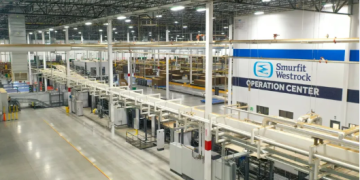




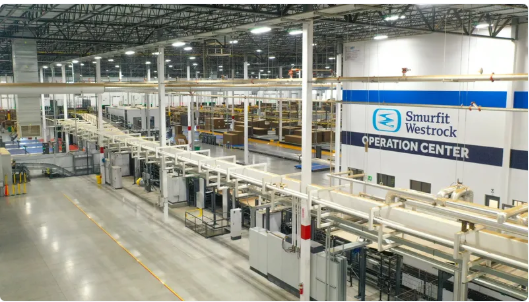
Smurfit Westrock’s large-scale corrugated packaging facility in Pleasant Prairie, Wisconsin, is being positioned by the company as a benchmark for next-generation industrial automation, with leadership describing it as a “superplant” due to its scale, efficiency and advanced production systems.
The term, initially used informally during the site’s groundbreaking in June 2024 under WestRock before the formation of Smurfit Westrock, now designates a small number of strategically important facilities designed to serve entire high-demand regions rather than relying on multiple smaller plants.
The 595,000-square-foot facility, which represents a $136 million investment, produces around 3 billion square feet of corrugated boxes annually—approximately three times the output of a standard plant, according to Don Sparaco, president of corrugated packaging for North America at Smurfit Westrock.
The plant became operational in May 2025 following completion in April, and now employs up to 200 workers. Its product range spans pre-print and white-top packaging, recycled and kraft board, high-performance liners, wet-strength materials and food-grade packaging solutions.
Output includes a broad mix of corrugated formats such as mid-sized shipping cartons used for moving, rotary die-cut boxes for food delivery like pizza packaging, large industrial containers for chemicals and produce, and smaller formats tailored for healthcare and beauty industries.
Strategic location in a high-demand logistics corridor
The facility is located in Pleasant Prairie, Wisconsin, an area that has undergone significant industrial expansion over the past 15 years along the Interstate 94 corridor. The village hosts major corporate and logistics players, including Uline’s headquarters, expanding Amazon operations, and Haribo’s first U.S. manufacturing site.
Around the time of the plant’s development, the Wisconsin Department of Transportation allocated $885,000 to support the construction of a rail spur connecting the site to the Union Pacific mainline. The rail connection enables inbound deliveries of raw materials such as paper and starch, while also positioning the site as a potential logistics attractor for other rail-dependent industries.
The plant is strategically placed along the Wisconsin–Illinois border to serve the greater Chicago region, one of the highest consumption areas for corrugated packaging in the United States, second only to Los Angeles.
Chicago’s demand is closely tied to its role as a national food and beverage manufacturing hub, home to major producers such as Conagra, Kraft Heinz and Mondelēz International. The city also functions as a central freight interchange point and the largest rail hub in North America, handling roughly one in four U.S. freight trains daily.
As Sparaco noted, the concentration of production and logistics activity in the region made investment in the area a strategic necessity to modernize assets and support both existing and emerging customers.
Pleasant Prairie is one of only two Smurfit Westrock sites classified as a “superplant” in North America, alongside a facility in Longview, Washington, which opened in November 2023. Lessons learned from that earlier site were incorporated into the design and engineering of the Wisconsin plant, particularly around material flow and production efficiency.
Automation reshaping labor requirements
A defining feature of the facility is its high degree of automation and robotics, which significantly reduces the need for manual labor compared to traditional corrugated box plants while improving consistency and safety.
“A facility engineered like we have here in Pleasant Prairie uses about 60% of the labor that a traditional box plant would use because of that automation,” said Sparaco.
The plant’s design reflects a broader industrial shift toward consolidating production into fewer but larger, highly automated hubs capable of serving entire regional markets with integrated logistics, rail access and high-volume manufacturing capacity.