



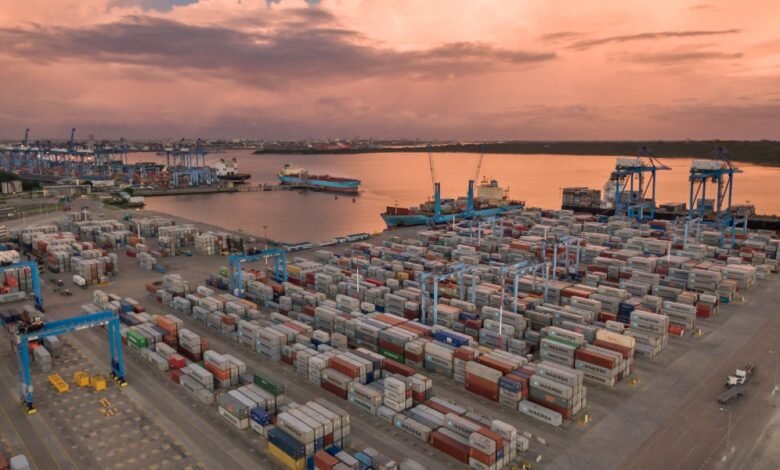
CMA CGM has signed an agreement to invest Ksh106bn (approximately $820m) in the modernisation and expansion of two key terminals at the Port of Mombasa, under a cooperation framework with the Kenyan government.
The investment marks a significant long-term commitment by CMA CGM, which has operated in Kenya since 2005. The company said the project is designed to increase cargo-handling capacity, enhance regional trade flows, and improve Kenya’s connectivity to global shipping networks at a time of rising maritime demand.
Beyond capacity expansion, the upgrade is expected to improve supply chain efficiency and reinforce Mombasa’s role as a strategic logistics hub for both regional and international trade. The port is a critical gateway for East Africa and serves multiple landlocked countries, including Uganda, Rwanda, South Sudan and the Democratic Republic of Congo.
The project is also set to strengthen inland logistics corridors linking Kenya with broader East and Central African markets, supporting trade integration across the region.
The investment aligns with Kenya’s broader infrastructure strategy, which is increasingly focused on public-private partnerships to modernise port assets. In April 2025, the country’s National Treasury confirmed it was pursuing a PPP model to upgrade both the Port of Mombasa and the Port of Lamu, with financing expected to come from infrastructure bonds targeted at long-term institutional investors such as pension funds and insurance companies.
CMA CGM stated that the agreement forms part of a wider strategy to develop port infrastructure, improve logistics integration, and support the decarbonisation of transport chains across Africa.
The group is already active across the continent, operating and participating in the development of nine container terminals. These include the Kribi Container Terminal in Cameroon, the Lekki Deep Sea Port in Nigeria, and a new deepwater terminal in Pointe-Noire, Republic of the Congo.
A new white paper argues that the shipping industry’s fragmented approach to climate risk management is leaving it increasingly exposed to interconnected regulatory, legal and operational vulnerabilities.
The report, titled “Navigating climate transition risks in global shipping”, is based on a peer-reviewed academic study conducted by researchers from Erasmus Rotterdam University, the University of Copenhagen and University College London.
The study identifies five key categories of transition risk litigation, policy, contractual, technology and social and maps how disruptions in one area can trigger cascading effects across others.
It highlights, for example, how regulations such as the International Maritime Organization’s Carbon Intensity Indicator (CII) require investment in emissions-reduction technologies and operational changes. These adjustments then raise unresolved contractual questions around cost allocation and performance guarantees, which may ultimately escalate into litigation.
The research also notes that growing social pressure for stronger environmental performance can accelerate regulatory action while simultaneously increasing exposure to greenwashing claims and shareholder disputes linked to climate disclosures.
Hannah Mosmans, external PhD researcher at the Department of Law & Markets at Erasmus School of Law, emphasised the need for a more integrated approach to climate risk in shipping.
“Addressing climate transition risks in shipping requires more than isolated legal or technical solutions: it demands genuine interdisciplinary collaboration,” she said. “The challenges we face sit at the intersection of public and private law, economic incentives, policy design, and technological and safety considerations. Only by connecting these perspectives can we begin to understand how risks propagate through the maritime supply chain and develop responses that are both effective and workable in practice. This research shows that bridging disciplines is not simply valuable, but essential, if we are to navigate the complexity of maritime decarbonisation and meaningfully address these wicked problems.”
The paper notes that with the International Maritime Organization advancing towards the adoption of its Net Zero Framework, and regulatory mechanisms such as the EU Emissions Trading System (EU ETS) and FuelEU Maritime already in force, the industry can no longer treat legal, contractual, technological and social risks as separate issues.
It stresses that decisions made today around fuels, vessel investment, contracting structures and financing will shape exposure to risk for decades, with impacts rarely confined to a single category.
Using a mixed-methods approach combining a systematic literature review (2014–2025) and legal doctrinal analysis of maritime conventions, case law and regulatory frameworks, the study illustrates how risks propagate through what it describes as “cascade chains.”
One example shows how inclusion of shipping in the EU ETS introduces carbon pricing obligations, prompting operational changes such as slow steaming or route optimisation. These changes then create contractual uncertainty around cost allocation and performance obligations, which can ultimately lead to disputes and litigation.
The white paper concludes that the industry’s biggest challenge is not individual regulations or technologies, but the absence of an integrated framework capable of managing interconnected transition risks across the entire maritime ecosystem.