




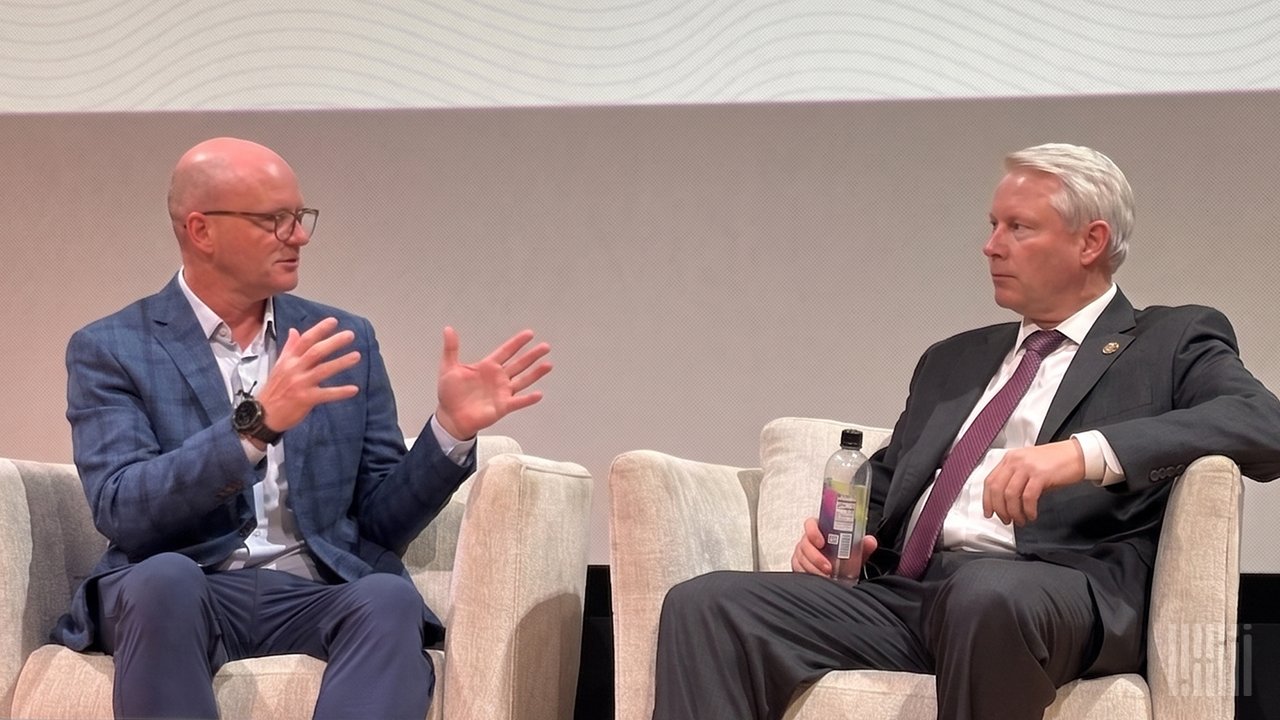
In Cleveland, the fallout from the recent Supreme Court “Montgomery” decision which significantly expands potential broker liability in trucking incidents was the underlying tension at the Federal Motor Carrier Safety Administration discussion during FreightWaves’ Freight Fraud Symposium held at the Rock & Roll Hall of Fame.
While the case itself was not the central topic of the event, it quickly became impossible to avoid during a keynote conversation between FMCSA Deputy Administrator Jesse Elison and FreightWaves CEO Craig Fuller, reflecting how deeply the ruling is already reshaping expectations across the freight brokerage industry.
Elison insisted that, from the agency’s perspective, the ruling does not fundamentally alter FMCSA’s statutory authority. “It doesn’t change anything for us. We have the same authorities that we had. We don’t have safety authority over brokers,” he said. But he also acknowledged that the legal interpretation emerging from Montgomery is shifting how brokers are viewed in relation to motor carrier operations.
The ruling has removed a long-standing assumption in the brokerage sector that intermediaries were largely insulated from liability when hiring carriers, particularly when carriers were properly registered or did not show regulatory red flags in FMCSA records. That framework is now under pressure, forcing brokers to reassess how they evaluate carrier safety.
Elison noted that while FMCSA does not regulate brokers as safety-certified entities, the broader interpretation of “with respect to motor vehicles” now places broker activity closer to the regulatory perimeter than before. This shift is forcing the industry to rethink what “adequate vetting” actually means in practice.
The debate was sharpened when Echo Global Logistics CEO Doug Waggoner questioned the effectiveness of FMCSA carrier oversight, referencing long-standing estimates that not all carriers are fully vetted by the agency. He argued that brokers are now effectively carrying more legal responsibility for safety verification than the regulator itself provides.
Elison pushed back on that framing, stating that FMCSA interacts with a much larger share of the carrier population than is often assumed, through inspections and enforcement touchpoints covering what he estimated to be 60–70% of carriers. However, he conceded that expectations are evolving. “What is the standard?” he asked, highlighting the lack of clarity now facing brokers.
He also reiterated that FMCSA is not a certification body. The agency only issues formal safety fitness determinations when a carrier is deemed unsatisfactory, leaving most operational assessments to industry actors.
That gap between regulation and operational responsibility is now becoming more visible. Industry voices such as Transportation Intermediaries Association president Chris Burroughs have called for FMCSA to take a more active role in providing clearer guidance and tools for compliance in a post-Montgomery environment.
Elison suggested that the central challenge ahead will be defining a consistent and practical standard for carrier evaluation — particularly for small carriers that may lack extensive inspection histories but are nonetheless legitimate operators.
He pointed to the difficulty raised by brokers trying to assess very small fleets, noting that even carriers with just a few trucks may not have enough inspection data to establish a clear safety profile. The question of how such operators can be fairly evaluated is now part of the broader policy debate.
The discussion also coincided with the rollout of Motus, the new registration and identity verification system introduced by the U.S. Department of Transportation. The system is designed to strengthen fraud prevention in freight markets by using biometrics and enhanced data validation to confirm carrier and business identities.
Elison described Motus as one of FMCSA’s most important tools in tackling freight fraud, particularly through improved identity verification and additional business-level checks. He also stressed that most carriers do not need to take immediate action, noting that adoption would be phased.
Overall, the conversation underscored a freight system in transition — where legal precedent, regulatory limits, and new digital enforcement tools are converging to reshape how safety responsibility is defined between regulators, brokers, and carriers.