



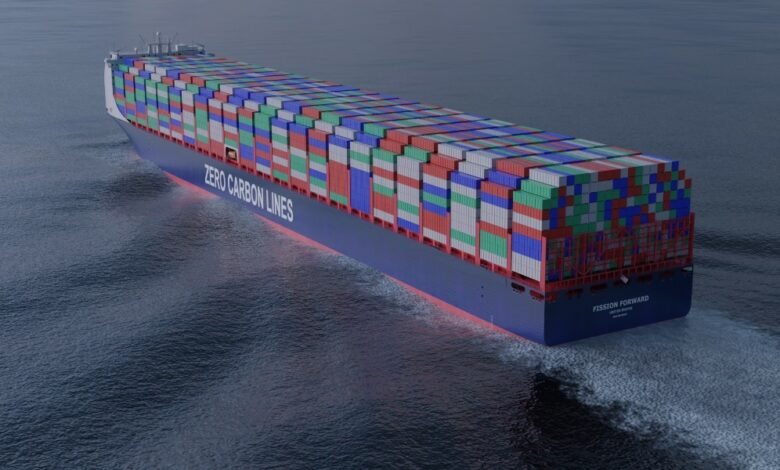
The growing pressure on global shipping routes, particularly between Asia and Europe, is reviving long-standing discussions about alternative propulsion models — including a bold return to nuclear-powered containerships.
According to Andrew Craig-Bennett, recent geopolitical instability and the increasing likelihood of vessels avoiding traditional chokepoints such as the Suez Canal are reshaping the economics of long-haul trade. If ships are forced to take longer routes, he argues, the case for a fleet of extremely large, high-speed nuclear containerships becomes significantly more credible.
He envisions a model based on around a dozen vessels, each with a capacity of approximately 25,000 TEU, operating at speeds of at least 25 knots between a limited number of global hub ports. From an engineering standpoint, Craig-Bennett suggests such ships are already feasible using existing technologies, with port infrastructure capable of adapting to their size requirements.
The constraints, he stresses, are not technical but financial and regulatory — and above all, political. Civil nuclear deployment at sea continues to face structural barriers that have little to do with ship design capability.
Insurance, often viewed as a potential obstacle, is considered less of a limiting factor. Craig-Bennett argues that the development of frameworks for marine insurance has traditionally followed from the emergence of maritime risks, and that a lot of the background work for insuring nuclear-powered merchant ships has already been done.
Under his proposed structure, only a small number of major ports would be required to accommodate such ships, alongside dedicated drydocking and nuclear refuelling infrastructure. Unlike naval reactors, commercial systems would require less enriched fuel, meaning refuelling operations would be longer but still manageable within standard maintenance cycles.
From a financing standpoint, he said nuclear containerships could be structured as long-term leased assets because of the higher upfront cost but much lower lifetime fuel costs. In this model, capital expenditure would be offset by operating savings over decades of service.
Craig-Bennett also highlights the possibility of container shipping alliances or external investors — including governments — owning fleets of nuclear-powered vessels and leasing capacity to existing shipping lines. This would mirror infrastructure-heavy models already seen in LNG shipping, where liquefaction, transport, and regasification assets are integrated across long-term contracts.
However, he notes that container consortium structures themselves may lack the long-term financial stability required for such capital-intensive projects. Individual container lines, by contrast, could potentially support 25-year leasing arrangements for dedicated slot allocations.
The most important constraint identified, beyond financing and infrastructure, is human capital. The global shortage of qualified reactor officers represents a critical bottleneck. Training such specialists can take up to a decade, and their career paths are traditionally tied to naval or energy sectors rather than commercial shipping.
Craig-Bennett suggests that expanding the professional pathways for nuclear-qualified maritime officers — and significantly increasing compensation levels — would be essential if such a model were ever to become viable at scale.
He concludes that nuclear-powered shipping should not be viewed purely through an environmental lens, but as a commercial response to structural changes in global trade routes and maritime risk.
Whether the industry is ready to pursue such a transformation remains uncertain, but the discussion itself is clearly re-emerging.