



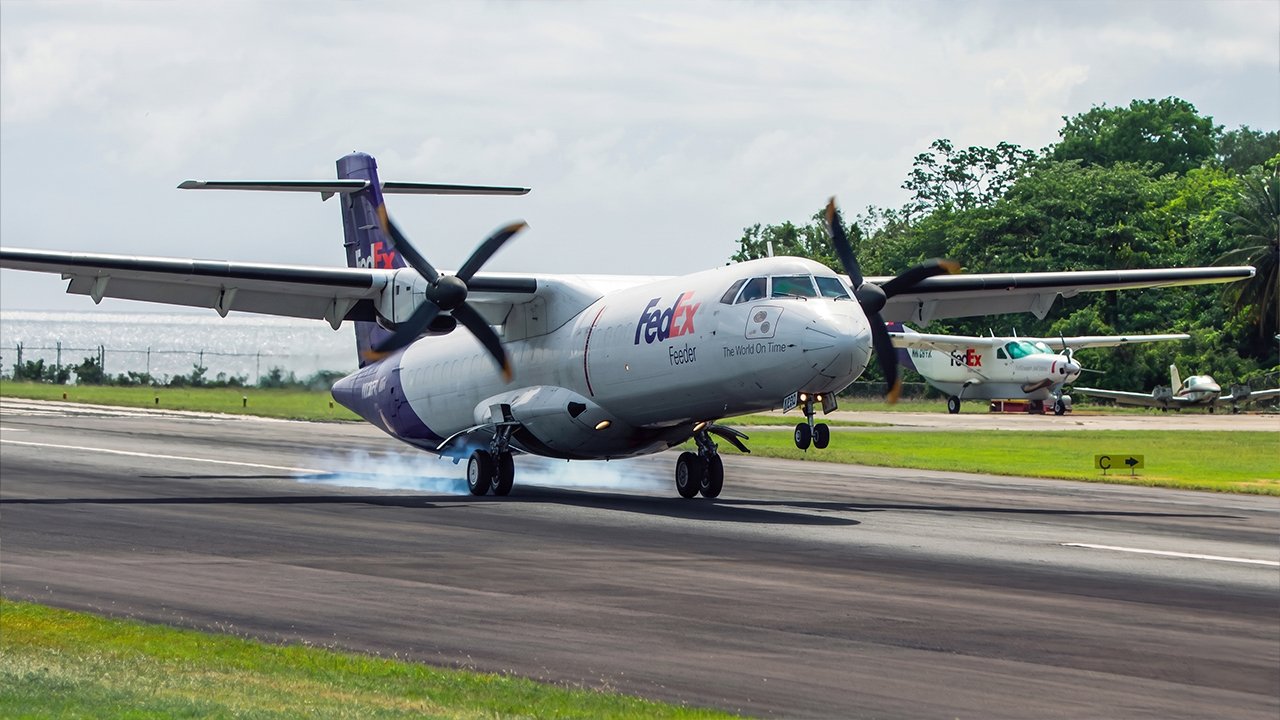
Mountain Air Cargo, a regional cargo airline operating on behalf of FedEx, is seeking a waiver from the U.S. Federal Aviation Administration (FAA) as part of its fleet modernisation strategy, warning that key cargo services to several Caribbean islands could be jeopardised without regulatory relief.
The North Carolina-based carrier has formally petitioned the FAA for permission to increase payload limits under Part 135 regulations, allowing it to continue serving Aruba, Curaçao and Bonaire as it transitions from older ATR 42 freighters to larger and more capable ATR 72 aircraft.
At the centre of the issue is a regulatory distinction between the two aircraft types. While Mountain Air’s ATR 42 fleet operates under Part 135 rules governing commuter and on-demand operators, its ATR 72 aircraft fall under Part 121 regulations, which apply to scheduled commercial airlines and impose stricter requirements for overwater operations.
Mountain Air currently serves the Caribbean destinations using ATR 42 freighters carrying a modified payload of 7,500 pounds. When these routes were launched in 2024, the ATR 42 was selected because Part 135 regulations allow extended overwater operations of up to three hours, provided additional safety requirements are met.
However, the planned replacement of the ATR 42 fleet with ATR 72 aircraft creates a new challenge. Under Part 121 rules, aircraft are generally limited to 60 minutes of flying time over water unless they receive Extended-range Twin-engine Operational Performance Standards (ETOPS) approval.
Although Aruba, Curaçao and Bonaire are only about 20 miles beyond the overwater limits established under Part 121 regulations, the requirement would still force Mountain Air to obtain and maintain a full ETOPS programme.
The airline argues that the cost and administrative burden associated with ETOPS certification are disproportionate to the minimal additional distance involved.
“ETOPS approval would be required solely to accommodate an additional 20 miles of overwater distance to the destination,” the company stated in its filing. “While we fully respect the regulatory framework and the safety protections it provides, the operational cost and administrative burden of maintaining a fully compliant ETOPS program is disproportionate relative to the incremental distance involved.”
Mountain Air currently operates a fleet that includes 10 ATR 42 freighters, 13 ATR 72-200 and ATR 72-600 aircraft, as well as Cessna 408 SkyCourier aircraft supplied by FedEx. The carrier plays a critical role within the FedEx network by connecting smaller regional markets with larger hub airports that support package transfers across the global system.
The company’s fleet renewal strategy is driven in part by the ageing ATR 42 fleet and the decreasing availability of replacement aircraft. ATR has stopped producing the ATR 42 in a cargo configuration, making long-term fleet expansion increasingly difficult.
In contrast, the ATR 72 offers greater capacity, improved efficiency and enhanced reliability. FedEx itself reinforced this direction last year by ordering 10 additional ATR 72-600 freighters for deployment among its regional partner airlines.
The larger aircraft would significantly improve operational performance on Caribbean routes. According to Mountain Air Cargo, flights to Aruba, Curaçao and Bonaire routinely operate at between 85% and 100% of ATR 42 capacity.
This high demand means that disruptions caused by maintenance issues, adverse weather or aircraft unavailability can quickly generate cargo backlogs that take days or even weeks to clear because of the ATR 42’s limited carrying capacity.
The ATR 72 can transport approximately 16,800 pounds of cargo. However, Mountain Air is not seeking approval to operate at full payload under Part 135. Instead, the carrier has requested an increase from 7,500 pounds to 10,500 pounds.
The proposed limit represents a 40% increase over the current authorised payload while remaining approximately 38% below the aircraft’s maximum cargo capacity. The unused payload margin would allow the aircraft to carry additional fuel, enhancing operational flexibility and safety margins during overwater operations.
“We believe this increase will provide sufficient capacity to accommodate missed or delayed freight in addition to expected daily totals, thereby ensuring a reliable continuity of service to the public in Aruba, Curaçao and Bonaire,” the company explained in its petition.
Mountain Air also warned that without the requested exemption, the gradual retirement of ATR 42 aircraft combined with the expansion of the ATR 72 fleet could threaten the long-term viability of these Caribbean services.
The carrier argues that operating the ATR 72 under Part 135 with an adjusted payload limit would allow essential cargo links to continue uninterrupted while remaining aligned with the intent of existing regulations and without significantly overlapping with traditional Part 121 airline operations.
As the FAA reviews the request, the decision could have important implications not only for Mountain Air Cargo’s Caribbean network but also for how regional cargo operators balance fleet modernisation, operational efficiency and regulatory compliance in niche markets.