



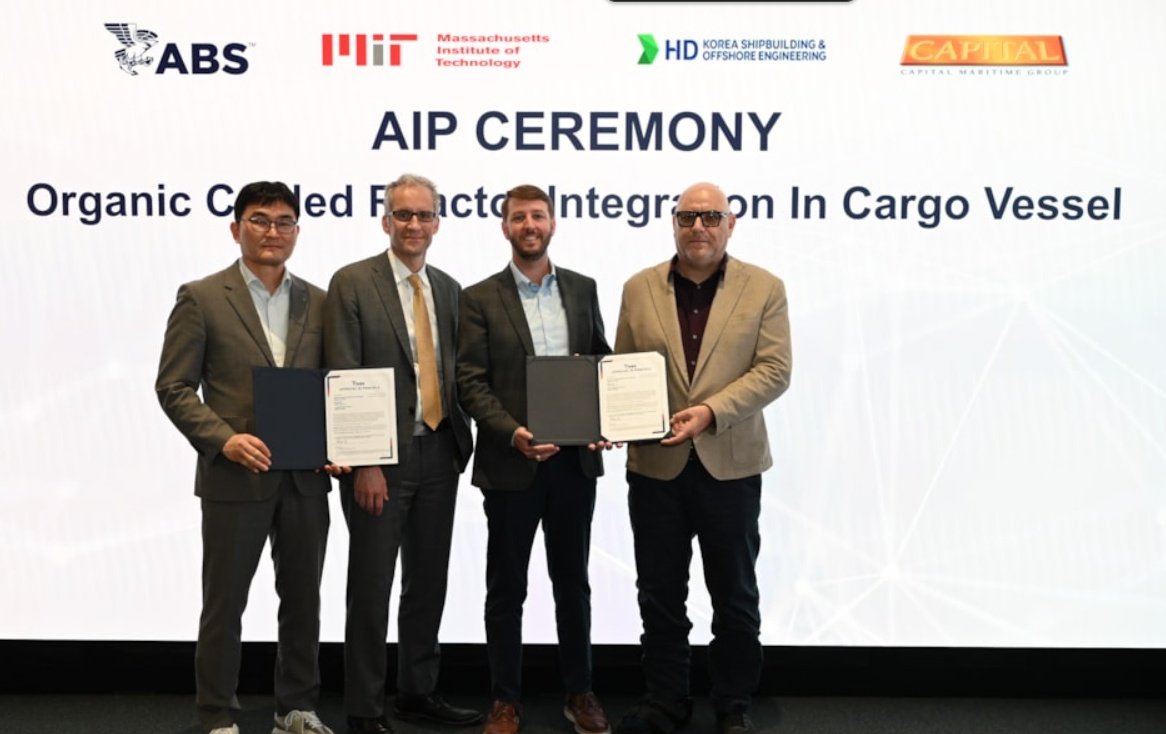
A major step has been taken in the exploration of nuclear propulsion for commercial vessels, as American Bureau of Shipping (ABS) has granted approval in principle (AIP) for a next-generation reactor design intended for integration into cargo ship propulsion systems.
The concept has been developed through a collaboration between the Massachusetts Institute of Technology, HD Korea Shipbuilding & Offshore Engineering (HD KSOE), and Capital Maritime Group, forming part of the MIT Maritime Consortium.
A new approach to nuclear propulsion at sea
The approved design introduces a synthetic fluid system used to transfer heat directly from the reactor core. Unlike conventional reactor concepts, which typically focus on thermal outputs in the range of 10 to 20 megawatts at micro-scale applications, this new model is engineered with near-atmospheric operating pressure.
This technical choice enables thinner and lighter reactor vessels, which in turn supports modular construction techniques and simplifies transport and integration into shipbuilding processes.
First approval within the MIT Maritime Consortium
This AIP marks the first approval granted under the MIT Maritime Consortium framework, where ABS, HD KSOE, and Capital Maritime Group act as founding members.
The consortium is focused on accelerating maritime innovation across multiple domains, including alternative fuels, nuclear technologies, data-driven operational systems, autonomy, cybersecurity, and onboard manufacturing capabilities.
ABS reviewed the reactor-to-machinery interface in line with existing classification requirements, ensuring the concept aligns with foundational safety and regulatory frameworks for future maritime deployment.
Industry sees nuclear as a frontier solution
Patrick Ryan, SVP and CTO of ABS, described the design as a significant technological development with potential long-term implications for the industry:
“The MIT reactor design is an interesting piece of technology. With characteristics that can support modular fabrication and vessel integration, these emerging technologies represent one possible pathway toward the safe, practical development of next-generation commercial shipping solutions.”
From the industry side, Stergios Stergiou, chief sustainability officer at Capital Clean Energy Carriers, highlighted the broader responsibility of exploring unconventional energy solutions:
“It is our responsibility as an industry to explore every potential solution, including those that challenge conventional thinking. Nuclear propulsion is one such frontier.”
A long-term vision for shipping decarbonisation
While nuclear propulsion remains at an early conceptual and regulatory stage, developments like this reflect a growing willingness within the maritime sector to explore high-impact, low-emission alternatives.
The MIT-led reactor concept positions itself as part of a wider push to rethink vessel energy systems entirely, moving beyond incremental fuel transitions toward fundamentally new propulsion architectures for the decades ahead.