




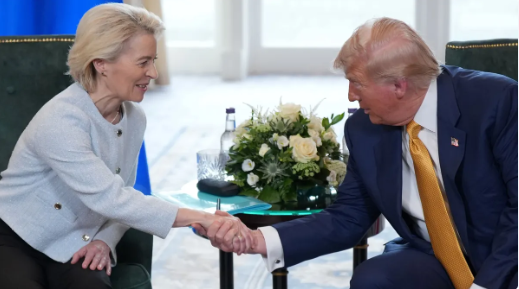
The European Union has formally approved the implementation of key elements of its framework trade agreement with the United States, marking the final step in a months-long and politically sensitive negotiation process that reshapes transatlantic trade conditions.
Following a vote in the European Parliament on Tuesday, the bloc has cleared the way to remove tariffs on all industrial goods imported from the United States, while also granting preferential market access for a range of American agricultural and seafood products. As part of the agreement, the EU will extend tariff-free treatment for lobster imports, including processed lobster, reinforcing long-standing trade flows in the seafood sector.
In return, the United States has agreed to cap tariffs on EU imports at 15%, as outlined in the deal reached in Turnberry, Scotland, last July. EU officials indicated that implementation of the agreement is expected before the end of the month, with some measures potentially taking effect as early as next week.
The approval brings closure to a prolonged legislative process in which the agreement was previously delayed on two occasions, including in response to newly imposed tariffs and broader geopolitical tensions, such as former US President Donald Trump’s threats related to Greenland.
Alongside tariff reductions and expanded market access, the EU has also introduced a series of safeguard mechanisms within the implementing legislation. These include a “sunset clause” that defines the conditions under which the agreement can be reviewed or adjusted in response to shifts in trade relations or market dynamics.
Bernd Lange, chair of the European Parliament’s International Trade Committee, described the regulation as part of the EU’s “defensive toolbox”, stating that it not only stabilises EU–US trade relations but also ensures the bloc can respond if commitments are not upheld by the United States.
Under the sunset clause, preferential treatment for industrial goods and agricultural imports will automatically expire on 31 December 2029, unless renewed following a European Commission review and new legislative approval. Lange also noted during a press conference that the agreement remains “unbalanced” due to differing tariff structures between the two sides.
The legislation also introduces conditions linked to US tariff policy developments since the initial agreement was reached. The EU will be able to suspend preferential treatment if US tariffs on steel and aluminium derivative imports remain above 15% beyond 31 December 2026. It also reserves the right to suspend parts of the agreement if US tariffs exceed the agreed 15% ceiling.
The broader context remains shaped by ongoing US trade investigations. Earlier this month, US Trade Representative Jamieson Greer proposed new tariffs of 10% or 12.5% on 60 trading partners, including a potential 10% rate on EU exports, linked to alleged failures to enforce forced labour bans under a Section 301 investigation initiated in March. A separate investigation is also examining global overcapacity in manufacturing across 16 trading partners, including the EU.
Despite these developments, Greer has indicated that any resulting tariffs would not override the existing EU–US agreement. “We understand that a deal is a deal,” he said, adding that the US intends to address problematic trade practices while taking the Turnberry agreement into account.