



A major milestone for U.S. freight transportation was officially celebrated in Baltimore as CSX and public officials inaugurated the newly upgraded Howard Street Tunnel, a transformative infrastructure project valued at $495 million that is set to significantly expand intermodal rail capacity along the East Coast.
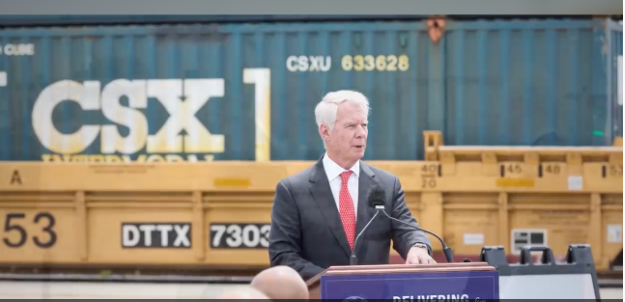
The ribbon-cutting ceremony brought together Maryland Governor Wes Moore, federal and local officials, rail industry representatives, labor leaders, and CSX executives to mark the official launch of double-stack rail service at the Helen Delich Bentley Port of Baltimore.
Governor Moore described the achievement as a turning point for both Maryland and the Port of Baltimore.
“This is a transformative day for the Port of Baltimore and for Maryland,” he said, highlighting the benefits of the public-private partnership behind the project. According to Moore, the tunnel upgrade will expand shipping capacity, create thousands of jobs, generate approximately $1 billion in annual economic benefits, and contribute to lower emissions through more efficient freight transportation.
The project centered on the modernization of the 131-year-old Howard Street Tunnel, originally opened by the Baltimore & Ohio Railroad in 1895. CSX conducted a ceremonial train run through the tunnel in September, while regular freight operations began several weeks ago.
To accommodate modern double-stack container trains, engineers increased the tunnel’s clearance by 18 inches and completed similar clearance improvements at 21 locations across Maryland, Delaware, and Pennsylvania. These upgrades now enable uninterrupted double-stack rail operations connecting the Port of Baltimore with destinations stretching from Massachusetts to Florida, as well as major inland markets in the Midwest.
Before the project, height restrictions inside the tunnel forced trains to follow longer and less efficient routes. Freight often had to detour through Selkirk, New York, via the CSX/B&O and River Line corridors, or be rerouted through Hagerstown, Maryland, and transferred to Norfolk Southern before returning to CSX tracks near Philadelphia.
The successful completion of the project was made possible through a partnership involving the State of Maryland, the Federal Railroad Administration, and CSX. Officials noted that the final cost came in below the original estimate of $566 million, thanks in part to $217 million from the state and $125 million in federal funding.
Among those attending the ceremony were CSX Chief Executive Steve Angel, Federal Railroad Administrator David Fink, and U.S. Senators Chris Van Hollen and Angela Alsobrooks.
For CSX, the project removes one of the network’s most significant operational constraints.
“With full double-stack clearance now in place, we’ve removed a long-standing constraint in Baltimore and unlocked a more direct, efficient connection between the port and inland markets,” said Angel. He added that the upgrade will allow the railway to move more freight using existing train services while offering customers greater flexibility and capacity across the East Coast.
The Port of Baltimore expects the tunnel improvements to increase annual container throughput by approximately 160,000 containers. The resulting growth is projected to support around 13,000 new jobs, including positions linked to logistics, warehousing, port operations, and construction.
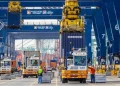
The timing aligns with continued growth at Baltimore’s container facilities. In 2025, Seagirt Marine Terminal, operated by Ports America, handled a record 1,113,309 TEUs. Weekly container vessel calls increased from 12 in 2024 to 15 in 2025, while Mediterranean Shipping Company (MSC) is preparing to launch a new Asia-Mediterranean service on 1 July.
According to Jonathan Daniels, Executive Director of the Maryland Port Administration, the tunnel project ranks among the most significant developments in the port’s history.
He noted that lowering the track by just 18 inches inside a tunnel built more than a century ago has created the necessary clearance for double-stack operations, opening the door to increased cargo volumes, job creation, and environmental benefits. Daniels also emphasized that the Port of Baltimore now offers one of the fastest and most efficient routes for moving containerized cargo to the Midwest.
The port’s long-term growth strategy has also been supported by significant private-sector investment. Since 2010, Ports America has invested more than $600 million in infrastructure, equipment, and technology upgrades in Baltimore.
“This is a game-changing initiative for Ports America Chesapeake and the container business at the Port of Baltimore,” said Mark Schmidt, President of Ports America Chesapeake. He stressed that double-stack capability will strengthen Seagirt Marine Terminal’s position among the top-performing container ports in the United States.
Beyond the economic benefits, the project is expected to deliver substantial environmental gains. Over the next 30 years, it could reduce truck fuel consumption by approximately 137 million gallons and eliminate around 1.2 billion truck miles from U.S. highways.
The Port of Baltimore continues to play a strategic role in American trade. In 2025, it handled 50 million tons of foreign cargo, making it the port’s second-best year on record. It also remains one of the nation’s leading gateways for automobiles, imported gypsum, salt and sugar, as well as export coal.
The completion of the Howard Street Tunnel project positions Baltimore to capture even greater volumes of containerized freight while reinforcing its status as a key logistics hub on the U.S. East Coast.