



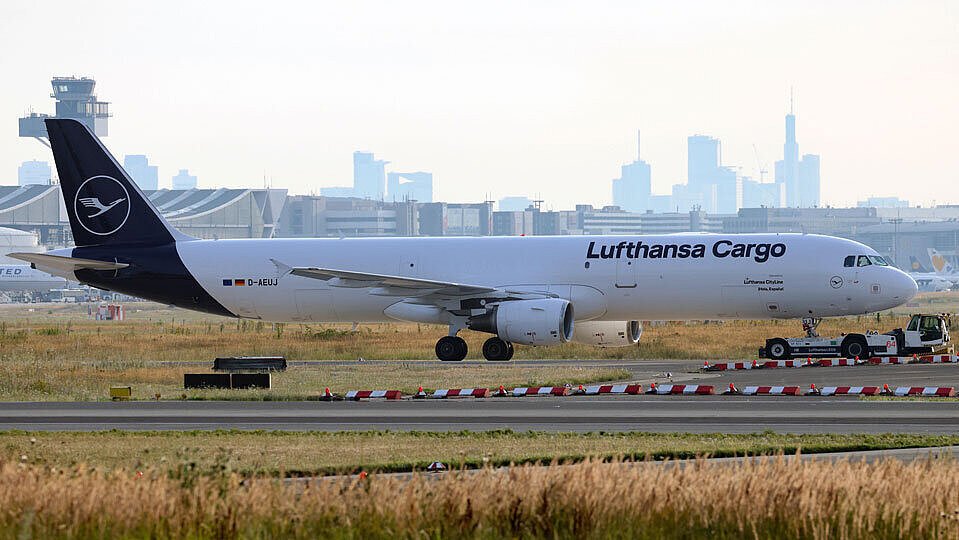
Lufthansa Cargo insists it is working to return its fleet of four Airbus A321 converted freighters to commercial service after nearly four months on the ground. However, developments surrounding the aircraft have fueled growing speculation that the German carrier is preparing to walk away from the program altogether.
According to several aviation and logistics industry sources, Lufthansa Cargo is considering ending its narrowbody freighter operation less than four years after launching it. The aircraft have reportedly failed to meet performance expectations, while the carrier has found that its existing passenger belly capacity and trucking network are sufficient to serve most regional freight demand across Europe.
The four Airbus A321 freighters were operated by Lufthansa CityLine, which provided pilots and operational support. Their operations came to a halt in mid-April when Lufthansa Group accelerated the closure of the loss-making regional airline amid rising fuel costs linked to the Iran conflict and ongoing labor disputes. Since then, the aircraft have remained parked at Frankfurt Airport.
At the time of the grounding, Lufthansa Cargo reaffirmed its commitment to restoring the service.
“Our strategic European network is a key component in maintaining global supply chains. Lufthansa Cargo and the Lufthansa Group are aware of this responsibility. We will now be working with the Lufthansa Group to find a way to offer this cargo capacity to our customers again as soon as possible,” the company said.
Fleet launched to strengthen regional cargo network
Lufthansa Cargo, currently the world’s 14th-largest scheduled cargo airline, operates a fleet of 12 Boeing 777 freighters while also managing cargo transported in the belly holds of Lufthansa Group passenger aircraft.
The A321 converted freighters entered the fleet during 2022 and 2023 through leases from BBAM Aircraft Leasing & Management. The aircraft were converted into freighters by a specialized maintenance provider, allowing them to carry cargo containers on the main deck.
The fleet primarily served short- and medium-haul routes across Europe, as well as parts of the Middle East and North Africa, with a particular focus on e-commerce shipments.
Earlier this year, Lufthansa Cargo executives publicly highlighted the aircraft’s value, particularly for time-critical automotive logistics.
One example involved an emergency charter from Frankfurt to Vienna with less than 24 hours’ notice to collect automotive components before delivering them to Belgrade, preventing a production line shutdown. Two additional charter flights followed shortly afterward.
In February, the airline also completed 11 A321 freighter flights from Casablanca, Morocco, over an 11-day period to support Mercedes-Benz operations.
Search for a new operator continues
In late June, Lufthansa Cargo said it was evaluating third-party operators to replace CityLine and eventually resume A321 operations.
Spokeswoman Katharina Stegmann said the airline was seeking a long-term operating model outside the Lufthansa Group rather than implementing a temporary solution.
She noted that there was no confirmed timeline for returning the aircraft to service and acknowledged that the suspension could potentially last throughout the summer schedule.
Neutral paint scheme raises new questions
Industry speculation intensified after Lufthansa Cargo confirmed it had removed its branding and livery from all four aircraft.
According to company spokesman Jan Paulin, the aircraft were repainted in a neutral color scheme while discussions continue regarding future operating options.
“As part of the ongoing evaluation of different operating scenarios, the aircraft have been transitioned to a neutral exterior appearance,” Paulin said, adding that the aircraft continue to undergo routine inspections and maintenance while parked.
His latest statement emphasized discussions with several potential operators but notably stopped short of saying the aircraft would eventually return to Lufthansa Cargo’s own operations.
Industry believes Lufthansa is looking for an exit
Several aviation executives familiar with the situation believe the neutral repaint signals Lufthansa Cargo is attempting either to terminate its leases with BBAM or sublease the aircraft to another cargo airline.
According to one industry executive, BBAM has little interest in taking the aircraft back due to weak demand across the narrowbody freighter market. At the same time, Lufthansa would prefer to avoid becoming an intermediary responsible for lease obligations if the aircraft were subleased.
Ending the leases altogether could also prove expensive, potentially costing Lufthansa millions of dollars in termination fees.
BBAM declined to comment on the situation.
Weak market challenges Airbus A321 freighters
The uncertainty surrounding Lufthansa’s fleet reflects broader problems affecting the Airbus A321 converted freighter market.
During the pandemic, demand for cargo aircraft conversions surged as air freight volumes reached record levels. Since then the market has eased dramatically and there are many operators with more aircraft than they need.
Several companies have already reduced or abandoned A321 freighter operations.
Miami-based Global Crossing Airlines has parked two of its four A321 freighters because of weaker demand and ongoing lease obligations.
In March 2025 SmartLynx Airlines was forced to stop cargo operations after losing a major customer.
Meanwhile, Air Transport Services Group (ATSG), one of the world’s largest freighter lessors, dissolved its Airbus A321 conversion joint venture earlier this year after demand for converted aircraft collapsed.
Even Turkish Airlines Cargo, which temporarily wet-leases A321 freighters to supplement capacity, reportedly considers the aircraft unprofitable.
Experts question the aircraft’s economics
FreightWaves spoke with several air cargo analysts and airline executives, all of whom agreed that the Airbus A321 freighter can only be profitable under very specific operating conditions.
According to industry specialists, the Boeing 737-800 converted freighter remains the more efficient aircraft in this market.
The A321 is heavier, consumes more fuel and has generated higher-than-expected maintenance costs, leading to significantly higher operating expenses per flight.
Lease costs are also generally higher because many A321 conversions involve newer aircraft and include conversion expenses within the lease agreements.
Data from Aerodynamic Advisory illustrates the challenge. Of the 82 Airbus A321 converted freighters currently in service worldwide, approximately 38% are inactive. By comparison, only 14.8% of the 283 Boeing 737-800 converted freighters are currently parked.
Experts say the A321 performs best on high-frequency e-commerce routes where its larger volume can be fully utilized. Outside that niche, profitability becomes much harder to achieve.
One logistics executive described the aircraft as economically unsustainable under current market conditions, arguing that even full e-commerce loads often only allow operators to break even, particularly with elevated fuel prices.
Alternative capacity has minimized disruption
Despite the prolonged grounding of the A321 fleet, Lufthansa Cargo says customers have experienced little disruption.
The airline has continued serving regional shipments through its Boeing 777 freighters, the belly capacity of Lufthansa Group passenger aircraft and its broader logistics network.
Industry observers largely agree.
Jonathan Mellink, Head of Sales and Marketing at consultancy Rotate, estimated that the grounded A321 fleet previously provided around 210 metric tons of daily intra-European cargo capacity. While the aircraft offered faster regional connections than trucks or passenger aircraft, he believes their absence has had only a limited impact.
Germany-based logistics company Dachser also reported minimal disruption, saying its extensive European road network has successfully absorbed freight that previously moved aboard the A321 freighters.
Another executive representing an air freight shipping cooperative likewise said customers have not experienced significant delays, citing the wide availability of alternative regional air cargo services and trucking capacity.
While Lufthansa Cargo continues to publicly evaluate options for the fleet, the combination of neutral aircraft branding, ongoing lease discussions and unfavorable market conditions has strengthened industry expectations that the carrier may ultimately abandon its Airbus A321 freighter program rather than return the aircraft to regular service.